A Compendium of the Ancient Gods
Tyche, plate

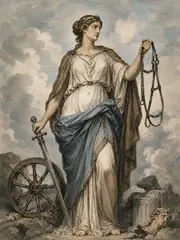
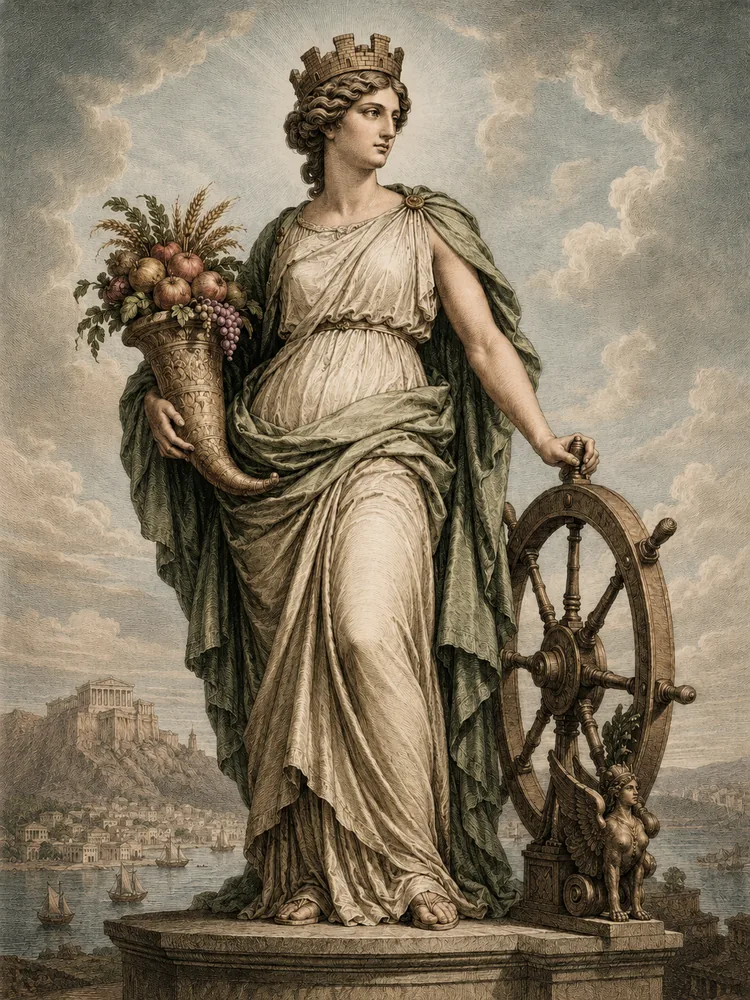
Tyche was Fortune — the goddess of luck, of chance, of the unpredictable element in human affairs. In Hesiod she is one of the Oceanids (a relatively minor figure), but her importance grew enormously in the Hellenistic period (after the late fourth century BCE), when the disorientations of the post-Alexander world — the rapid rise and fall of cities and kingdoms, the displacement of populations, the substitution of personal achievement for ancestral standing — gave the principle of luck a new theological prominence. Each of the great Hellenistic cities had its own Tyche, depicted with a mural crown and a cornucopia, embodying the particular fortunes of that city. The famous Tyche of Antioch, sculpted by Eutychides of Sicyon about 300 BCE, was one of the most influential of these images, copied throughout the Hellenistic and Roman world.

The popular reverence for Tyche was great, but the philosophical attitude toward her was more complex. The Stoics distinguished between true fate (which was the rational order of the cosmos) and apparent luck (which was simply our ignorance of the chains of causation that produced events); Tyche, in their view, was a name for the latter. The Epicureans had less use for her; the popular religion continued to honor her without much philosophical refinement. She had no proper mythology of her own — she was a personification, not a narrative figure — but her cult and her iconography were extensive. Her Roman counterpart was Fortuna, who in the Roman period developed a more elaborate cult and mythology of her own, treated in Volume IV.
Curator’s note

What the sources say, and what later tradition added. The sources for this bay

Hesiod, Theogony 360 (the Oceanid); Pindar, Olympian 12 (a developed treatment of Tyche as the divine principle behind individual fortunes). The Hellenistic prominence of Tyche is principally documented in coinage and statuary; the Tyche of Antioch survives in numerous Roman copies, the best-known in the Vatican.

Kin in the sources

Each tie is quoted from the entry that states it.

The same god in other rooms

The ancient sources themselves name these as one god under different names. See Tyche and Fortuna hung together

When the sources speak

Dated witnesses for The Mysteries. A date marks when the evidence was written down, not when the belief began. The whole timeline

c. 1600–1100 BCE
Mycenaean palace tablets in Linear B record offerings and divine names, but little continuous myth.
c. 1100–800 BCE
Post-palatial oral traditions and changing cult landscapes precede the surviving alphabetic epics.
late 8th–7th centuries BCE
The Iliad, Odyssey, Hesiodic Theogony and Works and Days give influential but non-exclusive divine orders.
7th–6th centuries BCE
Homeric Hymns, lyric poetry, colonization, and local sanctuary traditions multiply regional narratives.
6th–5th centuries BCE
Orphic, Pythagorean, and mystery materials develop alternative cosmogonies and afterlife doctrines.
5th century BCE
Athenian tragedy and comedy recast heroic houses and divine justice for civic audiences.
4th century BCE
Philosophers, antiquarians, and local historians interpret or criticize inherited myth.
323–31 BCE
Hellenistic poets and scholars systematize variants across an enlarged Greek world.

Floor plan

The rooms follow one another in the order their peoples first appear in the written record.

  1. The Cradle of Citiesc. 3400 BCE to 395 CE. 115 works
  2. The Gift of the Nilec. 4000 BCE to 395 CE. 73 works
  3. The Olympian Orderc. 1600 BCE to 750 CE. 152 works
  4. The Persian Worldc. 2000 BCE to 1010 CE. 30 works
  5. The Levantine Borderlandsc. 1200 BCE to 500 CE. 20 works
  6. The Edges of Empirec. 2000 BCE to 1500 CE. 33 works
  7. The Etruscan Worldc. 900 BCE to 750 CE. 22 works
  8. The Roman Inheritancec. 1200 BCE to 500 CE. 58 works
  9. The Northern Inheritancec. 2000 BCE to 1600 CE. 131 works