
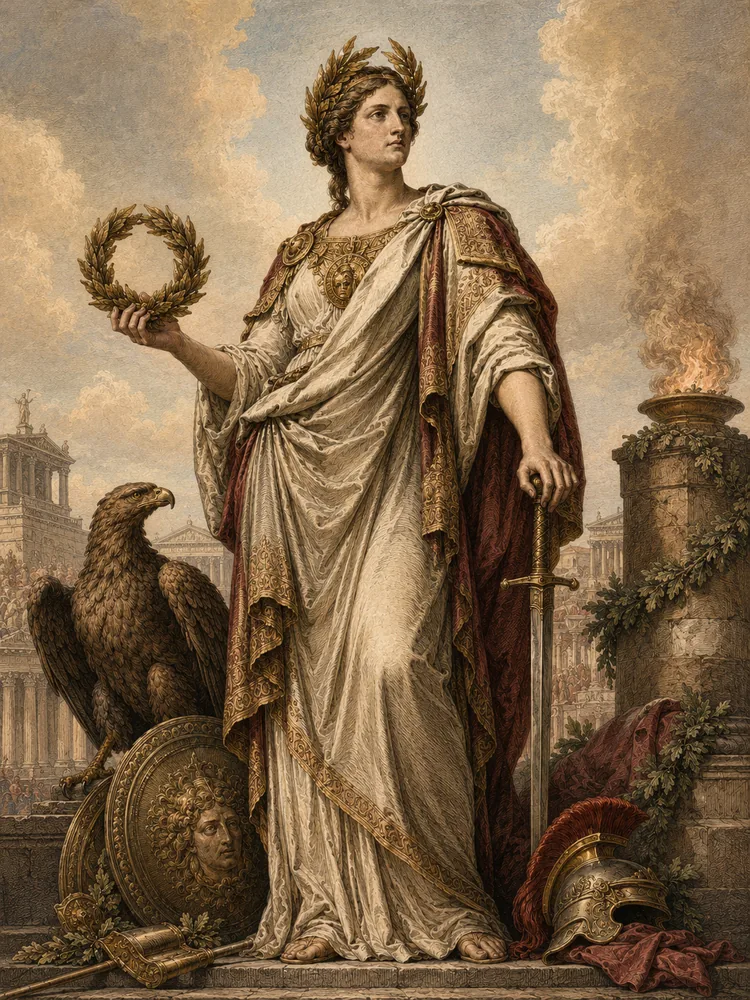

Honos was the Roman personification of military and civic honor — the public recognition due to the man of merit, the dignity that comes from valorous service. He was paired in cult with Virtus, who was Valor herself; the two were almost always worshipped together. The temple of Honos and Virtus, dedicated jointly, stood outside the Porta Capena, where the consul Marcellus, after his Sicilian victories of 222 and 211 BCE, vowed and built a magnificent twin sanctuary. Marcellus's intention was to keep the two virtues together — for there could be no honor without valor, and no valor (the Roman believed) deserving of full recognition without the public honor that crowned it.
The young Roman noble making his entry into public life was instructed to invoke both gods together, to seek both the substance and its recognition. Cicero, in De Legibus and elsewhere, treats them as the proper objects of Roman public reverence; "those things which procure honor and praise," he says, "are the foundation of the Republic." The pairing also supplied a moral and rhetorical commonplace: that valor without honor was wasted, and honor without valor was empty.
Honos was depicted as a young man crowned with laurel, holding a spear and a cornucopia — the spear for the warrior's part, the cornucopia for the rewards of merit. Coins from the late Republic and the early Empire show him on one side and Virtus on the other, the two faces of the Roman ideal of public service. By the late Empire the cult had largely faded, but the conceptual pairing of honor and valor remained one of the deepest resources of Roman political thought, and through Roman literature it passed into the moral vocabulary of medieval and modern Europe.