A Compendium of the Ancient Gods
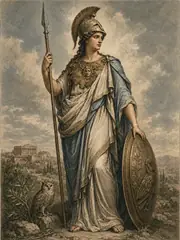
Virtus, plate

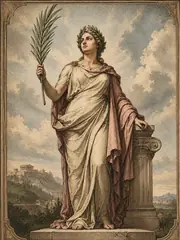
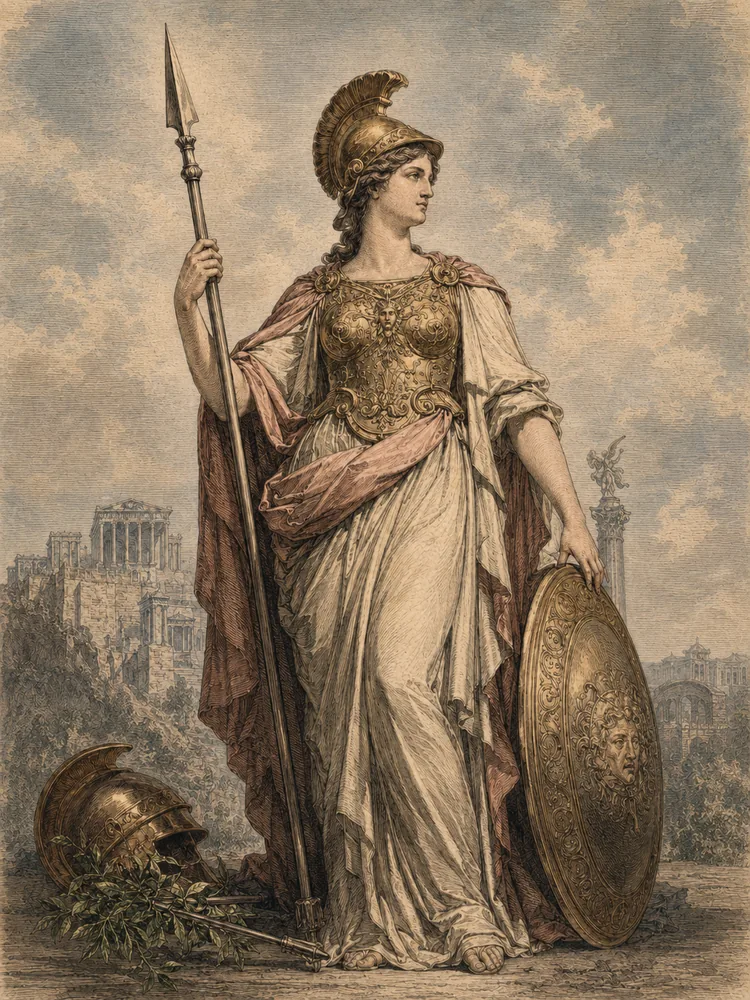
Virtus was the Roman goddess of valor and excellence — particularly the manly excellence (vir, "man," being the root of her name) that the Roman warrior and statesman cultivated as the foundation of a worthy life. She was depicted as an Amazon, helmeted and armed, with one breast exposed in the Greek manner; the iconography was largely Greek (borrowed from depictions of the goddess Arete or of armed Athena), but the conception was thoroughly Roman.

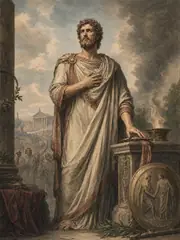
She was paired in cult with Honos, treated above; the joint temple of Honos and Virtus stood outside the Porta Capena, and the two were inseparable in Roman moral thinking. Where Honos was the public recognition of merit, Virtus was the merit itself — the inner quality of the worthy man, his courage, his discipline, his fortitude, his commitment to the public good. Cicero in De Officiis takes Virtus as the great organizing principle of the Roman moral life, and the elaborate analysis of duties (officia) by which Romans ordered their conduct was an analysis of how Virtus expressed itself in different situations.

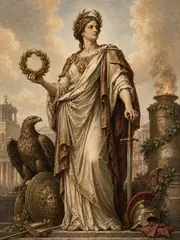
Marius after his victories over the Cimbri and Teutones (in 102 and 101 BCE) built a second temple of Honos and Virtus on the Capitoline; Marcellus had built the first outside the Porta Capena. The Marian temple was famous for the spoils displayed within and was one of the trophies by which the new man Marius asserted his place beside the noble dead. By the imperial period, Virtus had become a generic title — Virtus Augusti, Virtus Imperatoris — and like the other deified virtues was used to reinforce the imperial image. The conception of virtus, however, was alive in Roman moral thinking through the latest pagan period and was carefully transposed (with significant reinterpretation) into Christian doctrine, where the vir that was its root receded and its meaning broadened.
Curator’s note

What the sources say, and what later tradition added. The sources for this bay

Virtus is paired with Honos in the sources cited under that entry. The Marian temple is described by Cicero (Pro Sestio 116), Vitruvius (3.2.5, 7 praef. 17), and Festus (s.v. honos). The transition of virtus from the specifically Roman moral concept to the broader Christian and modern sense is treated in many places; Alasdair MacIntyre's After Virtue (1981) is a notable philosophical engagement.

Kin in the sources

Each tie is quoted from the entry that states it.

When the sources speak

Dated witnesses for The Deified Virtues and the Imperial Mystery Cults. A date marks when the evidence was written down, not when the belief began. The whole timeline

c. 1000–750 BCE
Iron Age communities of Latium and neighboring peoples develop the cult landscapes later absorbed into Roman tradition.
traditional 753 BCE
Roman foundation chronology places Romulus and the first civic institutions at the beginning of the city’s sacred history.
traditional 7th–6th centuries BCE
The regal period is credited with priesthoods, calendars, temples, and the organization of public rites.
509–264 BCE
Republican expansion incorporates Latin, Sabine, Etruscan, and Italian cults through treaty, migration, and evocatio.
264–146 BCE
Mediterranean conquest accelerates Greek interpretation and the importation or redefinition of foreign gods.
204 BCE
The Magna Mater is formally brought from Pessinus during the Second Punic War.
1st century BCE
Varro, Cicero, and other antiquarians document rites and divine names amid civil war and institutional change.
27 BCE–14 CE
Augustan restoration monumentalizes selected ancestral cults and rewrites Roman sacred history.

Floor plan

The rooms follow one another in the order their peoples first appear in the written record.

  1. The Cradle of Citiesc. 3400 BCE to 395 CE. 115 works
  2. The Gift of the Nilec. 4000 BCE to 395 CE. 73 works
  3. The Olympian Orderc. 1600 BCE to 750 CE. 152 works
  4. The Persian Worldc. 2000 BCE to 1010 CE. 30 works
  5. The Levantine Borderlandsc. 1200 BCE to 500 CE. 20 works
  6. The Edges of Empirec. 2000 BCE to 1500 CE. 33 works
  7. The Etruscan Worldc. 900 BCE to 750 CE. 22 works
  8. The Roman Inheritancec. 1200 BCE to 500 CE. 58 works
  9. The Northern Inheritancec. 2000 BCE to 1600 CE. 131 works