
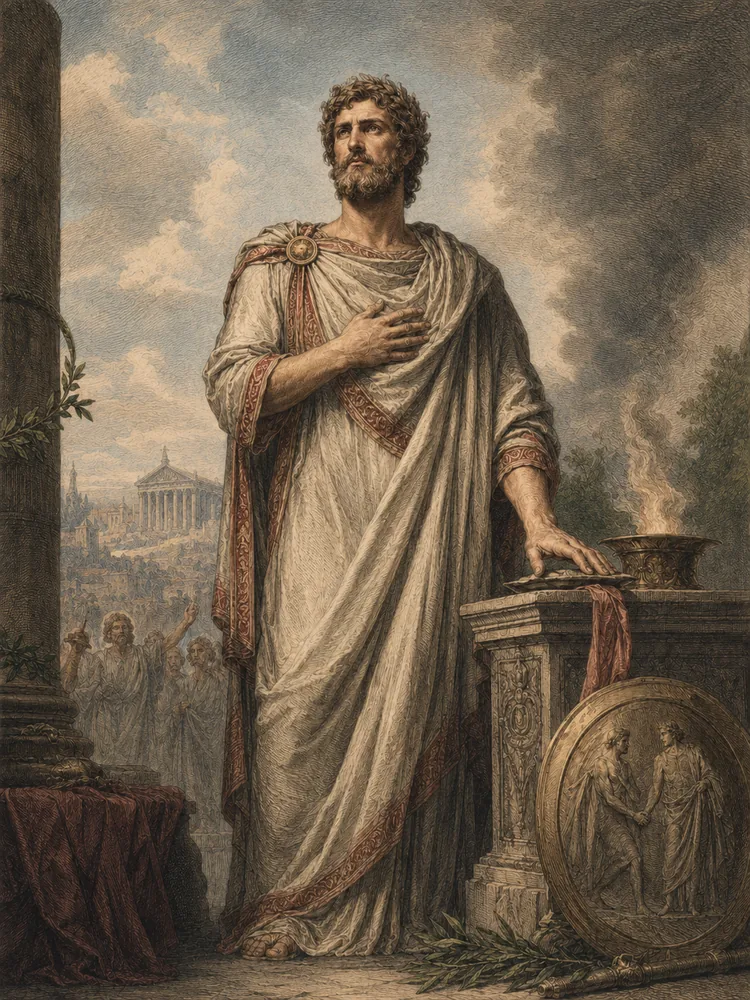
The Roman household had its Genius — the protective spirit that accompanied the head of the household and was honored at the family hearth — and when Augustus established the new political order after Actium, he extended this domestic conception to the state. The Genius Augusti — the Genius of the reigning emperor — became an object of public worship throughout the Empire. Sacrifices were made not to Augustus himself (which would have been improper for a living man, by Roman tradition) but to his Genius, his protective divine numen; this delicate distinction allowed the emperor to be the object of cult in his lifetime without the appearance of self-deification.
The development was carefully managed. In the eastern provinces, where Hellenistic king-cult had long been familiar, Roma and Augustus were worshipped together at large temples (Pergamum, Nicomedia). In Rome and Italy, where direct cult of a living ruler would have been resented, the emperor's Genius received the offerings instead. After death, the deceased emperor was elevated to full divinity by formal action of the Senate (the consecratio), becoming Divus Augustus, Divus Iulius, and so on. In each successive reign the living Genius and the dead Divi were both worshipped — the former for present protection, the latter for ancestral legitimacy.
The cult of the Genius Augusti was the primary religious test of political loyalty in the early Empire. Failure to participate — refusal to offer the small grain of incense at the public altar — was the principal evidence by which Christians (and a few others) were identified as enemies of the state. The famous letter of Pliny the Younger to Trajan (Letters 10.96), describing his examination of accused Christians in Bithynia, makes the test explicit: Pliny offered the suspects the chance to make the offering, and those who refused were executed. Trajan, in his reply, approved the procedure but instructed Pliny not to seek out Christians actively — they were to be punished only when accused, and only when their refusal was confirmed.