A Compendium of the Ancient Gods
Awaiting its plate

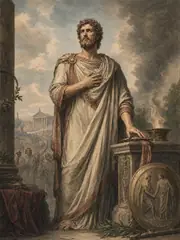
Dius Fidius — the Divine of the Faith — was an old Italic god of the sworn oath, the divinity by whom Romans swore their most binding oaths. He was identified with the Sabine god Semo Sancus (sometimes Sancus Dius Fidius, in the long form), and was perhaps the same god whom the Umbrians invoked as Sancius. His temple on the Quirinal Hill, traditionally founded by the king Tarquinius Superbus and dedicated in the early Republic, was one of the very oldest in Rome, and contained a famous statue of Gaia Caecilia, the wife of Tarquinius, with a spindle and distaff — the matron-image preserved through every later renovation.

The peculiar feature of swearing by Dius Fidius was that the oath had to be taken in the open air, beneath the sky, for the god was a sky-god (the dius element being cognate with Jupiter, deus, dies — the bright sky). Even his temple had a hole in the roof, that the sworn oath might pass directly to the god above. This requirement of open-air swearing distinguished Dius Fidius's oaths from those by Jupiter Lapis (sworn upon a stone) and by Hercules (sworn in the marketplace).

By the imperial period, Dius Fidius had been largely assimilated to Jupiter or to Hercules (whose Greek epithet pistios meant the same thing — "of the faith"), and his independent cult had faded. But his temple on the Quirinal continued to stand, and inscriptions to him as Sancus Sanctus Semo Deus Fidius are found through the second century. The sect of Christians whom the apologist Justin Martyr defended in the second century was charged, in Justin's report, with worshipping Simon Magus the heresiarch as a god — a charge based on a confused reading of an inscription to "Semoni Sanco Deo Fidio" on the Tiber Island. The misreading of Semo as Simon is preserved in Justin's First Apology and gave rise to a small literary controversy that stretched for centuries, until the rediscovery of the actual inscription in the seventeenth century settled the matter.

Curator’s note

What the sources say, and what later tradition added. The sources for this bay

Dius Fidius / Semo Sancus is described by Varro (De Lingua Latina 5.66), Livy (8.20.8 — the temple), Ovid (Fasti 6.213-218), Festus (s.v. Sancus), and Lactantius (Divinae Institutiones 1.15.5-7). The misreading of "Semoni Sanco" as "Simoni Sancto" by Justin Martyr (First Apology 26.2) and Irenaeus (Adversus Haereses 1.23.1) is corrected by the actual inscription CIL VI 567, found on the Tiber Island in 1574. The Iguvine Tablets — the great Umbrian religious text of the second century BCE — preserve material on the cult of Sansie / Sancius that is the closest parallel to Roman Dius Fidius and confirms the antiquity of the cult-formula.

When the sources speak

Dated witnesses for The Deified Virtues and the Imperial Mystery Cults. A date marks when the evidence was written down, not when the belief began. The whole timeline

c. 1000–750 BCE
Iron Age communities of Latium and neighboring peoples develop the cult landscapes later absorbed into Roman tradition.
traditional 753 BCE
Roman foundation chronology places Romulus and the first civic institutions at the beginning of the city’s sacred history.
traditional 7th–6th centuries BCE
The regal period is credited with priesthoods, calendars, temples, and the organization of public rites.
509–264 BCE
Republican expansion incorporates Latin, Sabine, Etruscan, and Italian cults through treaty, migration, and evocatio.
264–146 BCE
Mediterranean conquest accelerates Greek interpretation and the importation or redefinition of foreign gods.
204 BCE
The Magna Mater is formally brought from Pessinus during the Second Punic War.
1st century BCE
Varro, Cicero, and other antiquarians document rites and divine names amid civil war and institutional change.
27 BCE–14 CE
Augustan restoration monumentalizes selected ancestral cults and rewrites Roman sacred history.

Floor plan

The rooms follow one another in the order their peoples first appear in the written record.

  1. The Cradle of Citiesc. 3400 BCE to 395 CE. 115 works
  2. The Gift of the Nilec. 4000 BCE to 395 CE. 73 works
  3. The Olympian Orderc. 1600 BCE to 750 CE. 152 works
  4. The Persian Worldc. 2000 BCE to 1010 CE. 30 works
  5. The Levantine Borderlandsc. 1200 BCE to 500 CE. 20 works
  6. The Edges of Empirec. 2000 BCE to 1500 CE. 33 works
  7. The Etruscan Worldc. 900 BCE to 750 CE. 22 works
  8. The Roman Inheritancec. 1200 BCE to 500 CE. 58 works
  9. The Northern Inheritancec. 2000 BCE to 1600 CE. 131 works