
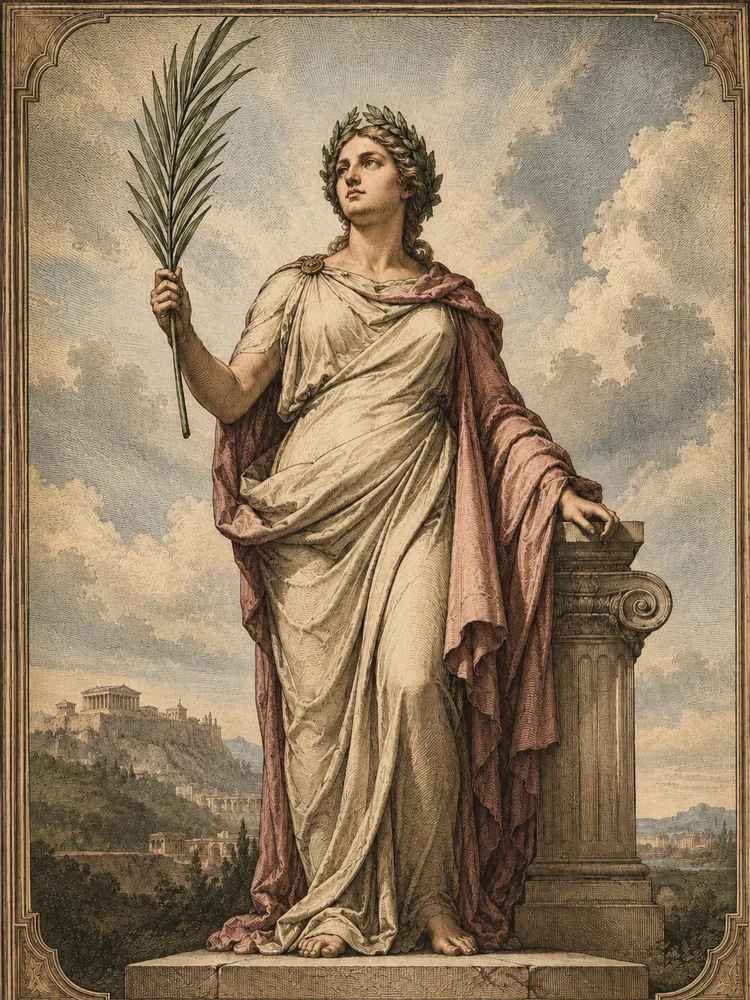

Spes was the Roman personification of hope, particularly the hope for offspring (an heir, a promising child), for political success (the elected office, the granted favor), for the safe return of the absent (the soldier, the merchant). She was depicted as a young woman, walking forward briskly with her gown raised slightly to clear her stride, holding a flower (often a lotus or poppy-bud) and a libation-bowl. The image was distinctive among Roman personifications, who were usually shown standing or seated in stately repose; Spes alone was depicted in motion, walking eagerly toward something.
Her great temple stood in the Forum Holitorium, the vegetable market between the Capitoline and the Tiber. It had been built during the First Punic War by the consul Aulus Atilius Calatinus in 254 BCE, was struck by lightning in 218 (just before Cannae — a poor omen), was burnt and rebuilt several times, and was preserved as part of the medieval church of S. Nicola in Carcere, where its travertine columns are still visible to those who know where to look in the church's structure.
Spes was particularly associated with Augustus's adopted heirs and with the imperial cult of dynastic continuity; coins of the Julio-Claudian and Flavian periods often show Spes with the legend SPES AUGUSTA or SPES POPULI ROMANI, marking the next generation of the imperial family as the hope of the state. After the dynastic crises of the third century, the cult declined; but Spes joined Fides and Pietas as one of the three theological virtues whose Latin names entered Christian doctrine virtually unchanged — Faith, Hope, and Charity — though the Christian reinterpretation gave each a meaning rather different from the Roman original.