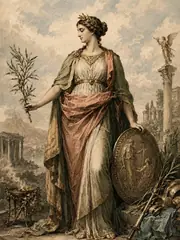
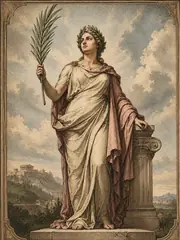
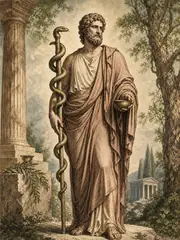
Salus was the Roman goddess of health, both personal and public — the bodily well-being of the individual, and the general welfare of the state. She is older than the Hellenized cult of Asclepius, with whom she was eventually equated as Salus-Hygieia; her temple on the Quirinal Hill, vowed by the consul Junius Bubulcus during the Samnite Wars and dedicated in 302 BCE, was one of the older Roman temples and contained famous wall-paintings by Fabius Pictor — the first Roman to achieve fame as a painter, and the same name as the historian Fabius Pictor (whether identical or merely related is debated).
Salus was worshipped also as Salus Publica, the welfare of the Roman people considered as a state — and in this aspect she was invoked at every political crisis as the guarantor of the city's continuance. Under the Empire, the formula "for the salus of the emperor" was the standard way of expressing loyalty to the regime, and the sacrifice for the emperor's salus was a regular feature of public worship. (Christians refused to make these sacrifices on theological grounds, and the matter became one of the central tests by which Roman authorities distinguished Christians from other subjects of the empire.)
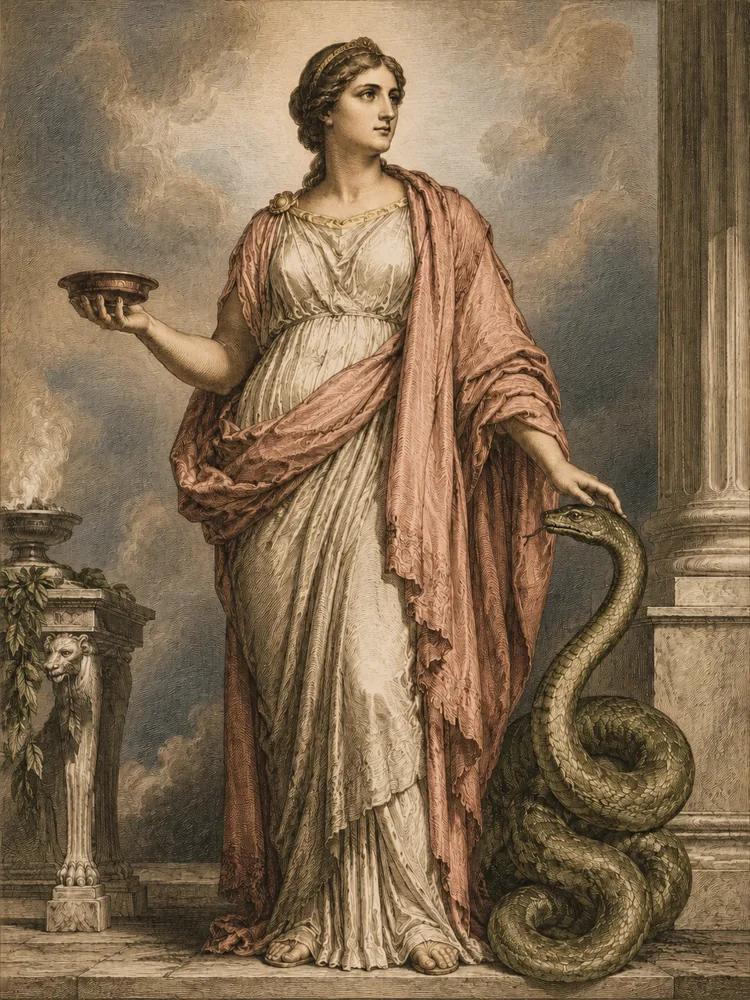
Her image was that of a matron seated on a throne, holding a libation-bowl in one hand and a serpent — the snake sacred to Asclepius, by whom Salus's identification with Hygieia was confirmed — in the other. The goddess remained a widely worshipped figure into the late Empire, with ample epigraphic evidence of personal vows for healing, particularly at her sanctuary on the Quirinal.
Curator’s note
What the sources say, and what later tradition added. The sources for this bay
Salus is described by Livy (9.43.25, 10.1.9), Pliny (Naturalis Historia 35.19, the Fabius Pictor paintings), Cicero (De Natura Deorum 3.61), and Ovid (Fasti 3.879). The Salus Augusti of imperial coinage is one of the most common reverse types from the second century onward. The conflict over Christian refusal to sacrifice for the emperor's salus is documented by Pliny the Younger (Letters 10.96, the famous letter to Trajan about the Christians of Bithynia), Tertullian (Apologeticus 30-32, the great Christian defense), and the Acts of the Christian martyrs.
When the sources speak
Dated witnesses for The Deified Virtues and the Imperial Mystery Cults. A date marks when the evidence was written down, not when the belief began. The whole timeline
- c. 1000–750 BCE
- Iron Age communities of Latium and neighboring peoples develop the cult landscapes later absorbed into Roman tradition.
- traditional 753 BCE
- Roman foundation chronology places Romulus and the first civic institutions at the beginning of the city’s sacred history.
- traditional 7th–6th centuries BCE
- The regal period is credited with priesthoods, calendars, temples, and the organization of public rites.
- 509–264 BCE
- Republican expansion incorporates Latin, Sabine, Etruscan, and Italian cults through treaty, migration, and evocatio.
- 264–146 BCE
- Mediterranean conquest accelerates Greek interpretation and the importation or redefinition of foreign gods.
- 204 BCE
- The Magna Mater is formally brought from Pessinus during the Second Punic War.
- 1st century BCE
- Varro, Cicero, and other antiquarians document rites and divine names amid civil war and institutional change.
- 27 BCE–14 CE
- Augustan restoration monumentalizes selected ancestral cults and rewrites Roman sacred history.