
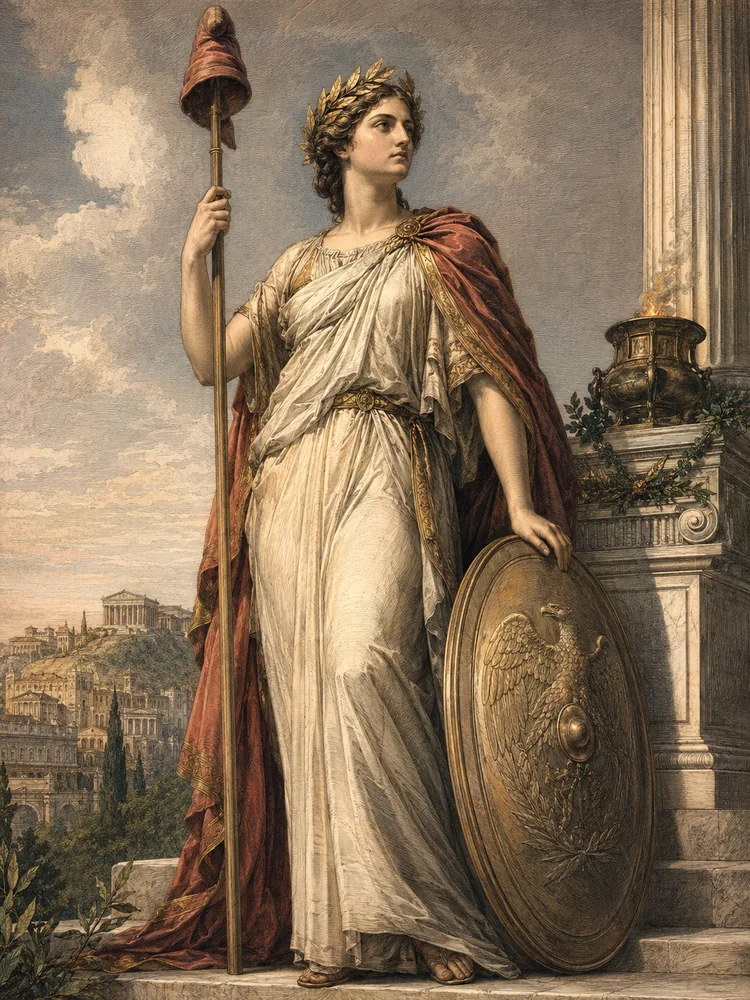

Libertas was the Roman personification of liberty, depicted as a stately matron in flowing robes, holding the rod with which slaves were touched in the rite of manumission (the vindicta) and the cap of liberty (the pileus) which the freed slave received in token of his new status. She was the special goddess of those who had passed from slavery to freedom — a class of considerable importance in Roman society — and her great temple stood on the Aventine, the hill of the Roman plebs, vowed by Tiberius Sempronius Gracchus during the Hannibalic Wars and dedicated in 238 BCE.
Libertas was also the goddess of political freedom — of the Roman Republic itself, in the technical sense — and she was invoked particularly in moments when that freedom was felt to be in danger. After the assassination of Julius Caesar in 44 BCE, the conspirators struck coins bearing the image of Libertas with a dagger and the cap of freedom — the famous EID MAR ("Ides of March") coin issued by Brutus, which is now one of the most valuable of all ancient coins. The political iconography of Libertas was thus deeply ambiguous: a goddess invoked by tyrannicides was a dangerous goddess for emperors to worship.
Nevertheless, the imperial period continued the cult, with the slight rebranding that Libertas now meant freedom from tyranny in the abstract — that is, freedom from rebellion, freedom under the emperor's wise guidance — rather than freedom from any particular ruler. The image and the temple persisted. The modern figure of Liberty, as on the Statue of Liberty in New York or on the great Republican coinage of the eighteenth century, descends directly from Roman Libertas: the cap, the torch, the stately bearing, even the rays of the crown are her ancient attributes lightly reinterpreted.