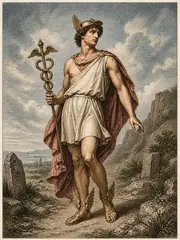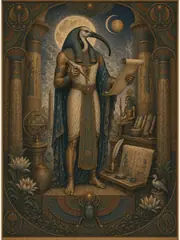
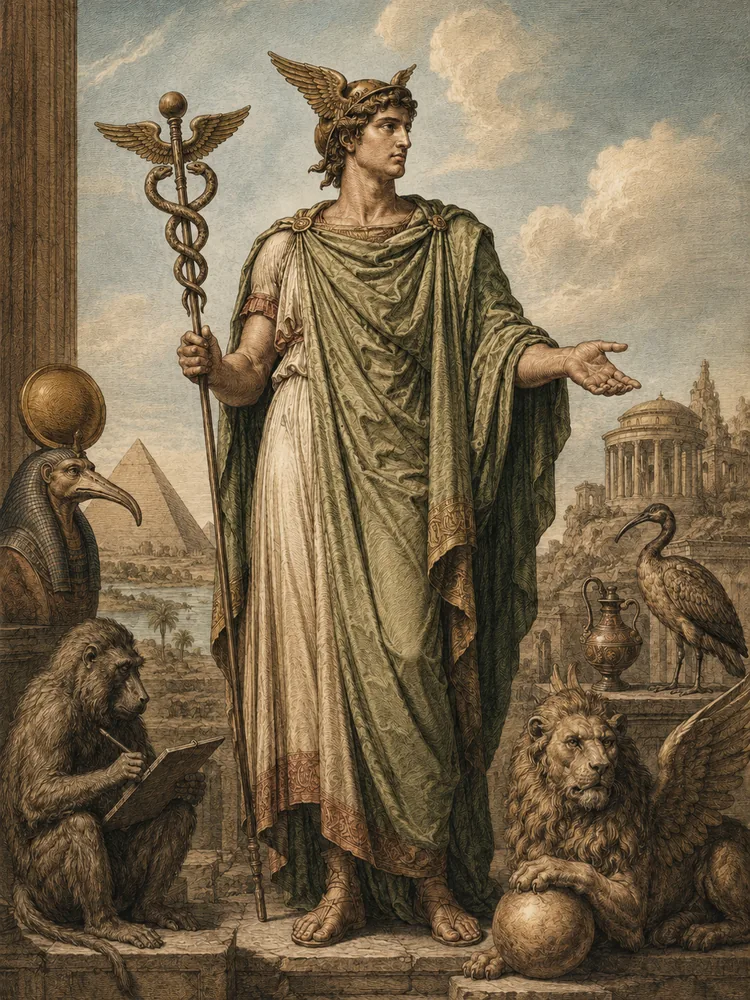
Hermes Trismegistus — "Hermes the Thrice-Great" — was the legendary author of a body of religious-philosophical literature produced in Hellenistic and Roman Egypt, in Greek language but with Egyptian theological content, between approximately the second century BCE and the third century of our era. The figure was a syncretism of the Greek Hermes (treated in Volume III) and the Egyptian Thoth (treated in Volume II), the two gods being already identified in Hellenistic times because both were patrons of writing, of wisdom, of the arts of the scribe; the epithet Trismegistus reflects an Egyptian formula for the very great Thoth. The historical Hermes Trismegistus, in the sense of an actual ancient sage who had written the works attributed to him, was not a real person; the works are pseudonymous, attributed to him as the legendary inventor of writing and the bringer of all wisdom.
The literature attributed to Hermes Trismegistus — collectively known as the Hermetica — consisted of two related bodies: the philosophical Hermetica (the Corpus Hermeticum, surviving in seventeen treatises in Greek; the Asclepius, surviving in Latin translation; and various fragments preserved by Stobaeus and others) and the technical Hermetica (works on astrology, alchemy, medicine, and magic, of which a great deal also survives). The philosophical Hermetica taught a complex theological doctrine, partly Platonic (with strong dependences on the Middle and Neo-Platonic philosophical traditions), partly Egyptian (preserving Egyptian theological vocabulary and conceptions), partly Stoic, partly mystery-religious, with the soul's ascent to divinity through gnostic illumination as a central theme. The technical Hermetica gave the West some of its principal traditions of esoteric science and magic.
The figure of Hermes Trismegistus had an extraordinary subsequent life. The Corpus Hermeticum was translated into Latin by Marsilio Ficino in 1463 (at Cosimo de' Medici's special request) and was, for the next century and a half, considered an authentic ancient Egyptian wisdom-tradition older than Plato and contemporary with Moses — until Isaac Casaubon in 1614 demonstrated by linguistic and stylistic analysis that the texts were of Hellenistic and Roman date and could not be the immemorial wisdom they claimed to be. Casaubon's demonstration was a foundational moment of modern critical philology; before it, Hermes had been a major inspiration of the Renaissance occult tradition (Pico della Mirandola, Giordano Bruno, the alchemists), and the influence persisted long after the historical demotion.