A Compendium of the Ancient Gods
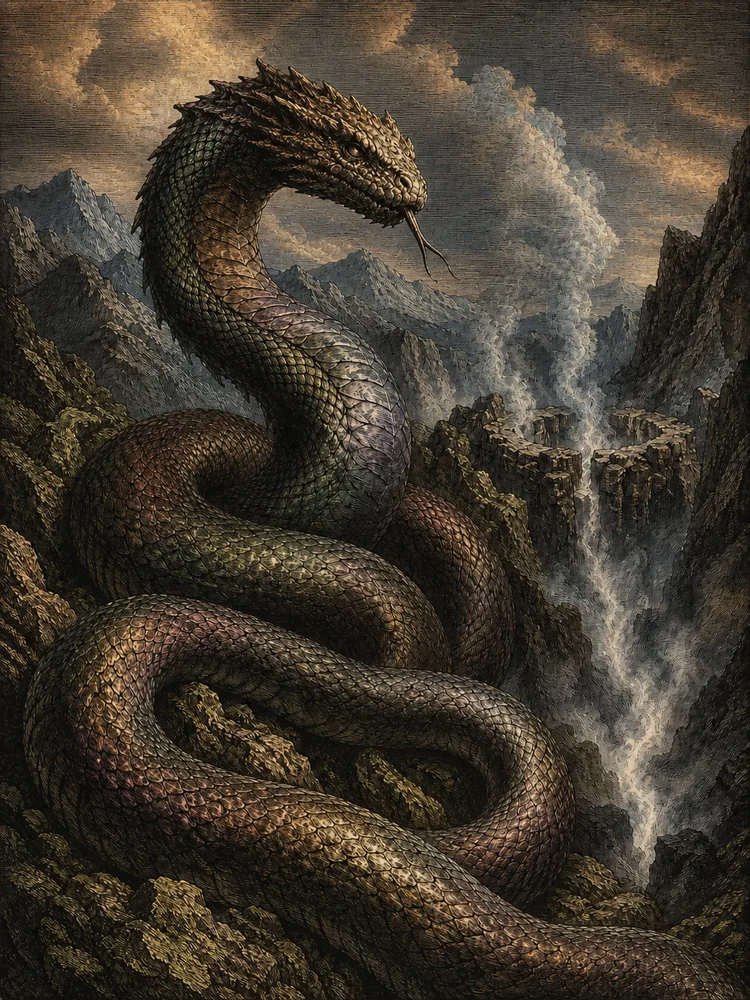
Python, plate

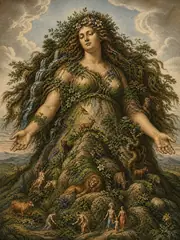
Before Delphi was the seat of Apollo it was an oracle of Earth herself, and the priestess who there gave answer to the suppliant did so by the inspiration of Gaia, mother of the gods. Beside the spring at the foot of Mount Parnassus there coiled, in those first days, a great serpent — the Python, born of the slime that remained after the deluge of Deucalion, when the receding waters had bred all manner of nameless creatures from the warm earth. The Python guarded the oracular cleft in the rock, and through her the Earth-priestess gave her counsel.

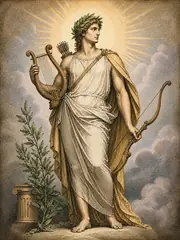
Now when Apollo, fourth-born of the gods, came of age and went forth in search of a place for his own oracle, he drew his bow against the Python and slew her at the spring of Castalia — for Hera, who had hated his mother Leto with an everlasting hatred, had set the serpent upon the wandering goddess in the time of Apollo's birth, and the matter was not forgotten. Three days the god pursued the wounded creature, and at last brought her down. Where her body fell to rot — the Greek verb is python, to rot — there Apollo founded his oracle, and gave the place its name; and the priestess of Apollo was thereafter called the Pythia, in memory of the serpent who had been there before her.

But to slay an earth-creature is no light thing, even for a god. Apollo was banished from Olympus for a great year of nine ordinary years, and served as a herdsman to King Admetus of Pherae in Thessaly, in expiation. Only afterward could he take up his place at Delphi, instituting the Pythian Games in honor of the killing — funeral games, for the serpent he had slain — which thereafter were celebrated every fourth year, and were second in renown only to the Olympian.

So at Delphi the older oracle of Earth was overlaid by the newer oracle of the Sun-god, but never wholly displaced; the Pythia who gave answer in Apollo's name spoke seated upon a tripod over a cleft in the rock that was the lair of Python, and the prophetic vapor that rose from the cleft, and the laurel she chewed before speaking, were both said to have been the gift of the older powers.
Curator’s note

What the sources say, and what later tradition added. The sources for this bay

The Python myth is preserved in the Homeric Hymn to Apollo (lines 300-374, the great hymn that is our earliest sustained narrative of Apollo's foundation of the oracle), in Hyginus (Fabulae 140), in the Pseudo-Apollodoran Bibliotheca (1.4.1), and in Pausanias (Description of Greece 10.6, which preserves a different and probably older version in which Apollo's adversary was a male serpent named Delphyne or Drakon). Strabo and Plutarch, both with personal knowledge of Delphi (Plutarch was a priest there in his later years), describe the chasm and the prophetic vapor; the question of whether the vapor was real has been much debated since J. P. Oberhummer in 1907 dismissed it as legend, but the geological surveys of de Boer and Hale (2000-2001) identified ethylene-bearing fissures beneath the temple that may corroborate the ancient testimony. The tension between the older Earth-oracle and the newer Apolline oracle is a real historical sequence, traceable in the cult-archaeology of Delphi back to Mycenaean times.

Kin in the sources

Each tie is quoted from the entry that states it.

When the sources speak

Dated witnesses for The Primordial Powers. A date marks when the evidence was written down, not when the belief began. The whole timeline

c. 1600–1100 BCE
Mycenaean palace tablets in Linear B record offerings and divine names, but little continuous myth.
c. 1100–800 BCE
Post-palatial oral traditions and changing cult landscapes precede the surviving alphabetic epics.
late 8th–7th centuries BCE
The Iliad, Odyssey, Hesiodic Theogony and Works and Days give influential but non-exclusive divine orders.
7th–6th centuries BCE
Homeric Hymns, lyric poetry, colonization, and local sanctuary traditions multiply regional narratives.
6th–5th centuries BCE
Orphic, Pythagorean, and mystery materials develop alternative cosmogonies and afterlife doctrines.
5th century BCE
Athenian tragedy and comedy recast heroic houses and divine justice for civic audiences.
4th century BCE
Philosophers, antiquarians, and local historians interpret or criticize inherited myth.
323–31 BCE
Hellenistic poets and scholars systematize variants across an enlarged Greek world.

Floor plan

The rooms follow one another in the order their peoples first appear in the written record.

  1. The Cradle of Citiesc. 3400 BCE to 395 CE. 115 works
  2. The Gift of the Nilec. 4000 BCE to 395 CE. 73 works
  3. The Olympian Orderc. 1600 BCE to 750 CE. 152 works
  4. The Persian Worldc. 2000 BCE to 1010 CE. 30 works
  5. The Levantine Borderlandsc. 1200 BCE to 500 CE. 20 works
  6. The Edges of Empirec. 2000 BCE to 1500 CE. 33 works
  7. The Etruscan Worldc. 900 BCE to 750 CE. 22 works
  8. The Roman Inheritancec. 1200 BCE to 500 CE. 58 works
  9. The Northern Inheritancec. 2000 BCE to 1600 CE. 131 works