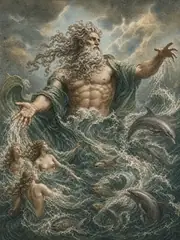
Nereus was the eldest son of Pontus and Gaia, the "Old Man of the Sea" — a kindly and truthful sea-god who, by his Oceanid wife Doris, was father of the fifty Nereids (the sea-nymphs), among whom were Thetis (mother of Achilles), Amphitrite (wife of Poseidon), Galatea (beloved of Polyphemus), and Psamathe (mother of Phocus). Nereus's special gift was prophecy: he knew the truth of all things, and would speak it if compelled, but he would resist by transforming himself into different shapes — fire, water, lion, serpent, tree — in the hope of escaping his interrogator. Heracles, on his way to fetch the apples of the Hesperides, came upon Nereus sleeping, seized him, held him fast through all his transformations, and so compelled him to give the directions to the western garden.
 Before thisPan
 Next on the wallProteus
Curator’s note
What the sources say, and what later tradition added. The sources for this bay
Hesiod, Theogony 233–264 (parentage and the Nereids); Apollodorus 2.5.11 (the Heracles encounter). The shape-shifting prophet-of-the-sea is a recurring Greek figure (Nereus, Proteus, Phorcys, in different functions); the type may reflect the Greek experience of the unpredictable and untrustworthy sea, whose appearance changes constantly and which yields its truths only to forced inquiry.
Kin in the sources
Each tie is quoted from the entry that states it.
 Child ofPontus
Nereus was the eldest son of Pontus and Gaia
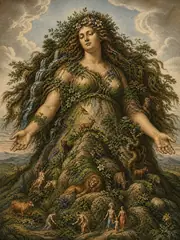 Child ofGaia
Nereus was the eldest son of Pontus and Gaia
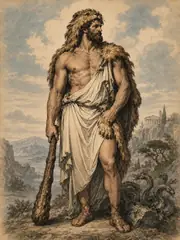 Rival ofHeracles
Heracles, on his way to fetch the apples of the Hesperides, came upon Nereus sleeping
- Compared withProteus
The shape-shifting prophet-of-the-sea is a recurring Greek figure (Nereus, Proteus, Phorcys, in different functions)
When the sources speak
Dated witnesses for The Sea, the Wild and the Wind. A date marks when the evidence was written down, not when the belief began. The whole timeline
- c. 1600–1100 BCE
- Mycenaean palace tablets in Linear B record offerings and divine names, but little continuous myth.
- c. 1100–800 BCE
- Post-palatial oral traditions and changing cult landscapes precede the surviving alphabetic epics.
- late 8th–7th centuries BCE
- The Iliad, Odyssey, Hesiodic Theogony and Works and Days give influential but non-exclusive divine orders.
- 7th–6th centuries BCE
- Homeric Hymns, lyric poetry, colonization, and local sanctuary traditions multiply regional narratives.
- 6th–5th centuries BCE
- Orphic, Pythagorean, and mystery materials develop alternative cosmogonies and afterlife doctrines.
- 5th century BCE
- Athenian tragedy and comedy recast heroic houses and divine justice for civic audiences.
- 4th century BCE
- Philosophers, antiquarians, and local historians interpret or criticize inherited myth.
- 323–31 BCE
- Hellenistic poets and scholars systematize variants across an enlarged Greek world.