A Compendium of the Ancient Gods
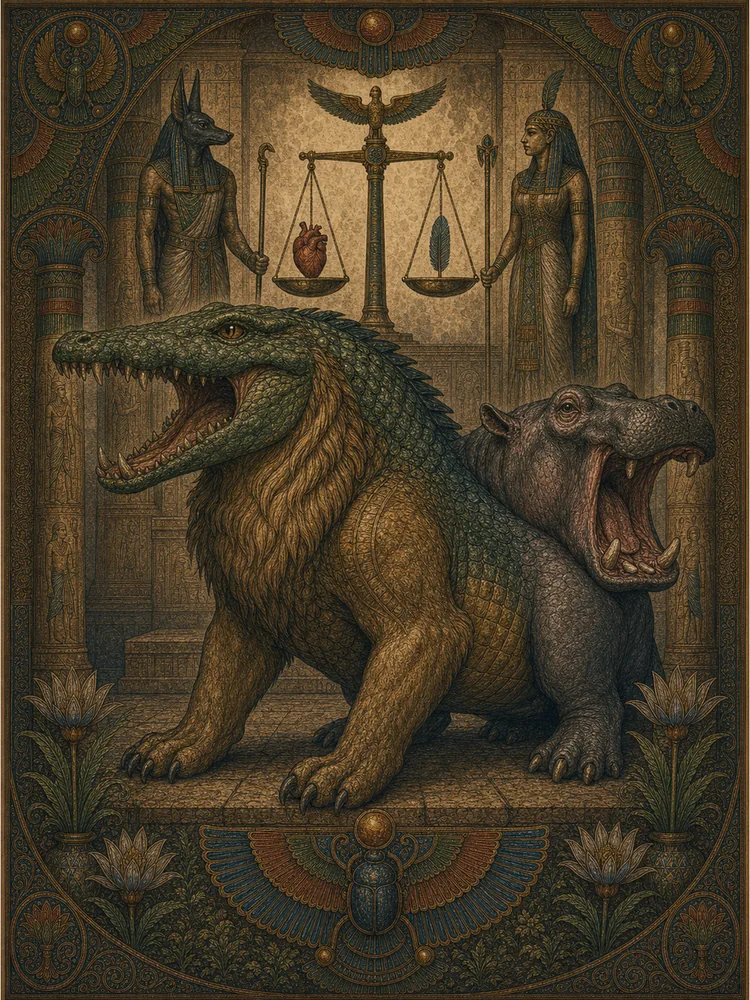
Ammit, plate

In the Hall of the Two Truths, at the place of the weighing of the heart, beside the great scales upon which the heart of the dead is laid against the feather of Maat, there crouches a creature of three forms: she has the head of a crocodile, the forequarters of a lion, and the hindquarters of a hippopotamus. She was called Ammit, the Swallower, and her function was simple and dreadful. If the heart of the dead, when set against the feather, was found to be heavy with falsehood — if Thoth declared the verdict of injustice — then the dead would be cast to her, and Ammit would devour the heart, and with it the soul, and the unjust would be no more.

She does not appear in any ordinary myth; she has no story save the story of the judgment. Her three forms were each a creature that the Egyptians knew to be deadly to humankind: the crocodile of the river, the lion of the desert, the hippopotamus of the marsh. To meet her was to meet the natural death thrice gathered, and to be unmade. The vignettes of the Book of the Dead nearly always show her at the foot of the scales, ready and patient; sometimes she is portrayed in detail, sometimes only by a single waiting muzzle.

Yet Ammit was not herself a power of evil. She did not pursue the dead nor seek them out; she was simply the consequence of an unjust life, set in place by Maat herself. In her presence the doctrine of judgment was made absolute: the soul that had not lived in truth would not endure beyond the body. To the Egyptian sensibility, this was not damnation but obliteration — a cleaner and starker fate than any later hell, and one whose horror lay precisely in its finality.
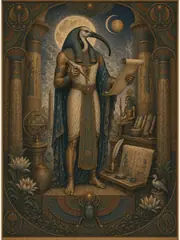
Curator’s note

What the sources say, and what later tradition added. The sources for this bay

Ammit (Egyptian ꜤꜤmmỉt, 'the Devourer') appears chiefly in the vignettes and texts of the Book of the Dead, especially the famous illustrated weighing-of-the-heart scenes from Chapter 125. She is named in the introductory section of that chapter and depicted in nearly every surviving illustrated copy of the New Kingdom and after. Her three components — crocodile, lion, hippopotamus — represent the most feared predators of the Egyptian environment. Her role is judicial rather than antagonistic: she is the executioner of Maat's verdict, not its enemy. The Egyptian conception of post-mortem judgment as resulting in either justification (becoming an akh) or annihilation (devouring by Ammit) is one of the most distinctive features of their afterlife theology, and stands in sharp contrast to the later Christian and Islamic doctrines of eternal punishment. The unjustified soul does not suffer forever; it ceases to be.

Kin in the sources

Each tie is quoted from the entry that states it.

When the sources speak

Dated witnesses for The Osirian Cycle. A date marks when the evidence was written down, not when the belief began. The whole timeline

c. 4000–3100 BCE
Predynastic regional symbols, burials, standards, and animal cults provide the deep background to later divine iconography.
c. 3100–2686 BCE
Early Dynastic kingship joins royal ideology to local cult centers and establishes many durable divine emblems.
c. 2686–2181 BCE
Old Kingdom pyramid complexes and the Pyramid Texts preserve the earliest large religious corpus.
c. 2181–1650 BCE
First Intermediate and Middle Kingdom traditions broaden mortuary access; Coffin Texts develop older royal materials.
c. 1550–1070 BCE
New Kingdom temple wealth, royal hymns, underworld books, and the Book of Going Forth by Day greatly expand the record.
c. 1353–1336 BCE
Akhenaten’s Aten program reorganizes royal cult but does not permanently erase the older divine plurality.
c. 1070–664 BCE
Third Intermediate Period priestly and regional powers reshape cult administration and divine kingship.
664–332 BCE
Late Period archaism, animal cults, and temple scholarship preserve and reinterpret older forms.

Floor plan

The rooms follow one another in the order their peoples first appear in the written record.

  1. The Cradle of Citiesc. 3400 BCE to 395 CE. 115 works
  2. The Gift of the Nilec. 4000 BCE to 395 CE. 73 works
  3. The Olympian Orderc. 1600 BCE to 750 CE. 152 works
  4. The Persian Worldc. 2000 BCE to 1010 CE. 30 works
  5. The Levantine Borderlandsc. 1200 BCE to 500 CE. 20 works
  6. The Edges of Empirec. 2000 BCE to 1500 CE. 33 works
  7. The Etruscan Worldc. 900 BCE to 750 CE. 22 works
  8. The Roman Inheritancec. 1200 BCE to 500 CE. 58 works
  9. The Northern Inheritancec. 2000 BCE to 1600 CE. 131 works