A Compendium of the Ancient Gods
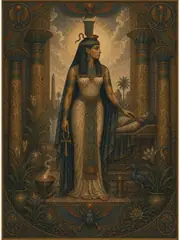
Meskhenet, plate

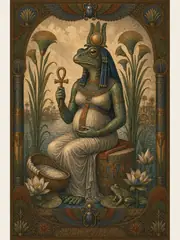
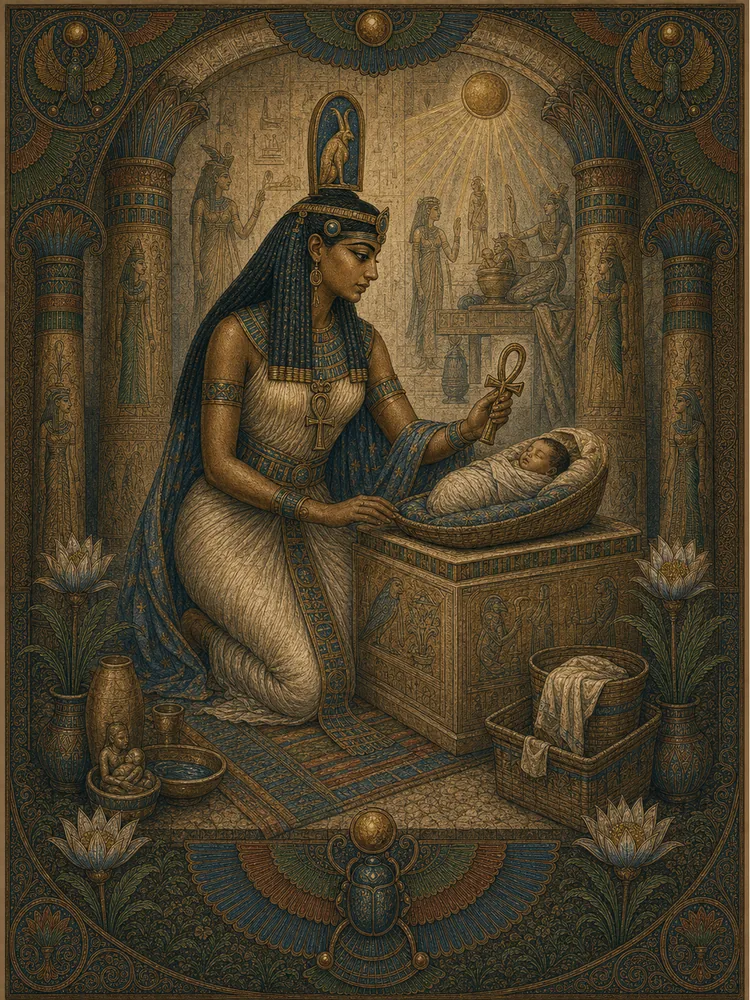
When a woman of Egypt came to the hour of childbirth, she squatted upon two bricks of clay laid one beside the other, that the child might come down upon them and be received. These were the meskhent, the birthing-bricks, and they were not mere objects: into them, in the moment of birth, came the goddess Meskhenet, who was the brick made divine. She it was who beheld the newborn and pronounced its fate, declaring at the very threshold of life what kind of life this should be.

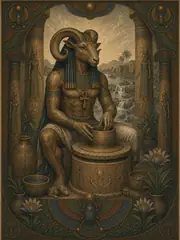
In the great romance preserved upon the Westcar Papyrus, when the wife of a priest of Ra was about to give birth to the three sons who would become the first kings of the Fifth Dynasty, the gods themselves came down to attend her: Isis stood before her, Nephthys behind, Heqet the frog-goddess hastened the labor, and Meskhenet stood by to fix the destiny of each child. As each son was lifted from the brick, Meskhenet pronounced upon him: 'A king who shall reign in this land.' So the futures of three pharaohs were spoken at the moment they drew their first breath.

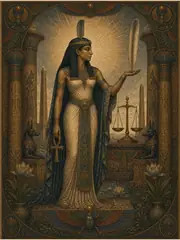
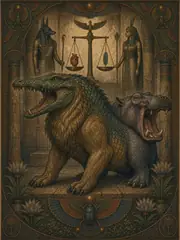
She was depicted as a woman whose head was the strange double-headed cow uterus that served as her hieroglyphic emblem, or more often as a birthing-brick personified, the brick standing upright and crowned with a woman's face. In the Hall of Judgment she had a second office: she stood beside the scales of Maat, for the destiny that she had spoken at birth must now be measured against the life that had followed. Thus she presided at both ends of the human course, the beginning and the reckoning.
Curator’s note

What the sources say, and what later tradition added. The sources for this bay

Meskhenet (Egyptian Msḫn.t) is attested from the Old Kingdom onward; her name derives from the word for the birth-brick. The dramatic narrative cited above is from the Westcar Papyrus (Berlin 3033, Middle Kingdom copy of an older tale), which preserves the prophecy of the Fifth Dynasty kings' birth and shows Meskhenet in her destiny-fixing function alongside Isis, Nephthys, Heqet, and the ram-god Khnum. She also appears in the weighing-of-the-heart scenes of the Book of the Dead, sometimes depicted alongside Renenutet (the goddess of the Ren-name) and Shai (the personified destiny). An actual birth-brick of Egyptian provenance was identified at South Abydos in 2002, painted with images of the goddesses attending the birth of a child — the only such object yet recovered, but confirming what the texts had long described.

Kin in the sources

Each tie is quoted from the entry that states it.

When the sources speak

Dated witnesses for The Osirian Cycle. A date marks when the evidence was written down, not when the belief began. The whole timeline

c. 4000–3100 BCE
Predynastic regional symbols, burials, standards, and animal cults provide the deep background to later divine iconography.
c. 3100–2686 BCE
Early Dynastic kingship joins royal ideology to local cult centers and establishes many durable divine emblems.
c. 2686–2181 BCE
Old Kingdom pyramid complexes and the Pyramid Texts preserve the earliest large religious corpus.
c. 2181–1650 BCE
First Intermediate and Middle Kingdom traditions broaden mortuary access; Coffin Texts develop older royal materials.
c. 1550–1070 BCE
New Kingdom temple wealth, royal hymns, underworld books, and the Book of Going Forth by Day greatly expand the record.
c. 1353–1336 BCE
Akhenaten’s Aten program reorganizes royal cult but does not permanently erase the older divine plurality.
c. 1070–664 BCE
Third Intermediate Period priestly and regional powers reshape cult administration and divine kingship.
664–332 BCE
Late Period archaism, animal cults, and temple scholarship preserve and reinterpret older forms.

Floor plan

The rooms follow one another in the order their peoples first appear in the written record.

  1. The Cradle of Citiesc. 3400 BCE to 395 CE. 115 works
  2. The Gift of the Nilec. 4000 BCE to 395 CE. 73 works
  3. The Olympian Orderc. 1600 BCE to 750 CE. 152 works
  4. The Persian Worldc. 2000 BCE to 1010 CE. 30 works
  5. The Levantine Borderlandsc. 1200 BCE to 500 CE. 20 works
  6. The Edges of Empirec. 2000 BCE to 1500 CE. 33 works
  7. The Etruscan Worldc. 900 BCE to 750 CE. 22 works
  8. The Roman Inheritancec. 1200 BCE to 500 CE. 58 works
  9. The Northern Inheritancec. 2000 BCE to 1600 CE. 131 works