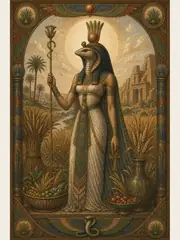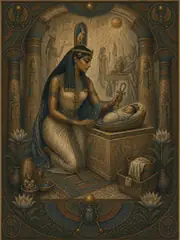
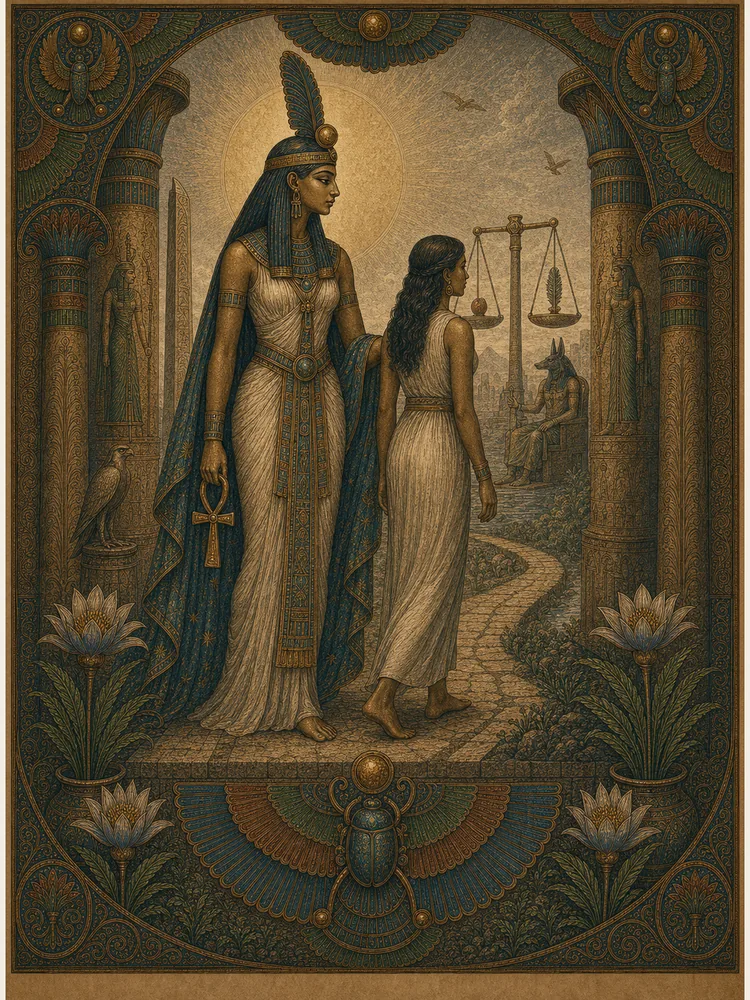
Each Egyptian was understood to possess his own Shai — his portion, his lot, his appointed destiny — and Shai was at once a thing belonging to him and a god accompanying him through life. He walked beside the soul from the day of birth to the day of judgment, neither commanding it nor abandoning it, but bearing witness to all its course. At the moment of death, Shai entered the Hall of Judgment with his charge and stood there as testimony: this was the life that was given, and this is the life that was lived.
The Egyptians did not see Shai as a tyrant fate that overrode the will. A man's Shai was his own; his choices made it; yet it had also been spoken at his birth by Meskhenet, and so it carried the weight of an ordained shape that the days of his life would fill. The wisdom-texts taught that to know one's Shai and to walk in agreement with it was the beginning of right living; to oppose one's Shai was to make the days short and the heart heavy. Yet to live in Maat was to fashion a Shai that would speak well in the Hall of Judgment, and so virtue and destiny were not opposites but the same thing seen from different sides.
In the Greek period, Egyptian Shai was identified with the Greek Agathos Daimon, the good genius that accompanied each man, and was depicted as a bearded serpent in the Greco-Egyptian magical papyri. The continuity is striking: under whichever culture's name, the figure stands for the personal destiny that walks with each life, and that must finally give an account of it.