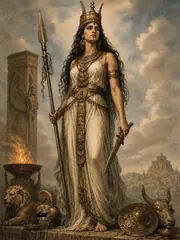
A Compendium of the Ancient Gods
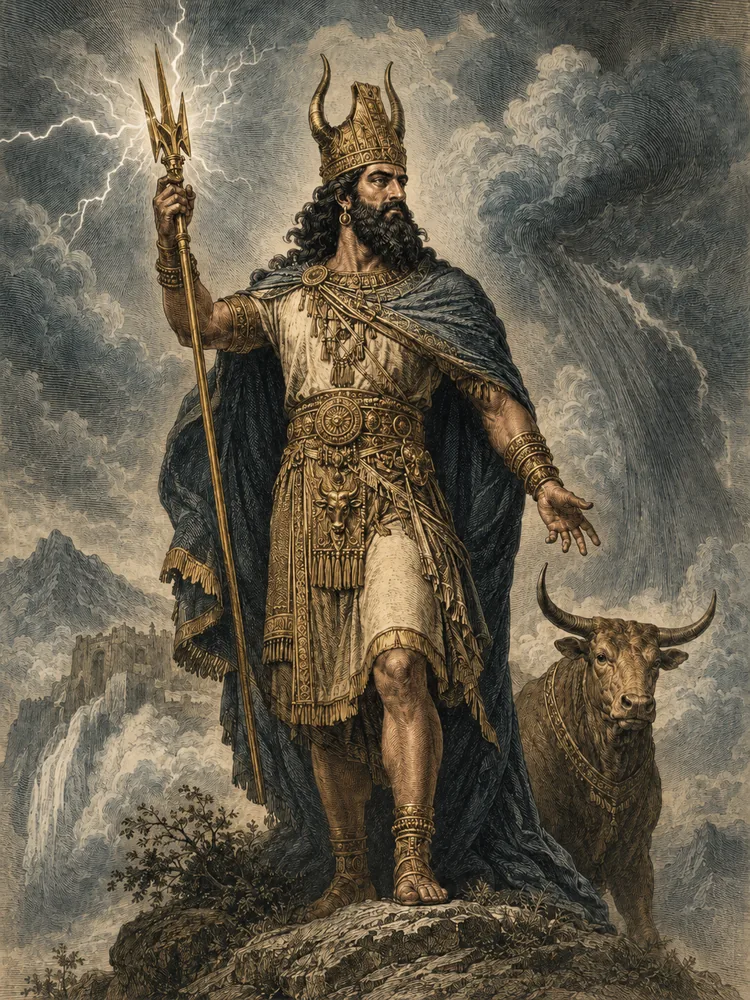
Baal, plate

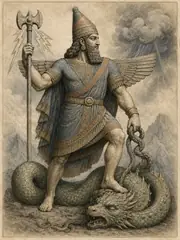
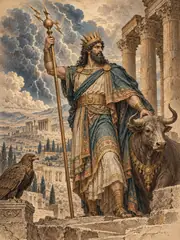
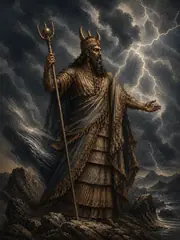
Baal — that is, "Lord," the title coming in Phoenician usage to function as a name — was the storm-god of Canaan, the rider on the clouds, the lord of Mount Saphon (the great peak above Ugarit, modern Jebel al-Aqra), the giver of rain and the bringer of fertility. His proper name was Hadad, the same Hadad whom the Mesopotamians called Adad and the Hittites called Tarhunt. In the great myth-cycle preserved on six tablets from Ugarit, his story is told.

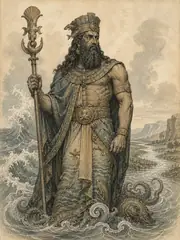
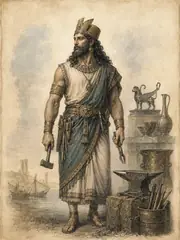
First, Baal contended with Yam, the Sea. Yam — "the beloved of El" — sent two messengers to the assembly of the gods, demanding that Baal be surrendered as his slave. The gods cowered; El assented; but Baal alone resisted. The craftsman-god Kothar-wa-Khasis fashioned for him two clubs, named Yagrush "Driver" and Aymur "Striker," with magical power. Baal hurled them in succession against Yam; the first staggered him, the second struck him in the forehead, and Yam fell. "Yam is dead," Baal cried, "and Baal shall reign!" So the kingship of the active gods was won.

But a king must have a palace. Baal had none, and the petition for one was the next labor. His sister-consort Anat went to El, and her arguments were not gentle: "I shall make thy grey hair flow with blood," she warned; El relented, the assent was given, and Kothar built upon the heights of Saphon a great palace of cedar and gold and lapis lazuli. When it was finished, Baal hesitated whether to set in it a window: he feared lest his enemies enter through it. But at length he ordered the window made, and through it he sent forth his thunder.

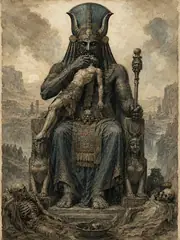
Then Baal's pride brought him low. He sent challenges to Mot — Death — calling him a slave; and Mot answered with quiet menace, summoning him to the netherworld. Baal could not refuse. He came down, and was swallowed by Mot, and the news was brought up to the gods: "Baal is dead!" El descended from his throne, sat in the dust, gashed his cheeks and chin, and cried out: "Baal is dead — what then of the people? Dagon's son — what of the multitudes? After Baal I will go down into the earth." Anat searched all the regions for her brother's body; she found it; she wept upon it; and she swore vengeance upon Mot. She sought him out, and she seized him: "With a sword she cleft him; with a sieve she winnowed him; with a fire she burned him; with a millstone she ground him; in the field she scattered him; the birds ate his flesh." So Death was destroyed.

And then — for the rains had ceased and the world was failing — El had a dream: that the heavens rained oil, that the wadis ran with honey. "Baal lives," El cried; "the prince, the lord of the earth, exists." And Baal was found, restored, alive in his palace. He fought Mot again, who returned in time; the tablet is broken at the climax, but Mot at the last gave way, conceding the kingship; and Baal reigned. So the dry season passed, and the rains returned.
Curator’s note

What the sources say, and what later tradition added. The sources for this bay

This summary of the Baal Cycle (KTU 1.1–1.6) is necessarily compressed; the original is some 1500 lines of broken alphabetic cuneiform on six tablets, and many points of sequence are debated. The text was discovered at Ras Shamra (Ugarit) in 1929 by Claude Schaeffer's excavations and edited by Charles Virolleaud. It is the single most important document of Canaanite religion and one of the major literary recoveries of the twentieth century. The Baal Cycle stands behind much in the Hebrew Bible — the Psalms in particular preserve numerous turns of phrase clearly inherited from Ugaritic poetry (Psalm 29 is a striking case, sometimes argued to be a re-attributed Baal hymn) — and the polemical denunciations of Baal worship in the books of Kings (1 Kings 16–22, the Elijah cycle) refer to a real and persistent religious situation, in which the same storm-god worshipped at Tyre and Sidon was also worshipped, against prophetic objection, by significant portions of the Israelite population. The seasonal pattern of Baal's death, descent, mourning, and resurrection — corresponding to the dry summer and the autumn return of the rains — is one of the clearest cases of seasonal myth in the ancient Near East.

Kin in the sources

Each tie is quoted from the entry that states it.

The same god in other rooms

The ancient sources themselves name these as one god under different names. See Adad, Tarhunt, Lametrus, Papas, Baal, Zeus, Hadad, Baalshamin and Tinia hung together

When the sources speak

Dated witnesses for Canaan and Phoenicia. A date marks when the evidence was written down, not when the belief began. The whole timeline

c. 3400–3000 BCE
Uruk-period writing and monumental temple economies create the earliest recoverable administrative setting for named divine institutions.
c. 2900–2350 BCE
Early Dynastic city-states preserve local cults, hymns, royal inscriptions, and god lists; later copies often transmit older compositions.
c. 2334–2154 BCE
The Akkadian Empire expands bilingual and imperial patterns of divine identification without erasing local cult titles.
c. 2112–2004 BCE
Ur III administration and scribal schooling standardize many Sumerian literary and liturgical forms.
c. 2000–1600 BCE
Old Babylonian schools copy major myths, laments, hymns, debates, and heroic narratives in the form most often used by modern editors.
c. 1650–1200 BCE
Hittite and Hurrian archives at Hattusa transmit Anatolian myths, imported Syrian materials, and ritual compositions.
c. 1400–1190 BCE
The tablets of Ugarit preserve the Baal Cycle, Kirta, Aqhat, ritual lists, and a dense Late Bronze Age West Semitic pantheon.
c. 1000–612 BCE
Neo-Assyrian and Neo-Babylonian empires collect, revise, and politically reinterpret older learned traditions.

Floor plan

The rooms follow one another in the order their peoples first appear in the written record.

  1. The Cradle of Citiesc. 3400 BCE to 395 CE. 115 works
  2. The Gift of the Nilec. 4000 BCE to 395 CE. 73 works
  3. The Olympian Orderc. 1600 BCE to 750 CE. 152 works
  4. The Persian Worldc. 2000 BCE to 1010 CE. 30 works
  5. The Levantine Borderlandsc. 1200 BCE to 500 CE. 20 works
  6. The Edges of Empirec. 2000 BCE to 1500 CE. 33 works
  7. The Etruscan Worldc. 900 BCE to 750 CE. 22 works
  8. The Roman Inheritancec. 1200 BCE to 500 CE. 58 works
  9. The Northern Inheritancec. 2000 BCE to 1600 CE. 131 works