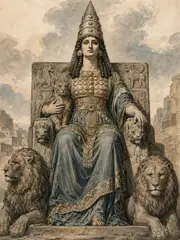
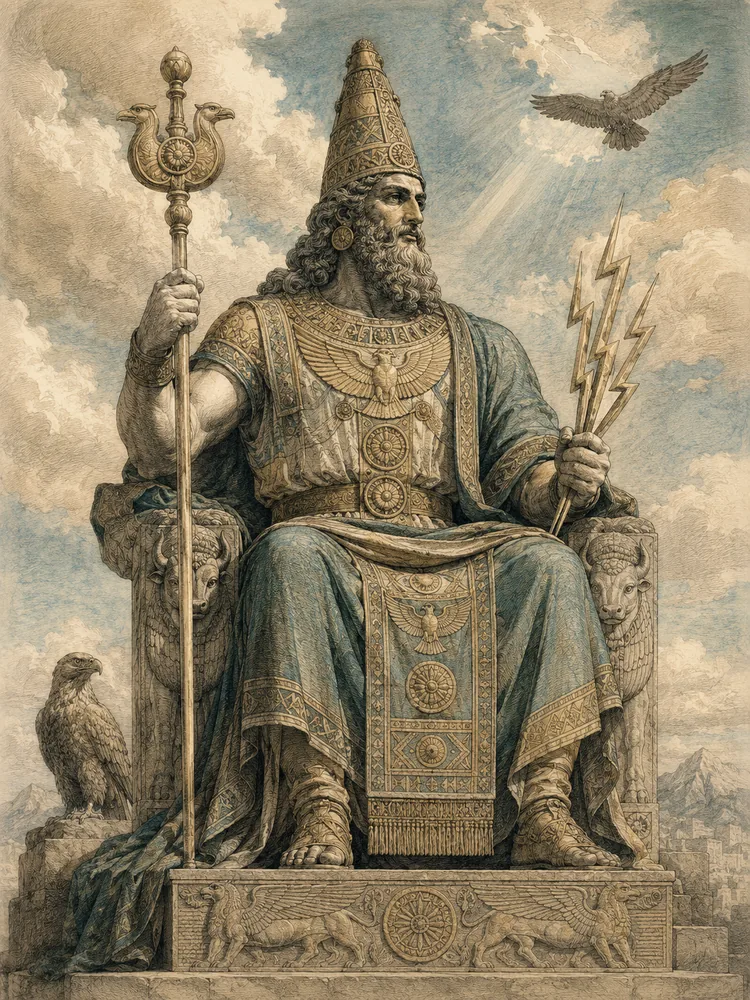
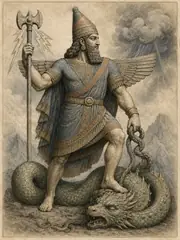
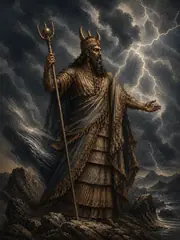
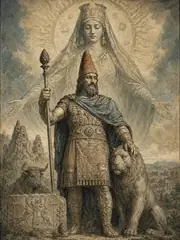
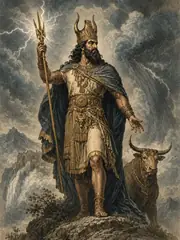
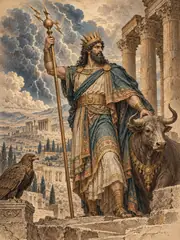
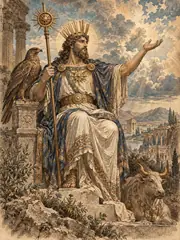
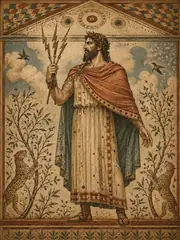
The Lydians, like most Indo-European peoples, had a sky-father — a high god of the upper air whose role in their pantheon corresponded to that of Zeus in Greek tradition or Tarhunt in Hittite. His name, in the partial Lydian inscriptional record, appears in forms which scholars have tentatively reconstructed as Lametrus or Levs.
Of his cult and of his myths, almost nothing of independent Lydian content survives. The Lydians' literary culture was heavily Hellenized by the Persian and Hellenistic periods, and what we know of their religion comes chiefly through Greek sources (Herodotus, Xanthus of Lydia in fragments, the encyclopedists), who simply translated the Lydian high god as Zeus and recorded little of distinctively Lydian content. He stands, accordingly, as a name and a function more than as a developed mythological figure.
When the sources speak
Dated witnesses for Anatolia. A date marks when the evidence was written down, not when the belief began. The whole timeline
- c. 3400–3000 BCE
- Uruk-period writing and monumental temple economies create the earliest recoverable administrative setting for named divine institutions.
- c. 2900–2350 BCE
- Early Dynastic city-states preserve local cults, hymns, royal inscriptions, and god lists; later copies often transmit older compositions.
- c. 2334–2154 BCE
- The Akkadian Empire expands bilingual and imperial patterns of divine identification without erasing local cult titles.
- c. 2112–2004 BCE
- Ur III administration and scribal schooling standardize many Sumerian literary and liturgical forms.
- c. 2000–1600 BCE
- Old Babylonian schools copy major myths, laments, hymns, debates, and heroic narratives in the form most often used by modern editors.
- c. 1650–1200 BCE
- Hittite and Hurrian archives at Hattusa transmit Anatolian myths, imported Syrian materials, and ritual compositions.
- c. 1400–1190 BCE
- The tablets of Ugarit preserve the Baal Cycle, Kirta, Aqhat, ritual lists, and a dense Late Bronze Age West Semitic pantheon.
- c. 1000–612 BCE
- Neo-Assyrian and Neo-Babylonian empires collect, revise, and politically reinterpret older learned traditions.