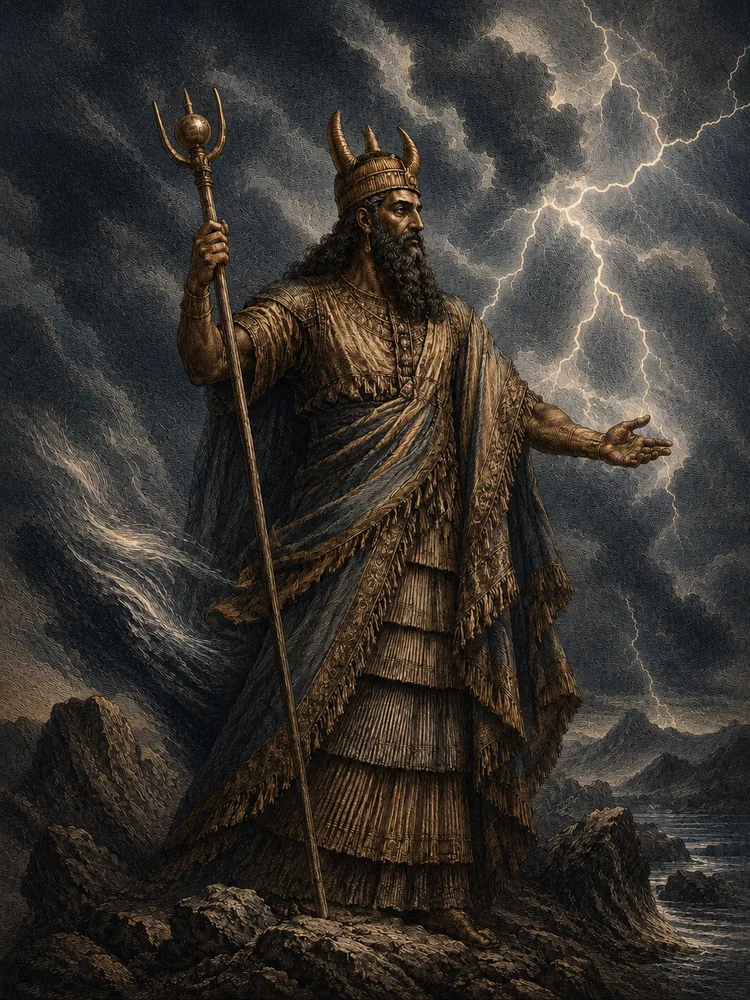
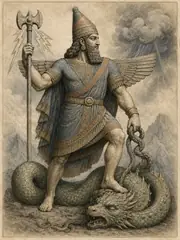
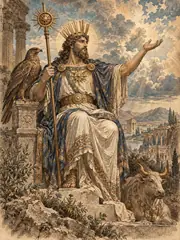
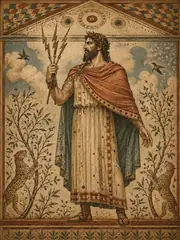
Adad was the storm-god of the Semitic Mesopotamian peoples, who in the west bore the name Hadad, in the south Adad, and at Aleppo Adad of Aleppo. His weapon was the lightning-bolt, his beast the bull, his voice the thunder; he stood upon a bull, and bore in either hand a forked thunderbolt, and so was figured upon countless seals and stelae. He sent the rain when he was pleased; he sent the storm when he was angry; he could withhold the rain altogether, and bring famine. He was a son of Anu in some traditions, of Enlil in others, and consort of Shala the lady of the storm-cloud.
 Before thisMarduk
 Next on the wallIshtar of Nineveh
Curator’s note
What the sources say, and what later tradition added. The sources for this bay
Adad/Hadad is one of the most widely worshipped gods of the ancient Near East, attested under cognate names from Mesopotamia to Anatolia (Hittite Tarhunt) to the Levant (Ugaritic Baal-Hadad) and into the Aramaean kingdoms. The famous Aramaean kingdom of Hadad-ezer ("Hadad has helped") draws its royal names from this god; the Old Testament occasionally refers to him as Rimmon ("the Thunderer") in the cult-name Hadad-rimmon. His iconography — the god atop a bull with thunderbolts in hand — is among the most stable of any ancient Near Eastern figure, persisting essentially unchanged for two thousand years and across multiple linguistic regions.
Kin in the sources
Each tie is quoted from the entry that states it.
 Child ofAnu
He was a son of Anu in some traditions, of Enlil in others
 Child ofEnlil
He was a son of Anu in some traditions, of Enlil in others
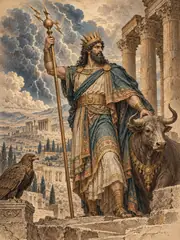 Named as the same god asHadad
who in the west bore the name Hadad, in the south Adad, and at Aleppo Adad of Aleppo
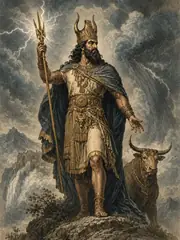 Named as the same god asBaal
His proper name was Hadad, the same Hadad whom the Mesopotamians called Adad
The same god in other rooms
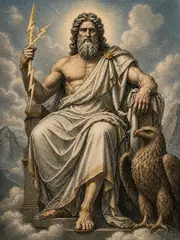
The ancient sources themselves name these as one god under different names. See Adad, Tarhunt, Lametrus, Papas, Baal, Zeus, Hadad, Baalshamin and Tinia hung together


When the sources speak
Dated witnesses for Akkad, Babylon and Assyria. A date marks when the evidence was written down, not when the belief began. The whole timeline
- c. 3400–3000 BCE
- Uruk-period writing and monumental temple economies create the earliest recoverable administrative setting for named divine institutions.
- c. 2900–2350 BCE
- Early Dynastic city-states preserve local cults, hymns, royal inscriptions, and god lists; later copies often transmit older compositions.
- c. 2334–2154 BCE
- The Akkadian Empire expands bilingual and imperial patterns of divine identification without erasing local cult titles.
- c. 2112–2004 BCE
- Ur III administration and scribal schooling standardize many Sumerian literary and liturgical forms.
- c. 2000–1600 BCE
- Old Babylonian schools copy major myths, laments, hymns, debates, and heroic narratives in the form most often used by modern editors.
- c. 1650–1200 BCE
- Hittite and Hurrian archives at Hattusa transmit Anatolian myths, imported Syrian materials, and ritual compositions.
- c. 1400–1190 BCE
- The tablets of Ugarit preserve the Baal Cycle, Kirta, Aqhat, ritual lists, and a dense Late Bronze Age West Semitic pantheon.
- c. 1000–612 BCE
- Neo-Assyrian and Neo-Babylonian empires collect, revise, and politically reinterpret older learned traditions.