A Compendium of the Ancient Gods
Hadad, plate

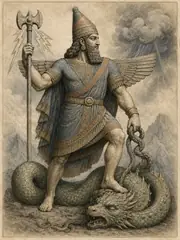
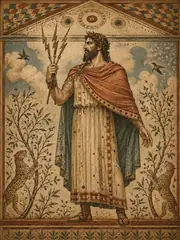
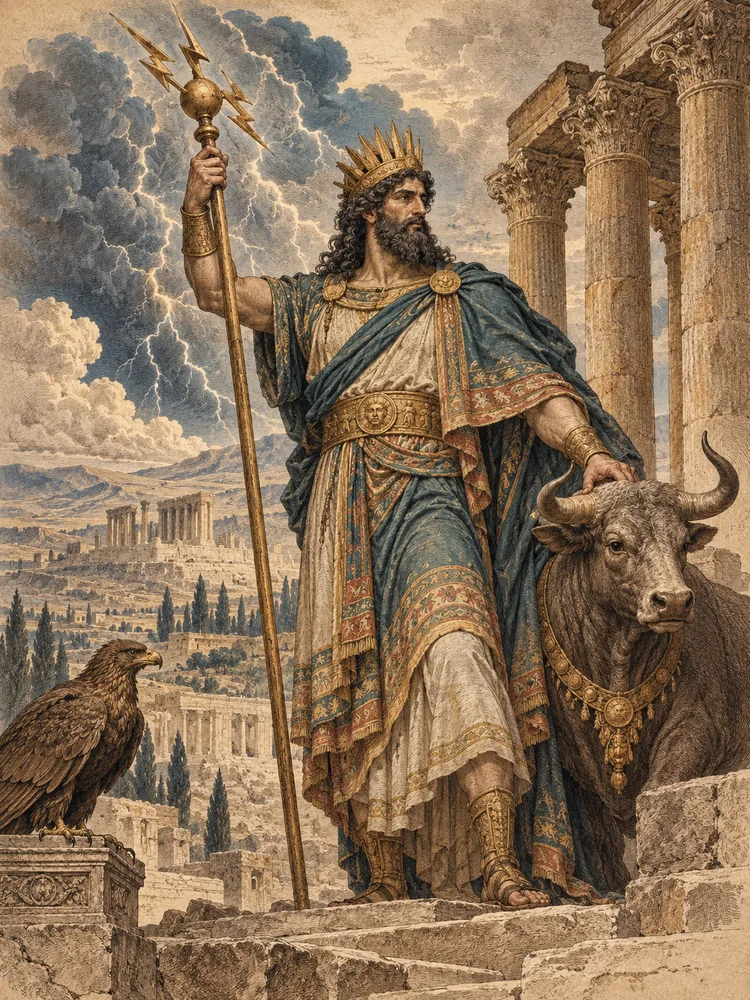
Hadad was the great storm-god of the Aramaeans — the same name as the Mesopotamian Adad, but with a distinct Aramaean cult-history that flourished in the lands of Syria from the late Bronze Age through the Roman imperial period. He was the wielder of thunder, the bringer of rain, the patron of vegetation, the divine king who ruled from his temple-mountain. His name means simply 'the Thunderer,' and he was one of the most widely worshipped of all Levantine deities, with cult-centers from Damascus to Aleppo to Hamath to the great oracle-shrine at Heliopolis (modern Baalbek) in the Beqaa Valley.

His iconography was distinctive: a bearded warrior wearing a tall conical hat (the polos of the eastern gods), holding a thunderbolt or a battle-axe in one hand and the reins of a chariot drawn by bulls in the other; his feet rested upon two bulls, the bull being his sacred animal. The bulls have a long history in Levantine religion — the storm-god of the Hittite-Canaanite world had ridden a bull-chariot for two thousand years before Hadad's Roman-imperial flowering, and the iconography of the god mounted upon his bull was one of the most stable elements of Near Eastern religious art.

His great Roman-period sanctuary at Heliopolis was one of the wonders of the eastern empire. Iuppiter Heliopolitanus — the Roman name for Hadad in this manifestation, with Iuppiter standing in for the Greek Zeus, with whom Hadad had been identified in the Hellenistic period — had his temple built (or rebuilt) under Augustus and his successors, and the gigantic ruins of the precinct can still be seen at Baalbek today: the six surviving columns of his temple are 22 metres high, the largest classical temple-columns ever erected. Around him in the precinct stood the temples of his consort Atargatis (treated below) and the youthful divine son Mercury-Hermes; the three together formed the Heliopolitan triad, a Syrian transposition of the older Canaanite trinity of father-mother-son that had flourished at Ugarit fifteen hundred years earlier.

Hadad's cult was carried throughout the Roman empire by Syrian merchants, soldiers, and slaves; dedications to Iuppiter Heliopolitanus have been found in Italy, in Britain, in Germany, in North Africa. The emperor Heliogabalus (218-222 of our era), who had been the priest of the related sun-god Elagabal of Emesa before becoming emperor, attempted to make the Syrian sun-cult the central religion of the Roman empire — an attempt that failed and that contributed to his assassination — but the episode demonstrates the depth of Syrian religious influence at Rome by the third century of our era. The Hadad-cult survived in attenuated form into the late Roman empire, was suppressed by Theodosius and his successors, and was finally eliminated by the Arab conquest of Syria in 636 of our era; the temple at Baalbek had become a fortress by then, with the Christian basilica that had been built within the precinct itself converted to other uses.

Curator’s note

What the sources say, and what later tradition added. The sources for this bay

Hadad is documented from numerous Aramaic and Greek inscriptions across Syria. The most extensive treatment of the Heliopolitan cult is in Friedrich K. Dörner and others' studies; the standard reference work is Henri Seyrig's Antiquités Syriennes (multiple volumes, 1934-1971), an indispensable collection of articles from the great French scholar of Syrian religious archaeology. The Baalbek complex has been excavated continuously since the early twentieth century; Friedrich Ragette's Baalbek (1980) remains a useful general account. The relation to Mesopotamian Adad is treated in our first volume; the present entry concentrates on the distinctively Aramaean and Roman-period developments. The story of Heliogabalus is preserved in Cassius Dio (Books 79-80), Herodian (Book 5), and the Historia Augusta. The conversion of the Heliopolis temple to a Christian basilica under Constantine is described by Eusebius in his Life of Constantine.

Kin in the sources

Each tie is quoted from the entry that states it.

The same god in other rooms

The ancient sources themselves name these as one god under different names. See Adad, Tarhunt, Lametrus, Papas, Baal, Zeus, Hadad, Baalshamin and Tinia hung together

When the sources speak

Dated witnesses for The Aramaean Gods of Syria. A date marks when the evidence was written down, not when the belief began. The whole timeline

c. 1200–900 BCE
Aramaean polities emerge in Syria within the post–Late Bronze Age political landscape.
9th–8th centuries BCE
Royal inscriptions and regional monuments attest Aramaean dynasties and their divine patrons.
8th–7th centuries BCE
Neo-Assyrian conquest redistributes populations and embeds Syrian cults within imperial networks.
539–332 BCE
Achaemenid rule sustains Aramaic as a major administrative language and connects Levantine and Arabian routes.
332–64 BCE
Hellenistic kingdoms introduce Greek civic and iconographic forms while local cults persist and hybridize.
4th century BCE–106 CE
The Nabataean kingdom develops Petra, Hegra, and a distinctive epigraphic and aniconic cult tradition.
64 BCE onward
Roman incorporation of Syria creates new military, civic, and commercial settings for local gods.
1st–3rd centuries CE
Palmyra’s caravan wealth supports monumental temples and multilingual dedications to Bel, Baalshamin, Yarhibol, Aglibol, and others.

Floor plan

The rooms follow one another in the order their peoples first appear in the written record.

  1. The Cradle of Citiesc. 3400 BCE to 395 CE. 115 works
  2. The Gift of the Nilec. 4000 BCE to 395 CE. 73 works
  3. The Olympian Orderc. 1600 BCE to 750 CE. 152 works
  4. The Persian Worldc. 2000 BCE to 1010 CE. 30 works
  5. The Levantine Borderlandsc. 1200 BCE to 500 CE. 20 works
  6. The Edges of Empirec. 2000 BCE to 1500 CE. 33 works
  7. The Etruscan Worldc. 900 BCE to 750 CE. 22 works
  8. The Roman Inheritancec. 1200 BCE to 500 CE. 58 works
  9. The Northern Inheritancec. 2000 BCE to 1600 CE. 131 works