A Compendium of the Ancient Gods
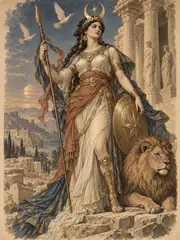
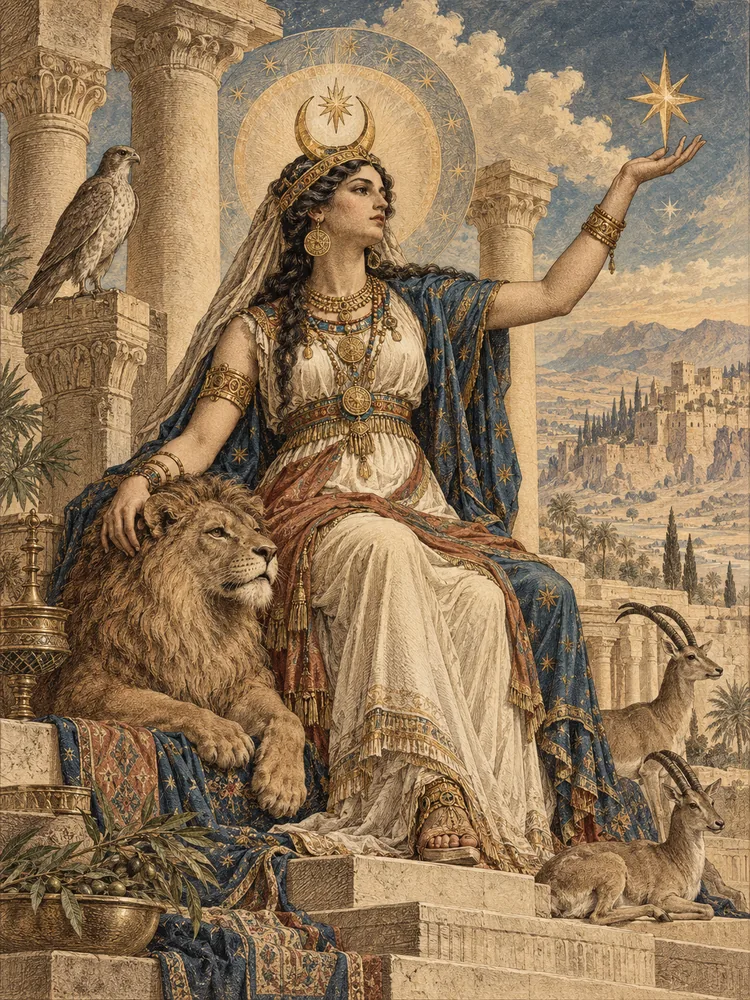
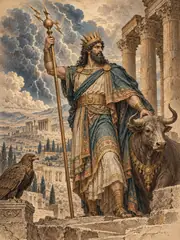
Allat (the Aramaean goddess), plate

Allat — al-Lat in the Arabic form — was a great goddess worshipped from northern Arabia through Syria into the late Roman period. Her name is the feminine form of Allah, the Arabic word for God, and means simply 'the Goddess' (al + ilat); the cult was widespread among the Arabian and northern-Arabian peoples and was carried into Syria by the trading and migrating populations. Her character varied somewhat among the regions where she was worshipped: among the Nabataeans she was a mother-goddess; among the Palmyrenes she was identified with Athena and was a warrior-goddess of the city; among the more general Aramaean and Syrian populations she was a sky-goddess and a fertility-figure.

She was sometimes paired with Baalshamin as the divine consort of the sky-lord, sometimes with Hadad in the storm-god's domain, sometimes she stood alone as a great independent deity; the variability reflects both the long history of her cult and the complexity of religious networks in the region. The cult was already old at the time of Herodotus, who in the fifth century before our era named her (under the form Alilat) as one of the great goddesses of the Arabs.

We treat the major Nabataean and Palmyrene developments under separate entries in the books that follow. Here it is sufficient to note that the figure was a unifying religious presence across the Levantine borderlands, recognized in similar form by Aramaeans, Nabataeans, Palmyrenes, and the Arabs of the deserts and the northern Hijaz. After the rise of Islam, her cult was extinguished, but her name was preserved in the Qur'an (Sura 53:19-23) as one of the three goddesses (with Al-Uzza and Manat) whose worship had to be renounced — and this passage, the so-called Satanic Verses controversy, has remained a touchstone in Islamic theology to this day.

Curator’s note

What the sources say, and what later tradition added. The sources for this bay

Allat is documented across many traditions; the present entry treats only the general Aramaean-Syrian aspect. Herodotus's reference (1.131, 3.8) is among the earliest. The Aramaean inscriptions are scattered across Syria; Henri Seyrig's articles treat various manifestations. The fuller treatment of the Nabataean Al-Lat is in Book II below; the Palmyrene Allat is in Book III. The Qur'anic passage and the Islamic tradition about the goddesses are treated in the entry on Manat in Book II.

Kin in the sources

Each tie is quoted from the entry that states it.

The same god in other rooms

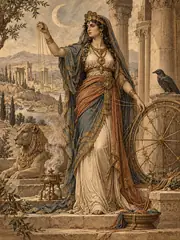
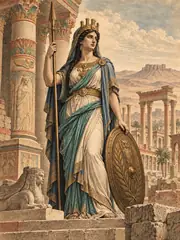
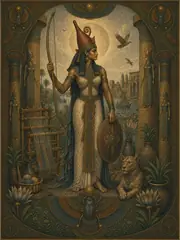
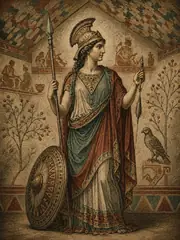
The ancient sources themselves name these as one god under different names. See Neith, Athena, Allat (the Aramaean goddess), Allat (Palmyrene) and Menrva hung together

When the sources speak

Dated witnesses for The Aramaean Gods of Syria. A date marks when the evidence was written down, not when the belief began. The whole timeline

c. 1200–900 BCE
Aramaean polities emerge in Syria within the post–Late Bronze Age political landscape.
9th–8th centuries BCE
Royal inscriptions and regional monuments attest Aramaean dynasties and their divine patrons.
8th–7th centuries BCE
Neo-Assyrian conquest redistributes populations and embeds Syrian cults within imperial networks.
539–332 BCE
Achaemenid rule sustains Aramaic as a major administrative language and connects Levantine and Arabian routes.
332–64 BCE
Hellenistic kingdoms introduce Greek civic and iconographic forms while local cults persist and hybridize.
4th century BCE–106 CE
The Nabataean kingdom develops Petra, Hegra, and a distinctive epigraphic and aniconic cult tradition.
64 BCE onward
Roman incorporation of Syria creates new military, civic, and commercial settings for local gods.
1st–3rd centuries CE
Palmyra’s caravan wealth supports monumental temples and multilingual dedications to Bel, Baalshamin, Yarhibol, Aglibol, and others.

Floor plan

The rooms follow one another in the order their peoples first appear in the written record.

  1. The Cradle of Citiesc. 3400 BCE to 395 CE. 115 works
  2. The Gift of the Nilec. 4000 BCE to 395 CE. 73 works
  3. The Olympian Orderc. 1600 BCE to 750 CE. 152 works
  4. The Persian Worldc. 2000 BCE to 1010 CE. 30 works
  5. The Levantine Borderlandsc. 1200 BCE to 500 CE. 20 works
  6. The Edges of Empirec. 2000 BCE to 1500 CE. 33 works
  7. The Etruscan Worldc. 900 BCE to 750 CE. 22 works
  8. The Roman Inheritancec. 1200 BCE to 500 CE. 58 works
  9. The Northern Inheritancec. 2000 BCE to 1600 CE. 131 works