Manat — 'Fate' or 'Lot' or 'Destiny' — was the goddess of fate among the Nabataeans and the pre-Islamic Arabs, the third of the three great Arabian goddesses (with al-Lat and al-Uzza) named in the Qur'an's Sura 53. She was the divine personification of allotment — the lot that fell to a man at birth, the fortune that came to him in life, the death that ended his career. Her name is cognate with the Hebrew menath (portion, lot) and with various Aramaic and Arabic words for fate; the figure was a Semitic counterpart of the Greek Moira and the Roman Parca, with a similar function as a goddess of the inevitable.
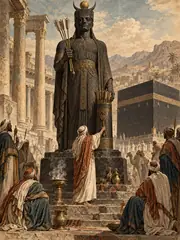
Her chief sanctuary was at Qudayd, between Mecca and Medina, where her cult-stone (a black rock similar in form to the Black Stone of the Ka'ba) was the focus of a major regional pilgrimage. The pre-Islamic Arabs held her in particular veneration: the Quraysh of Mecca, the Aws and Khazraj of Medina, and the Hudhayl of the western Hijaz all maintained cults of Manat, and the rite of the pilgrimage to her sanctuary at Qudayd was an important element in the pre-Islamic religious calendar of western Arabia.
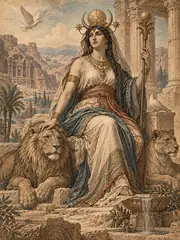
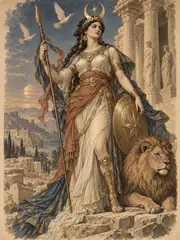
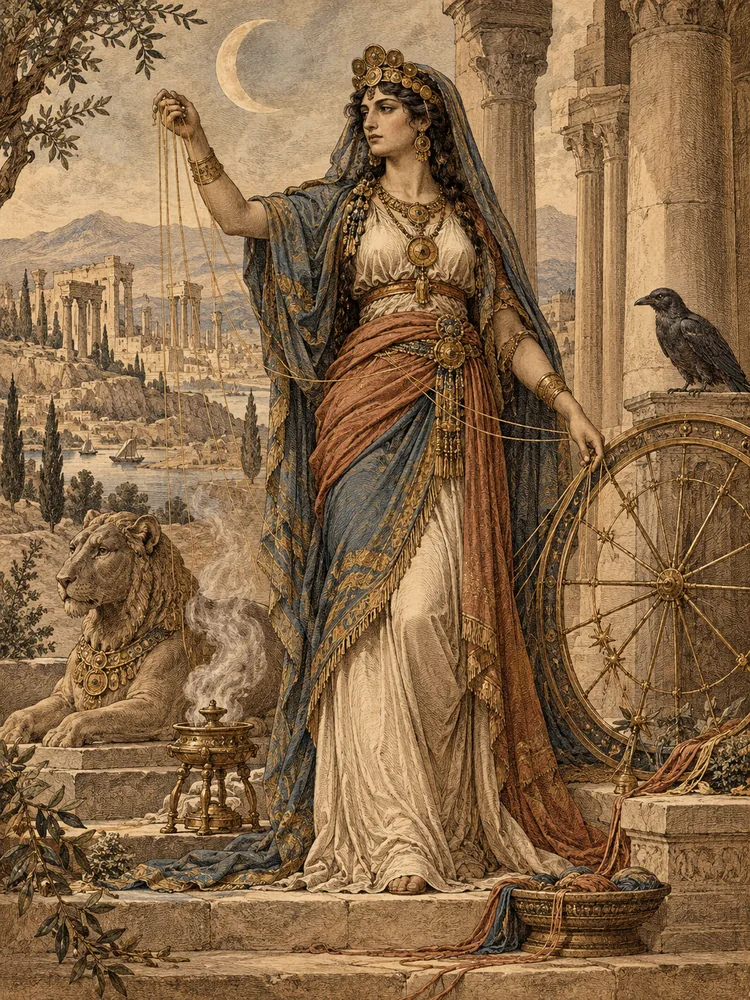
The Nabataean Manat appears in inscriptions from Hegra and elsewhere; she was depicted as a stately goddess, sometimes with a winged victory beside her, sometimes with a wheel of fortune, sometimes simply as an aniconic stone. Her cult was less developed than al-Lat's or al-Uzza's in the Nabataean kingdom, but expanded southward into the Hijaz where she became one of the chief deities of the pre-Islamic Arabs.
The destruction of Manat's cult was carried out by Sa'd ibn Zayd al-Ashhali in 630 of our era, on Muhammad's orders. The sanctuary at Qudayd was destroyed, the cult-image broken, and the priesthood scattered. The rite of pilgrimage to Qudayd, which had previously been an essential part of the pre-Islamic hajj cycle, was abolished and was eventually replaced by the Islamic restructuring of the Meccan pilgrimage. The Qur'anic passage at Sura 53:19-23 — 'Have you considered al-Lat and al-Uzza, and Manat, the third, the other? Are males yours and females his?' — is one of the foundational texts of Islamic monotheism, and the destruction of the three goddesses' cults was understood by Muhammad's followers as the central religious act of the new community.