A Compendium of the Ancient Gods
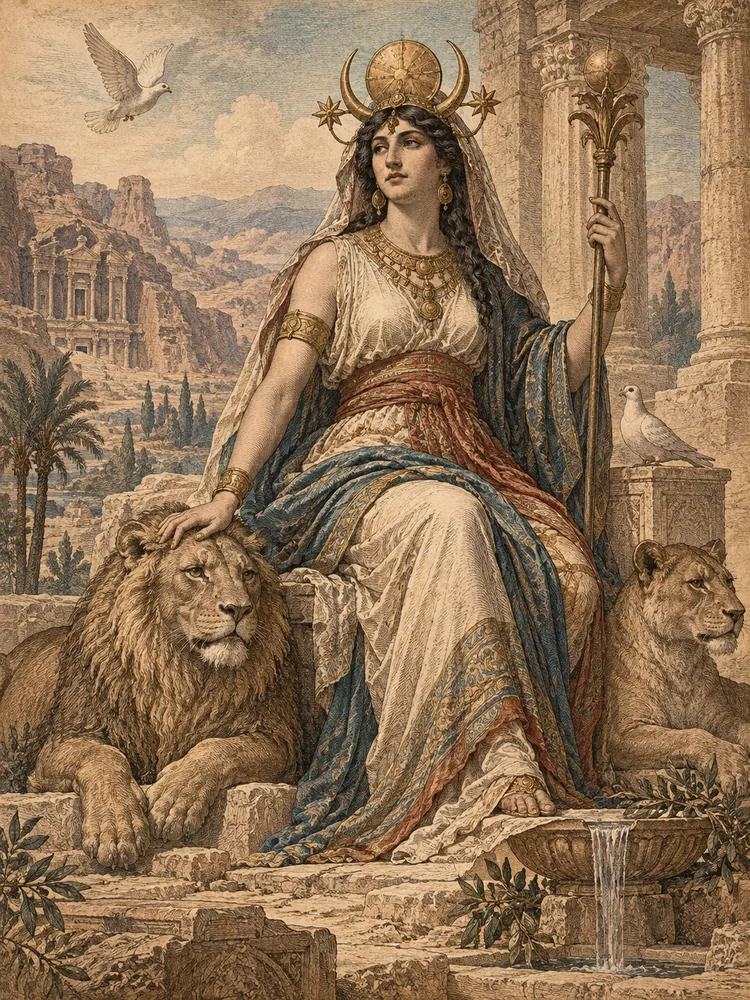
Al-Lat, plate

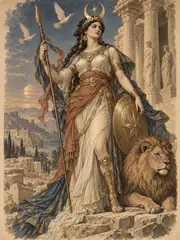
Al-Lat — 'the Goddess,' from al + ilat, the feminine of 'the God' — was the great mother-goddess of the Nabataeans, the divine consort or counterpart of Dushara. Her name is the same word as Allat (the more general Aramaean form, treated in Book I), but the Nabataean cult had its own distinct character and its own particular sites of worship. She was depicted on coins as a stately matron, sometimes seated on a throne, sometimes standing with attendants; her cult-image at Petra was probably aniconic in the Nabataean style, but Hellenistic-influenced sites (such as Hegra in northern Arabia) preserved Greco-Roman figural images of her.

Al-Lat was a fertility-goddess in some of her aspects, a war-goddess in others, a sky-goddess and queen-of-heaven in still others. She was identified by the Greek writers with Athena and with Aphrodite — Herodotus (1.131) had identified her with Aphrodite Urania ('Heavenly Aphrodite'), describing her as one of the great goddesses of the Arabs — and the breadth of her functions made multiple Greek identifications plausible. Her sanctuary at Hegra (Mada'in Salih, in northwest Saudi Arabia) was one of the major Nabataean religious sites, and the relief sculptures that survive there give us our clearest iconographic record of Nabataean al-Lat.

After the absorption of the Nabataean kingdom into the Roman empire, al-Lat's cult continued in much of the former Nabataean territory and spread further into the Hijaz and central Arabia. By the time of the prophet Muhammad in the early seventh century of our era, al-Lat was one of the most widely worshipped goddesses of pre-Islamic Arabia, with a major sanctuary at Ta'if (about ninety kilometers southeast of Mecca) where she was worshipped in the form of a great cubical stone. The Qur'an (Sura 53:19-23) names her as one of the three goddesses (with al-Uzza and Manat) whose worship Muhammad denounced; the same passage is the locus of the so-called Satanic Verses controversy, in which (according to some early Islamic sources) Muhammad initially recognized the three goddesses as legitimate intercessors before retracting the verses as having been suggested by Satan.

Al-Lat's cult was extinguished by Muhammad's followers in the years 630-632 of our era; the great cube-stone at Ta'if was destroyed by Mughira ibn Shu'ba on Muhammad's orders, and the institution of her priesthood was abolished. The figure thus has the distinction of being one of the very last great Semitic mother-goddesses to be actively worshipped — her cult ran from the late Bronze Age through the rise of Islam, a span of perhaps two thousand years — and the destruction of her sanctuaries was one of the foundational acts of the new religion.
Curator’s note

What the sources say, and what later tradition added. The sources for this bay

Al-Lat is documented in Nabataean inscriptions, in the Greek and Latin sources (Herodotus 1.131, 3.8; Strabo 16.4.26; the Suda), and in the early Islamic sources (the Kitab al-Asnam of Hisham ibn al-Kalbi, c. 819 of our era). The destruction of her cult is described in the early Islamic biographies of Muhammad (Ibn Ishaq, the Sira, in the recension of Ibn Hisham). The standard treatments are Hisham al-Kalbi's Book of Idols (translated by Nabih Amin Faris, 1952), F. V. Winnett and W. L. Reed's Ancient Records from North Arabia (1970), and John Healey's The Religion of the Nabataeans (2001). The Satanic Verses passage is the subject of much Islamic scholarship; Shahab Ahmed's Before Orthodoxy: The Satanic Verses in Early Islam (2017) is the most thorough recent treatment.

Kin in the sources

Each tie is quoted from the entry that states it.

When the sources speak

Dated witnesses for The Nabataean Pantheon of Petra and the Hijaz. A date marks when the evidence was written down, not when the belief began. The whole timeline

c. 1200–900 BCE
Aramaean polities emerge in Syria within the post–Late Bronze Age political landscape.
9th–8th centuries BCE
Royal inscriptions and regional monuments attest Aramaean dynasties and their divine patrons.
8th–7th centuries BCE
Neo-Assyrian conquest redistributes populations and embeds Syrian cults within imperial networks.
539–332 BCE
Achaemenid rule sustains Aramaic as a major administrative language and connects Levantine and Arabian routes.
332–64 BCE
Hellenistic kingdoms introduce Greek civic and iconographic forms while local cults persist and hybridize.
4th century BCE–106 CE
The Nabataean kingdom develops Petra, Hegra, and a distinctive epigraphic and aniconic cult tradition.
64 BCE onward
Roman incorporation of Syria creates new military, civic, and commercial settings for local gods.
1st–3rd centuries CE
Palmyra’s caravan wealth supports monumental temples and multilingual dedications to Bel, Baalshamin, Yarhibol, Aglibol, and others.

Floor plan

The rooms follow one another in the order their peoples first appear in the written record.

  1. The Cradle of Citiesc. 3400 BCE to 395 CE. 115 works
  2. The Gift of the Nilec. 4000 BCE to 395 CE. 73 works
  3. The Olympian Orderc. 1600 BCE to 750 CE. 152 works
  4. The Persian Worldc. 2000 BCE to 1010 CE. 30 works
  5. The Levantine Borderlandsc. 1200 BCE to 500 CE. 20 works
  6. The Edges of Empirec. 2000 BCE to 1500 CE. 33 works
  7. The Etruscan Worldc. 900 BCE to 750 CE. 22 works
  8. The Roman Inheritancec. 1200 BCE to 500 CE. 58 works
  9. The Northern Inheritancec. 2000 BCE to 1600 CE. 131 works