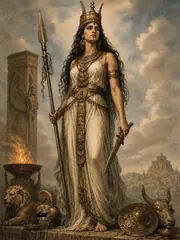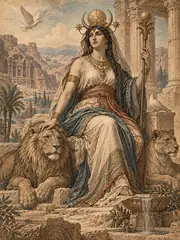
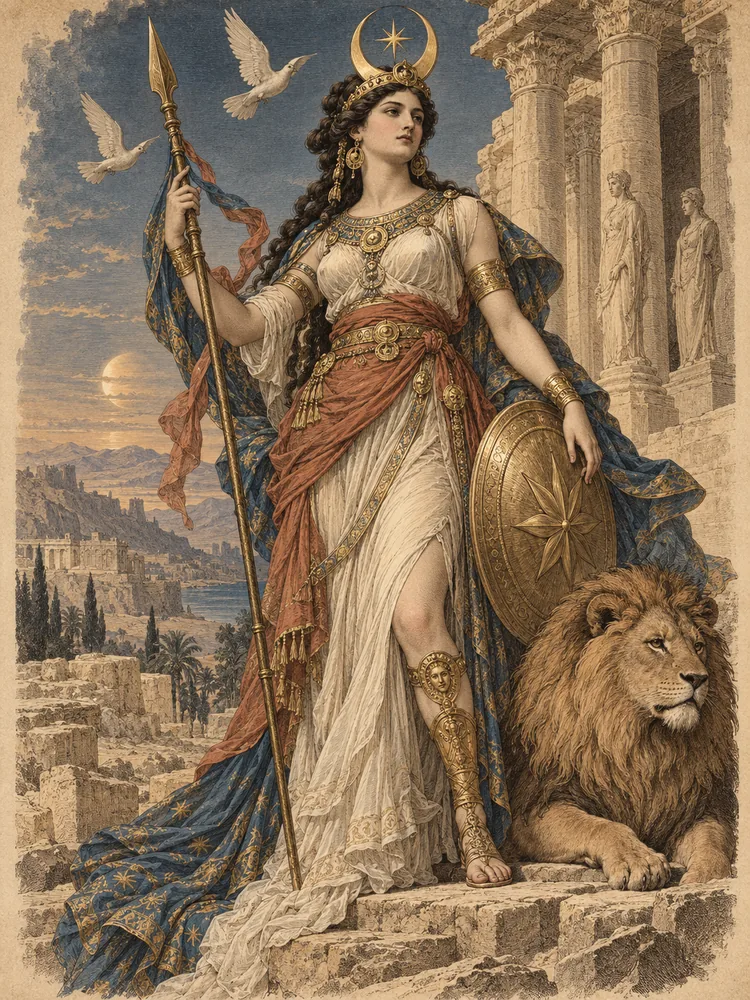
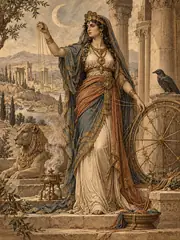
Al-Uzza — 'the Mighty One' — was a warrior-goddess of the Nabataean and pre-Islamic Arabian pantheon, the second of the three great Arabian goddesses (with al-Lat and Manat) named in the Qur'an's Sura 53. She was a maiden-goddess, identified with the planet Venus in its morning-star aspect (where al-Lat may have been Venus the evening-star, though the matter is debated), and her cult was particularly developed among the warrior-aristocracy of the northern Arabian tribes.
Her great sanctuary among the Quraysh of Mecca was at Nakhla, in a wadi about three days' journey east of Mecca, where her cult-tree (a great acacia, or perhaps a cluster of three sacred trees) stood. The sanctuary was one of the chief religious sites of the pre-Islamic Hijaz, and Muhammad himself, before his prophetic career, is recorded in some early Islamic sources to have made offerings there in his youth (a detail which the later Islamic tradition variously preserves or suppresses, depending on the theological tendency of the source). After the proclamation of Islam, al-Uzza's sanctuary at Nakhla was destroyed by Khalid ibn al-Walid in 630 of our era, on Muhammad's orders; the sacred trees were cut down and the cult-image (a sword-wielding figure of the goddess, or perhaps a black stone) was demolished.
The Nabataean al-Uzza was probably the same figure as the Hijazi al-Uzza, with cult continuity from the Petra-Hegra region southward into the Arabian peninsula. Her iconography in the Hellenized Nabataean inscriptions sometimes resembled the Greek Athena (with whom she was occasionally identified) and sometimes the Greek Aphrodite (in her warrior aspect, Aphrodite Areia). The Sword and the planet Venus and the warrior-maiden iconography all point to a figure with deep continuities across the Semitic world — connections to the Babylonian Ishtar (also Venus, also warrior-maiden) and to the Canaanite Anat are clear.
Al-Uzza's significance in pre-Islamic Mecca is hard to overstate. She was one of the chief deities of the Quraysh, the tribe of Muhammad himself; her sanctuary at Nakhla was a major pilgrimage site; her image stood in the Ka'ba alongside the other deities of the Arabian pantheon. The Qur'anic denunciation of her worship was thus a denunciation of the religious practice of Muhammad's own tribe and city, and the destruction of her cult was an act of Muslim self-purification as much as of conquest of foreign religion. The figure stands as one of the great pre-Islamic Arab deities, and her career — from Nabataean warrior-maiden to Meccan goddess to extinguished pagan idol — is a compressed history of the religious transformation of Arabia between the second century before our era and the seventh century of our era.