A Compendium of the Ancient Gods
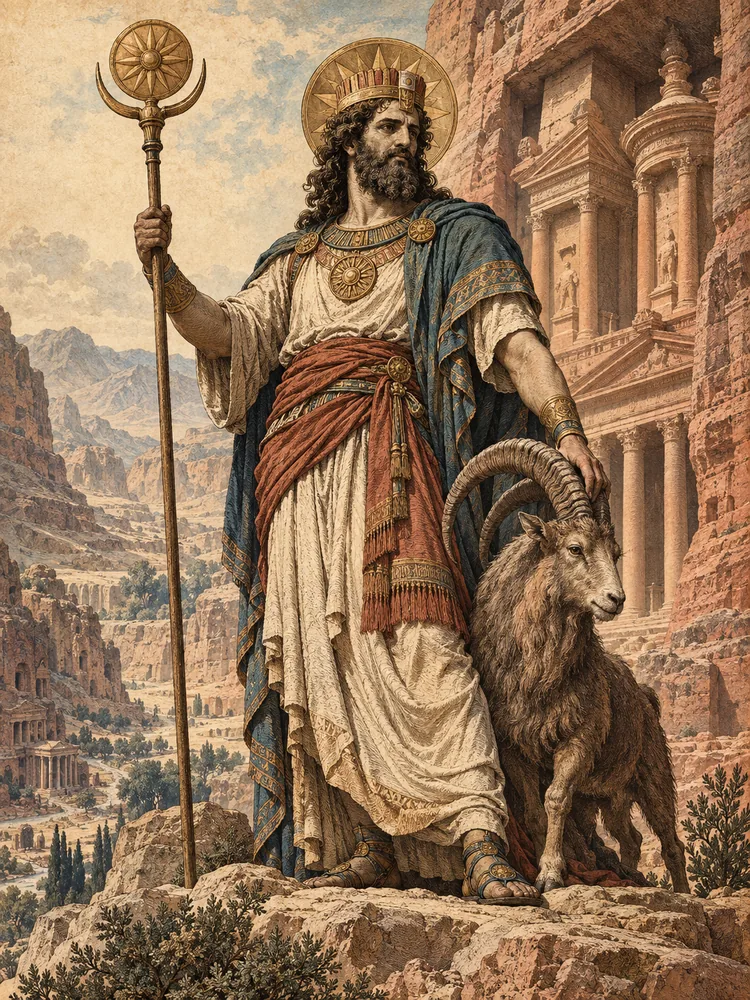
Dushara, plate

Dushara — Dhu-Shara, 'He of the Shara' (Shara being the name of the mountain ridge above Petra) — was the chief god of the Nabataeans, the divine patron of the royal house, and the lord of the great rock-cut sanctuary at Petra. He was a mountain-god in his original character, the divine occupant of the high red sandstone cliffs that surrounded the Nabataean capital, and his cult-image was traditionally aniconic — a black stone, square or pillar-shaped, set up at the high places. The Nabataean tradition was deeply suspicious of figural representation of deity, and Dushara's cult-stones (called baetyls, from a Semitic word meaning 'house of god') were the principal objects of his worship throughout the kingdom.

His great sanctuary at Petra — the city carved from the living rock, with its famous facade of the Khasneh ('Treasury') and the great stepped platform of the Qasr al-Bint (where the cult-image of Dushara probably stood) — flourished from the late third century before our era through the second century of our era. The royal tombs cut into the cliffs at Petra were under his protection; the king's coronation, his great state ceremonies, and his death and burial all involved Dushara's priesthood and his rites. The Nabataean kings styled themselves 'beloved of Dushara' on their inscriptions, and the god was the divine warrant of their authority.

In the Hellenistic and Roman periods, Dushara was identified with Dionysus by Greek writers (because the mountain-and-vine associations of the Greek god seemed to fit) and with Zeus and with the sun-god (because the mountain-throne and the supreme-god functions were felt) — but the identifications were imperfect. Dushara had no clear narrative myth in the Greek style; he was the lord of the mountain, the guarantor of the royal house, and the receiver of sacrifices and dedications. His cult was substantially aniconic, ritual rather than narrative, and bound closely to the Nabataean political and territorial identity.

After the Roman annexation of the Nabataean kingdom in 106 of our era, Dushara's cult continued under imperial protection for several centuries — Petra remained an important religious center into the third century — but the gradual Christianization of Arabia and the eventual Arab Islamic conquest of the seventh century extinguished the cult. The aniconic cult-stones of Dushara, however, fed into a deep current of Arabian religious sensibility that Islam would inherit; the Black Stone of the Ka'ba at Mecca, which Muslims kiss during the hajj, is in some sense a continuation of the baetyl-tradition of pre-Islamic Arabia, with Dushara's stones in the Petra-Mecca line being among the most prominent ancestors.

Curator’s note

What the sources say, and what later tradition added. The sources for this bay

Dushara is documented in numerous Nabataean Aramaic inscriptions from Petra, Hegra (Mada'in Salih), and other sites; the standard reference is Jean Starcky's articles in the Revue Biblique and elsewhere, and more recently John Healey's The Religion of the Nabataeans (2001). The aniconic tradition and the baetyl-cult is treated in Frank Moore Cross's Canaanite Myth and Hebrew Epic (1973) and in Tryggve Mettinger's No Graven Image? (1995). The Petra excavations have been extensive and ongoing; the Qasr al-Bint as the chief temple of Dushara has been studied by François Larché and others. The Greek-Hellenistic identifications with Dionysus, Zeus, and Helios are documented in Strabo (16.4.26), Hesychius, and the Suda.

Kin in the sources

Each tie is quoted from the entry that states it.

When the sources speak

Dated witnesses for The Nabataean Pantheon of Petra and the Hijaz. A date marks when the evidence was written down, not when the belief began. The whole timeline

c. 1200–900 BCE
Aramaean polities emerge in Syria within the post–Late Bronze Age political landscape.
9th–8th centuries BCE
Royal inscriptions and regional monuments attest Aramaean dynasties and their divine patrons.
8th–7th centuries BCE
Neo-Assyrian conquest redistributes populations and embeds Syrian cults within imperial networks.
539–332 BCE
Achaemenid rule sustains Aramaic as a major administrative language and connects Levantine and Arabian routes.
332–64 BCE
Hellenistic kingdoms introduce Greek civic and iconographic forms while local cults persist and hybridize.
4th century BCE–106 CE
The Nabataean kingdom develops Petra, Hegra, and a distinctive epigraphic and aniconic cult tradition.
64 BCE onward
Roman incorporation of Syria creates new military, civic, and commercial settings for local gods.
1st–3rd centuries CE
Palmyra’s caravan wealth supports monumental temples and multilingual dedications to Bel, Baalshamin, Yarhibol, Aglibol, and others.

Floor plan

The rooms follow one another in the order their peoples first appear in the written record.

  1. The Cradle of Citiesc. 3400 BCE to 395 CE. 115 works
  2. The Gift of the Nilec. 4000 BCE to 395 CE. 73 works
  3. The Olympian Orderc. 1600 BCE to 750 CE. 152 works
  4. The Persian Worldc. 2000 BCE to 1010 CE. 30 works
  5. The Levantine Borderlandsc. 1200 BCE to 500 CE. 20 works
  6. The Edges of Empirec. 2000 BCE to 1500 CE. 33 works
  7. The Etruscan Worldc. 900 BCE to 750 CE. 22 works
  8. The Roman Inheritancec. 1200 BCE to 500 CE. 58 works
  9. The Northern Inheritancec. 2000 BCE to 1600 CE. 131 works