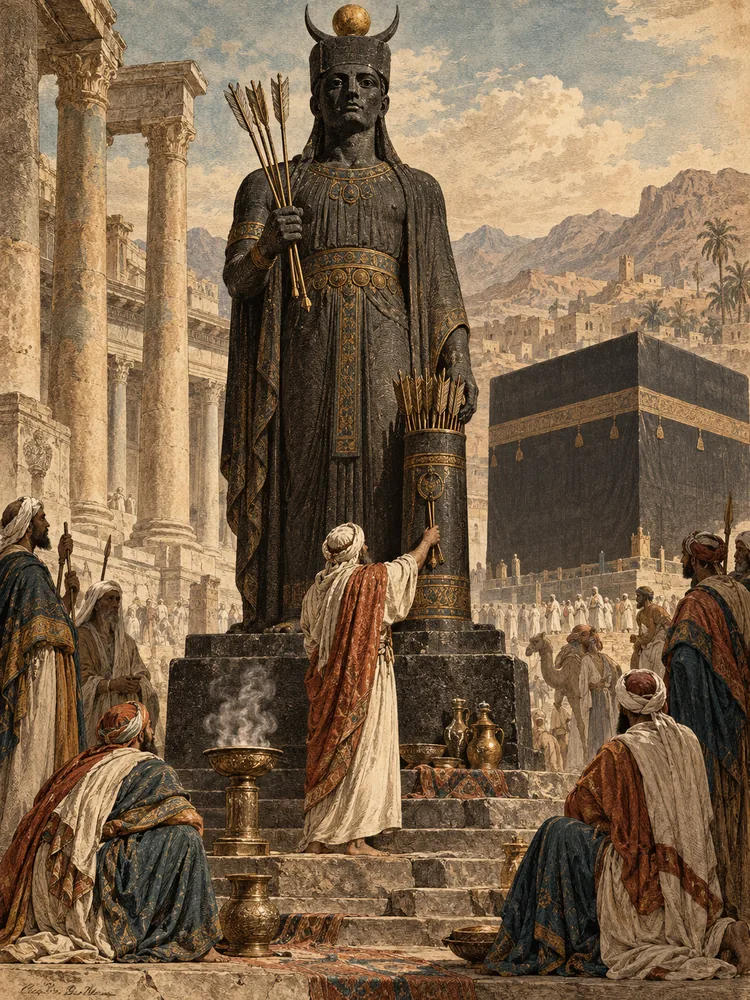
Hubal was an oracular god of pre-Islamic Mecca, whose great cult-image stood inside the Ka'ba and was the chief object of the public Quraysh religion in the generations before Muhammad. He was depicted as a man of red carnelian or red sandstone, carved in human form (one of the few figural cult-images among the Arabian pantheon), with one arm broken off and replaced with a golden one — the original arm having been broken in some long-past incident that the Meccans no longer remembered.
Hubal's chief function was oracular. Beside his image stood seven divining-arrows (sometimes described as kalam — pens — but functionally arrows), each marked with a particular question or category of question; a worshipper seeking guidance would draw one of the arrows, and the answer would be determined by which arrow was drawn. The system covered a range of decisions — whether to undertake a journey, whether to marry, whether to settle a dispute by negotiation or by violence — and was administered by a hereditary priesthood of the Quraysh.
Whether Hubal was a Nabataean or Arabian native deity, or a foreign import, is debated in the early Islamic sources. The Kitab al-Asnam of Hisham ibn al-Kalbi reports a tradition that Hubal was brought to Mecca from Syria by 'Amr ibn Luhayy, a great pre-Islamic chief who is reported to have been the founder of the Meccan idol-cult; if this tradition is historical, Hubal would have been a Nabataean or Aramaean import, perhaps a form of Baal Shamin or some related Levantine high-god. Other sources treat him as a native Arabian deity. Modern scholarship has been divided.
Hubal's image in the Ka'ba was destroyed by Muhammad in 630 of our era, when he conquered Mecca. The famous moment is described in the Sira: Muhammad entered the Ka'ba, struck each idol in turn with his staff, and recited 'The truth has come, and falsehood has vanished; verily falsehood is bound to vanish' (Qur'an 17:81). Hubal, as the chief idol, was the first or among the first destroyed. The site of his image was thereby cleansed and became the focal point of the Islamic Ka'ba; no trace of Hubal's cult survives in living religious practice, though his name is preserved in the Islamic chronicles as the chief god of pre-Islamic Mecca.