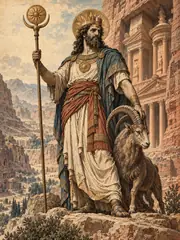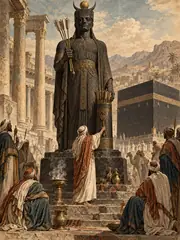
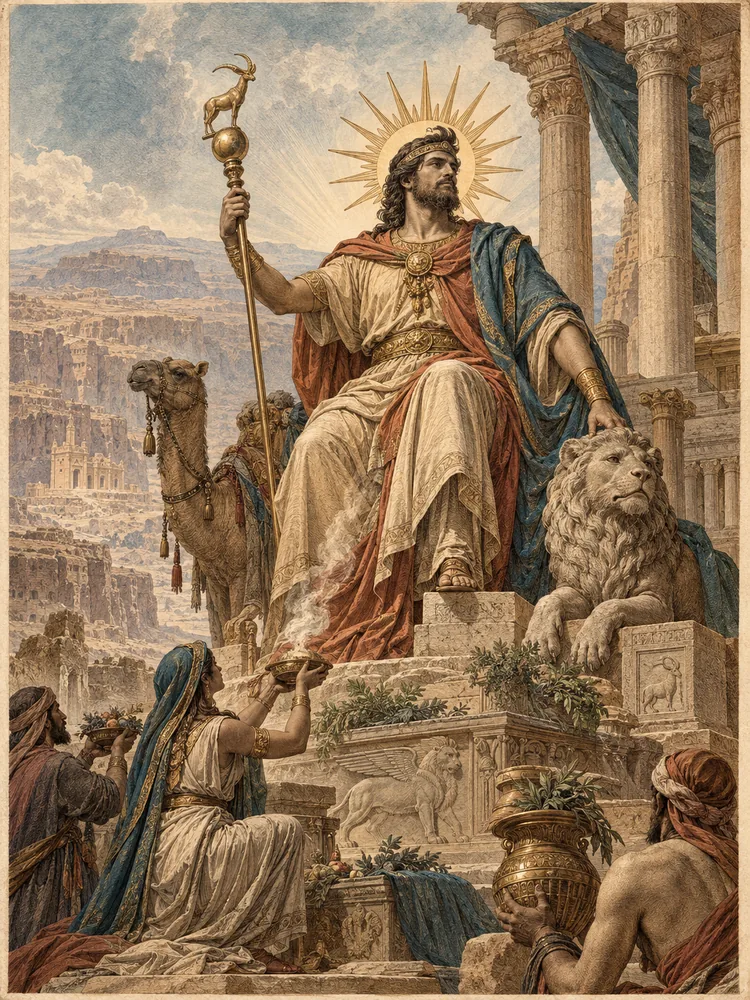

Obodas was the name of three successive kings of the Nabataean dynasty (Obodas I, c. 96-85 BCE; Obodas II, c. 62-60 BCE; Obodas III, c. 30-9 BCE), and was also the name of a deified ancestor whom the Nabataean royal house worshipped as their divine forebear. The historical kings and the deified king-ancestor cannot always be cleanly distinguished; the cult evolved through generations of reinforcement, with each historical Obodas accumulating divine attributes that further enhanced the cult of the original ancestor.
The chief sanctuary of the deified Obodas was at Avdat (Greek Oboda) in the Negev — a Nabataean caravan-stop in the northern reaches of the kingdom, on the route from Petra to Gaza, where a great temple complex was developed in the first century before our era. The kings of the Nabataean royal house made pilgrimages to Avdat to honor their divine ancestor, and the inscriptions of the temple invoke 'Dusares-Obodatos' (Dushara-Obodas) as a fused royal-and-mountain god, the chief deity of the Nabataean state.
The cult of the deified Nabataean king was not unique in the ancient Near East — the Hellenistic ruler-cults, particularly those of the Seleucid and Ptolemaic dynasties, provided the model — but the Nabataean form had distinctive features. The king was deified during his lifetime in some accounts, and was venerated as a tutelary deity of the realm even before his physical death; the 'epimanias Obodas' inscriptions (which name the king as 'manifest god') indicate an active living-king cult similar to the Ptolemaic. After death, the king's cult intensified, and his association with Dushara made him a kind of mediating figure between the high god of the mountain and the human community of the kingdom.
The cult of Obodas continued under Roman rule for a generation or two after the annexation of 106 of our era, but gradually faded as the Nabataean royal identity was absorbed into the Roman imperial system. The sanctuary at Avdat survived into the Byzantine period, when it was converted to a Christian basilica; the cult of Obodas was extinguished by the late fourth century. The figure stands as a witness to the religious-political theology of the Nabataean kingdom — a state in which kingship and divine power were closely intertwined, and in which the royal house provided one of the central foci of religious devotion.