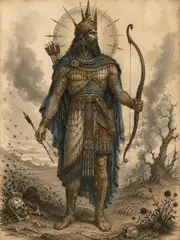
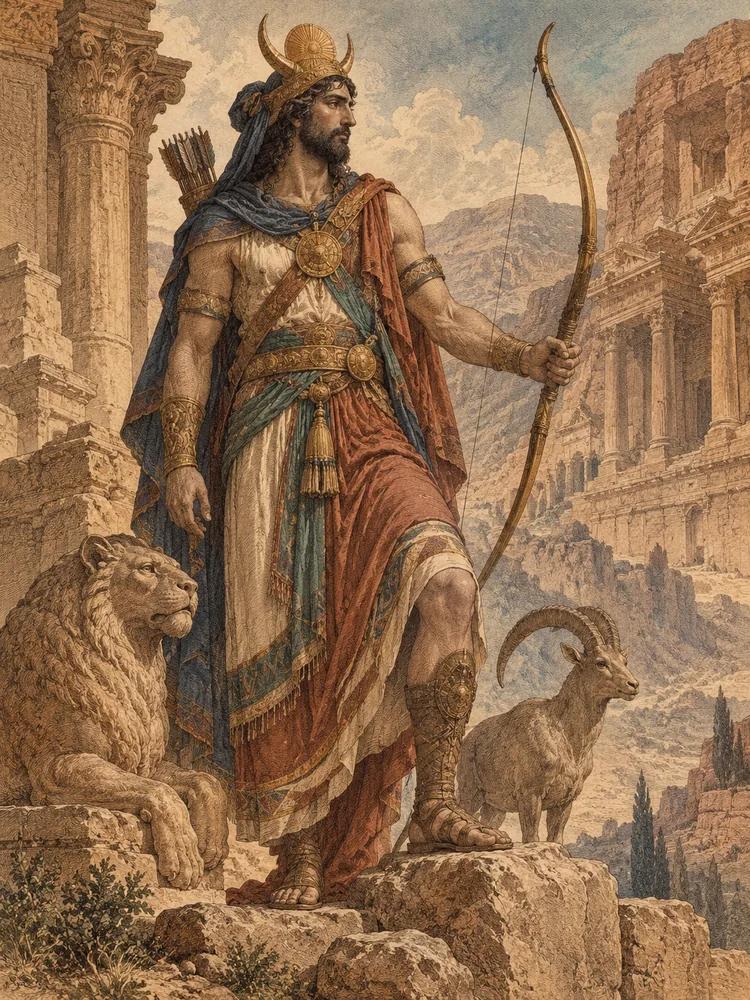
Qaus — 'the Bow' (qōs in older Edomite, qaus in later Nabataean Arabic) — was the national god of the Edomites, the people of southern Transjordan whose kingdom flourished from the late Bronze Age through the Persian period and who were the immediate predecessors of the Nabataeans in the lands east and south of the Dead Sea. His name was originally an epithet — 'the bow-bearer' or 'the bow-god' — and the iconography of the divine bow-bearer was widespread in the southern Levant, with parallels in the Canaanite Resheph and other warrior-archer deities.
Edomite personal names from the seventh and sixth centuries before our era are heavily Qaus-theophoric: Qaus-malak ('Qaus is king'), Qaus-anal ('Qaus answered'), Qaus-gabar ('Qaus is mighty'), and many others appear on seals, ostraca, and bullae from Edomite sites. The kings of Edom, when their names are preserved, often bore Qaus-names; the god was thus the warrant of Edomite kingship, the patron of the warrior-aristocracy, and the chief deity of the Edomite state.
After the Nabataean takeover of Edomite lands in the late Persian or early Hellenistic period, Qaus's cult was preserved and absorbed into the Nabataean religious system. He continued as a regional deity in the southern Nabataean territory, particularly in the lands south and east of the Dead Sea where the Edomite population had not been displaced. Nabataean inscriptions from Bostra and elsewhere record dedications to Qaus alongside dedications to Dushara, indicating that the Edomite god retained an independent cult position even within the Nabataean state religion.
The Hebrew Bible references Edomite religion and Qaus implicitly — the Edomite kings named in Genesis 36 (Bela, Jobab, Husham, Hadad, and others) bear names some of which may be Qaus-theophoric, though the Masoretic vocalization sometimes obscures the connection. The relations between Israelite and Edomite religion were close (the two peoples were held by their own traditions to be descended from the brothers Jacob and Esau), and the Israelite prohibition of certain practices may reflect awareness of and rejection of Edomite-Qausite worship. After the Roman annexation of the Nabataean kingdom and the Christianization of the southern Levant, Qaus's cult was extinguished; nothing of the figure survives in living religious practice, but his name is preserved on hundreds of ostraca and seals from the Edomite period and into the Nabataean record, and from these we can reconstruct the cult of one of the most thoroughly documented yet least-known national gods of the ancient Near East.