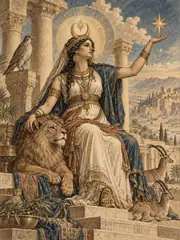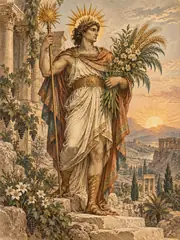
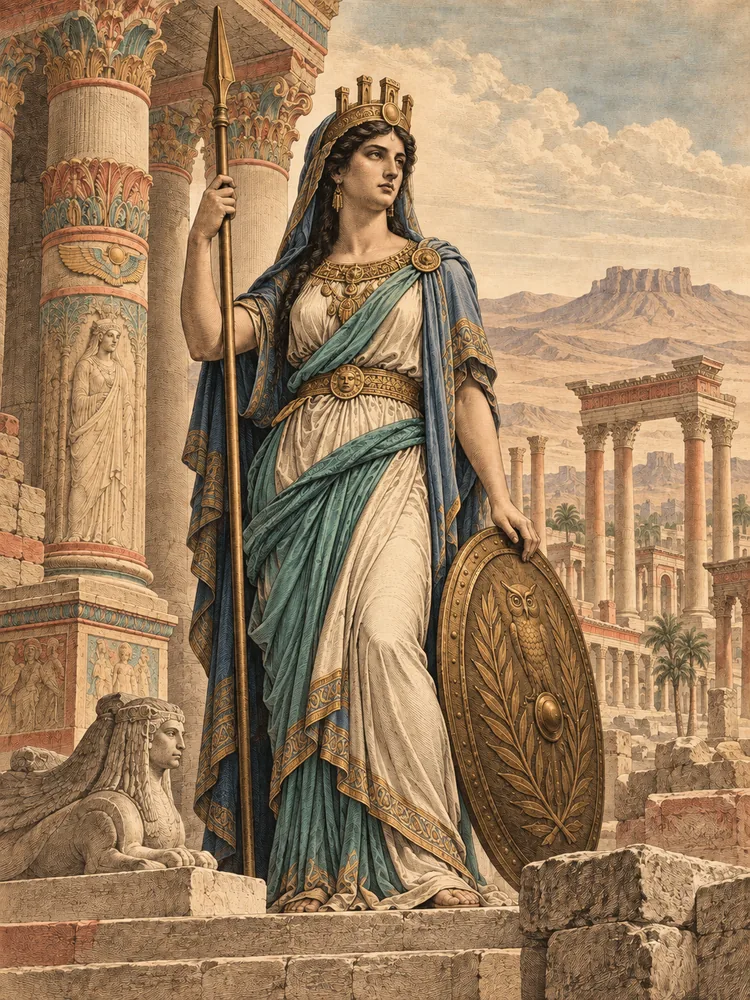

The Palmyrene Allat was a distinct local development of the broader Aramaean-Arabian goddess (treated in Books I and II above). At Palmyra, Allat had her own great sanctuary, the Allat Temple in the Diocletian's Camp area of the city, with a cult-image of her as Athena Promachos — the helmeted, spear-wielding warrior-maiden of the Greek tradition — that was wholly unlike the Nabataean and broader Arabian iconography of Allat as a stately mother-goddess. The Palmyrene Allat had been thoroughly Hellenized by the second century of our era, and she functioned in the Palmyrene pantheon as the civic patron of the city, the divine warrior-defender, paralleling the role of Athena at Athens or of Roma at Rome.
Her sanctuary was excavated by the Polish-Syrian missions of the 1970s and 1980s; the cult-statue of Allat-Athena, a fine Greek-style marble figure, was recovered intact and is one of the best preserved Palmyrene cult-images. Around her in the precinct stood subsidiary altars and statues — to her divine attendants, to the lesser deities of her cult-circle, to the donors who had endowed the sanctuary. Allat had been worshipped at Palmyra long before her Hellenization, with the older cult-image probably aniconic in the Nabataean style; the Greek statue replaced the earlier baetyl as part of the broader Hellenization of Palmyrene public religion in the imperial period.
The cult-statue and the temple of Allat at Palmyra were among the casualties of the ISIS destruction of 2015. The statue, which had been moved to the Palmyra Museum, was reportedly damaged when the museum was looted; the temple itself was demolished. The Polish team that had excavated the temple in earlier decades had fortunately produced extensive documentation, and the publications (especially Michał Gawlikowski's various articles and books) preserve the architectural and iconographic record.
Allat's cult at Palmyra is interesting as a case-study in religious Hellenization. The same goddess who at Mecca was the great Arab mother-figure, and who at Hegra was a pre-Hellenistic stately matron, at Palmyra became Athena Promachos — civic patroness, warrior-maiden, helmeted and armed. The transformation is not a substitution (Allat does not become a different goddess) but an expression: the same divine personality is given different iconographic and cultic shape according to the cultural traditions of the worshipping community. The Palmyrene Allat-Athena is a case in which the Hellenization went very deep without effacing the identity of the underlying figure.