A Compendium of the Ancient Gods
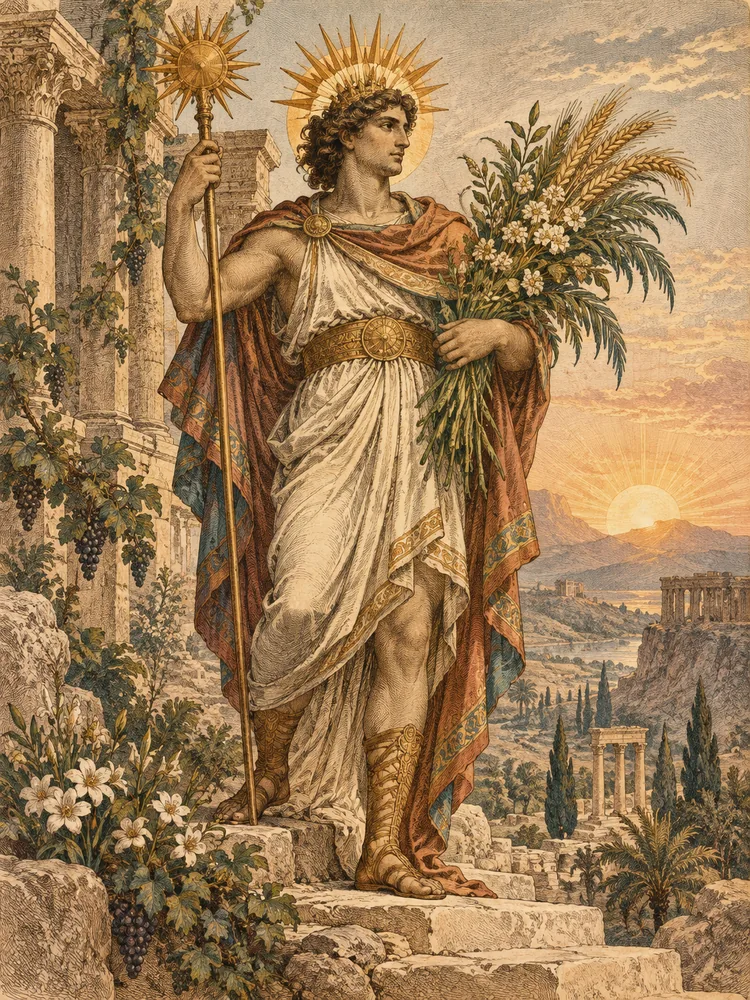
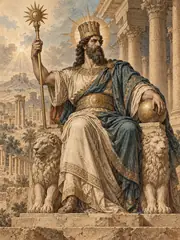
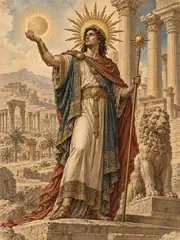
Malakbel, plate

Malakbel — 'the Messenger of Bel,' or perhaps 'Servant of Bel,' from Aramaic mlʾk + Bēl — was a solar deity of Palmyra, particularly associated with the morning sun (where Yarhibol was the full daylight sun and Malakbel was the rising), with the spring season (the rising of vegetation), and with vegetation-fertility cycles. He was the second of the great solar-lunar pair at Palmyra (with Aglibol the moon-god, treated above), and the two together formed a unit in the religious life of the city, with their joint sanctuary in the Sacred Garden where the Bnay Komare confraternity celebrated their festivals.

Malakbel's iconography was distinctive. He was depicted as a beardless young man with rays around his head, often with a sheaf of grain in his hand or with a cypress tree (the cypress being one of his sacred trees), sometimes shown rising from a flower or emerging from a spring. The vegetation-and-rebirth imagery suggests that Malakbel was conceived as a god of renewal — the morning sun bringing back the day, the spring sun bringing back the year, the new growth bringing back life — and the connection to dying-and-rising vegetation gods of the broader eastern Mediterranean (Adonis, Osiris, Tammuz) was probably felt by his worshippers, though the explicit identifications are not made in the surviving sources.

His cult was carried beyond Palmyra by the Palmyrene merchants and soldiers who served in the Roman empire. A famous altar to Malakbel from Rome (now in the Capitoline Museum) preserves an extended iconographic program: four reliefs showing the god in his various aspects, with Aramaic and Latin bilingual inscriptions identifying him as 'Malakbel and the gods of Palmyra.' The altar was set up in the second century of our era by Palmyrene merchants resident at Rome, and is one of the clearest examples of the export of Syrian religion into the Latin west.

After the destruction of Palmyra and the Christianization of the eastern empire, Malakbel's cult was extinguished. The Sacred Garden was abandoned; the cult-association of the Bnay Komare was dissolved; the rites of the morning sun ceased. The iconographic record, however, is rich, with reliefs from the Temple of Bel, from the Sacred Garden, from the funerary towers of the Valley of the Tombs, and from sites as far west as Rome documenting the cult. Malakbel is one of the better-attested of all Palmyrene deities, and the figure stands as a witness to the religious creativity of the great desert city.
Curator’s note

What the sources say, and what later tradition added. The sources for this bay

Malakbel is documented in numerous Palmyrene inscriptions and reliefs. The Capitoline altar (CIS II 3903) is published in the Corpus Inscriptionum Semiticarum and in many secondary works; Maurice Sartre's various studies on Palmyrene religion treat its iconography. The Sacred Garden materials are scattered through the publications of the early French missions to Palmyra; the standard collection is in the various Henri Seyrig articles. The standard scholarly treatment is Lucinda Dirven's The Palmyrenes of Dura-Europos: A Study of Religious Interaction in Roman Syria (1999), which deals with the export of Palmyrene cults to other parts of the empire.

Kin in the sources

Each tie is quoted from the entry that states it.

When the sources speak

Dated witnesses for The Gods of Palmyra. A date marks when the evidence was written down, not when the belief began. The whole timeline

c. 1200–900 BCE
Aramaean polities emerge in Syria within the post–Late Bronze Age political landscape.
9th–8th centuries BCE
Royal inscriptions and regional monuments attest Aramaean dynasties and their divine patrons.
8th–7th centuries BCE
Neo-Assyrian conquest redistributes populations and embeds Syrian cults within imperial networks.
539–332 BCE
Achaemenid rule sustains Aramaic as a major administrative language and connects Levantine and Arabian routes.
332–64 BCE
Hellenistic kingdoms introduce Greek civic and iconographic forms while local cults persist and hybridize.
4th century BCE–106 CE
The Nabataean kingdom develops Petra, Hegra, and a distinctive epigraphic and aniconic cult tradition.
64 BCE onward
Roman incorporation of Syria creates new military, civic, and commercial settings for local gods.
1st–3rd centuries CE
Palmyra’s caravan wealth supports monumental temples and multilingual dedications to Bel, Baalshamin, Yarhibol, Aglibol, and others.

Floor plan

The rooms follow one another in the order their peoples first appear in the written record.

  1. The Cradle of Citiesc. 3400 BCE to 395 CE. 115 works
  2. The Gift of the Nilec. 4000 BCE to 395 CE. 73 works
  3. The Olympian Orderc. 1600 BCE to 750 CE. 152 works
  4. The Persian Worldc. 2000 BCE to 1010 CE. 30 works
  5. The Levantine Borderlandsc. 1200 BCE to 500 CE. 20 works
  6. The Edges of Empirec. 2000 BCE to 1500 CE. 33 works
  7. The Etruscan Worldc. 900 BCE to 750 CE. 22 works
  8. The Roman Inheritancec. 1200 BCE to 500 CE. 58 works
  9. The Northern Inheritancec. 2000 BCE to 1600 CE. 131 works