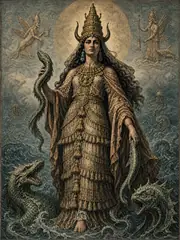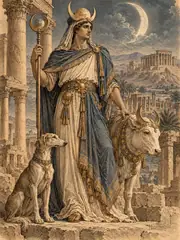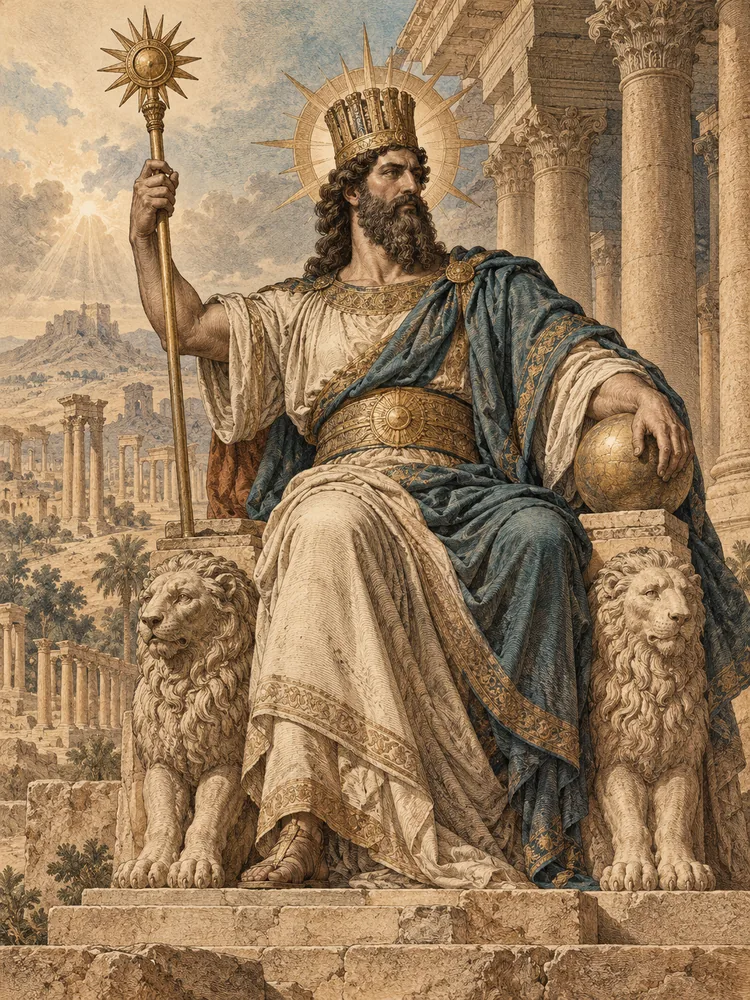
Bel was the chief god of Palmyra, the divine sovereign of the city, the Aramaean form of the older Mesopotamian Bēl ('Lord,' an epithet most often applied to Marduk in the Babylonian tradition). The cult was adopted by the Palmyrenes from Mesopotamian models in the first century before our era and developed into the central religious institution of the city. Bel was the supreme deity, the ruler of heaven, the source of cosmic order, the divine warrant of the Palmyrene state.
His great Temple of Bel — a massive precinct in the eastern part of the city, with a central temple-cella surrounded by a court two hundred meters on each side — was completed in 32 of our era under the Roman emperor Tiberius. The cella, built in the late Hellenistic style with pseudo-peripteral colonnade and richly carved decoration, was one of the supreme monuments of Roman provincial architecture. The cella stood for nineteen hundred years almost intact (it had been preserved through the medieval period as a Christian church, then an Islamic mosque, then a fort) until it was destroyed by ISIS in August 2015. The destruction was deliberate and ideological — the iconoclasm of an extremist Islamic movement against the surviving evidence of pre-Islamic Syrian paganism — and was one of the great cultural-archaeological tragedies of recent years.
Bel was conceived in the Palmyrene theology as the cosmic creator and ruler. The reliefs of the temple cella depict him in scenes of cosmic combat — Bel battling the sea-monster Tiamat in the Mesopotamian creation-mythology, the same scene preserved in the Babylonian Enuma Elish — and in scenes of his marriage to the goddesses of the city, of his procession through the heavens, and of his receiving the worship of the Palmyrene tribes. The iconography is heavily Mesopotamian in inspiration, but with Greek and Syrian additions: Bel is depicted as a bearded warrior on a chariot drawn by griffins, accompanied by the lesser gods Yarhibol and Aglibol, with Iarhibol on his right and Aglibol on his left.
His cult was the central public religion of Palmyra. The annual procession of Bel through the city was the chief festival of the Palmyrene year; the great Temple of Bel was the seat of the priestly college that maintained the city's relations with the gods; dedicatory inscriptions to Bel from Palmyrene caravan-traders, from city magistrates, from foreign visitors, fill the corpus of inscriptions. The cult was suppressed by the Christianization of Syria in the fourth and fifth centuries, but the Temple of Bel survived (as church and mosque) for fifteen centuries thereafter, until its destruction in our own time.