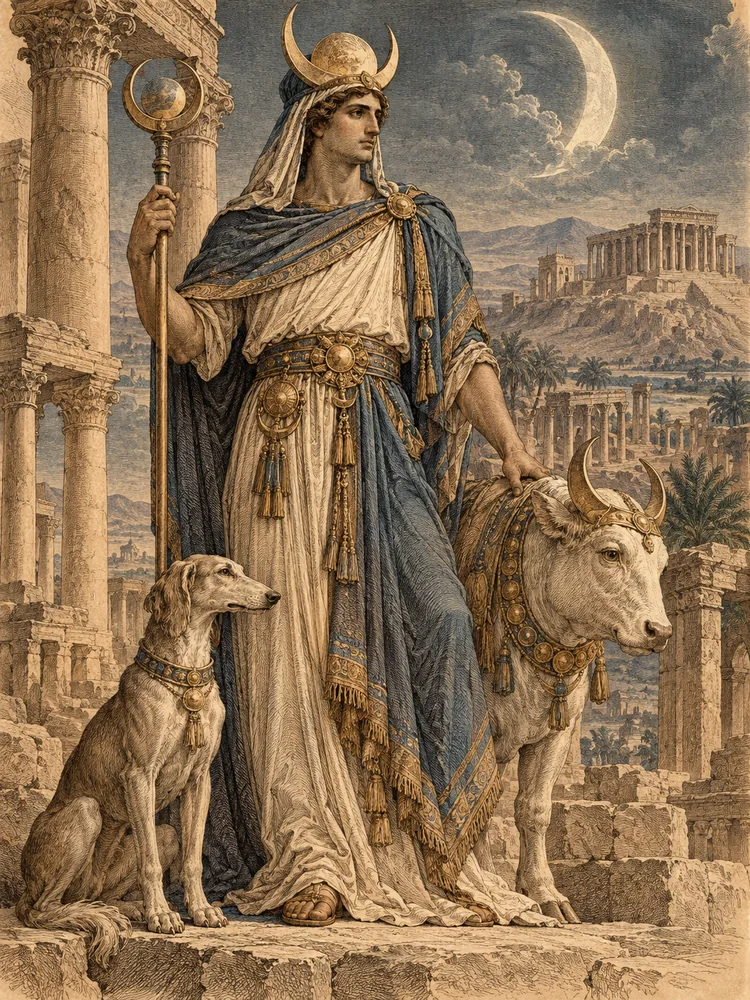
Aglibol was the moon-god of Palmyra, the divine attendant of Bel who stood on Bel's left hand as Yarhibol stood on his right. His name probably means 'Calf of Bel' (āg + Bēl), with the bull-and-calf imagery suggesting that Aglibol was originally a divine son or junior partner of the chief deity, perhaps with bull-iconography that connected him to the older Canaanite-Aramaean storm-god traditions. By the first century of our era, however, Aglibol was firmly the moon-god — the divine power of the lunar cycle, the marker of the months, the night-sky companion of the solar Yarhibol.
He was depicted in the great cult-relief of the Temple of Bel as a youthful warrior with a crescent moon resting horizontally upon his shoulders, the horns of the crescent rising upward like a yoke or a halo. The iconography is distinctive — the horizontally-laid crescent on the shoulders is a Palmyrene specialty, not found in the same form elsewhere — and was carefully preserved in numerous reliefs throughout the city. He is shown alongside Yarhibol as the dual celestial witness of the cosmic order.
Aglibol's cult had its own sanctuary at Palmyra, in addition to his role in the Temple of Bel. The 'Sacred Garden' of Aglibol and Malakbel (treated next) was a precinct in the city devoted to the two solar-lunar deities, where the great festival of the cult-association called the 'Sons of the Symposium' (the Bnay Komare) was celebrated; the inscriptions from this precinct preserve much information about the religious life of Palmyrene tribes and confraternities.
After the destruction of Palmyra by Aurelian in 273 of our era, Aglibol's cult declined along with the city's other religious institutions. The Temple of Bel survived as a Christian church and an Islamic mosque, but the iconography of Aglibol — which had depicted a pagan god with the crescent moon — was systematically defaced or covered over in the Christian and Islamic transformations of the building. What remained was carefully documented before the 2015 destruction; the photographic and drawn record of Aglibol in the Bel-temple reliefs is now our chief source for his cult.