A Compendium of the Ancient Gods
Yarhibol, plate

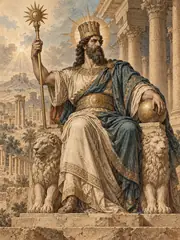
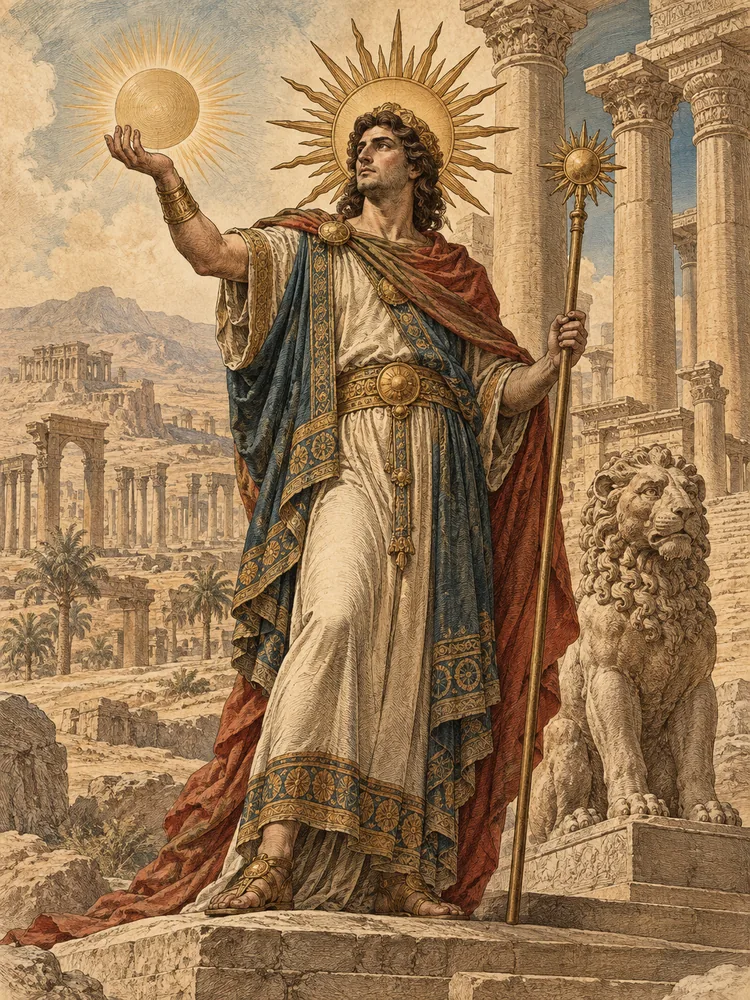
Yarhibol was the sun-god of Palmyra, the radiant attendant of Bel, the divine witness of oaths. His name probably means 'Lord of the Spring' (yarḥi being a variant of an Aramaic word for moon, but used in Palmyra for the spring of Efqa, the great oasis-spring that was the source of the city's water), and he was the divine guardian of the spring. Around the spring was the original sanctuary of Yarhibol — predating the great Temple of Bel by perhaps a century — and his priesthood was responsible for the rites that maintained the spring's sacred character.

By the first century of our era, Yarhibol had been associated with Bel and with the solar imagery of the developed Palmyrene pantheon. He stood on Bel's right hand in the great cult-relief of the Temple of Bel (preserved photographically before the destruction of 2015), depicted as a beardless youth in radiant armor, with rays around his head. The function had shifted: Yarhibol was now the sun-god, the bringer of daylight, the witness of justice. His association with the spring of Efqa remained, but it was overlaid by the broader solar significance.

His role as oath-witness made him a central deity of Palmyrene legal life. Contracts, treaties, and important agreements were sealed by oath in his name; the inscriptions record his function repeatedly. The Palmyrene Tariff of 137 of our era — the great bilingual inscription regulating customs duties, now in the Hermitage Museum in St. Petersburg — names Yarhibol as one of the divine guarantors of the customs system. So the god of the spring became the god of the oath, the divine warrant of contractual fidelity in the great trading city.

After the sack of Palmyra by Aurelian in 273 of our era and the Christianization of the eastern empire, Yarhibol's cult was extinguished. His sanctuary at the Efqa spring was abandoned, his role as oath-witness was taken over by Christian saints, and the rites at the spring continued in attenuated form (with Christianized formulas) until the medieval period. The spring itself, the original sacred site, dried up in the 1990s as a result of overpumping of the regional water table — an environmental loss that severed the last physical link to the original Palmyrene cult.

Curator’s note

What the sources say, and what later tradition added. The sources for this bay

Yarhibol is documented throughout the Palmyrene inscriptions. The Tariff of Palmyra is published in the standard CIS (Corpus Inscriptionum Semiticarum) and in the various editions of the Palmyrene corpus. The standard treatment of the deity is Henri Seyrig's article 'Le culte du soleil en Syrie à l'époque romaine' (Syria 48, 1971) and the relevant entries in Drijvers's various Palmyrene-religion publications. The Efqa spring is described in early-modern travel accounts (Robert Wood, The Ruins of Palmyra, 1753, and others); its drying up in the 1990s is documented in modern Syrian water-resource literature.

Kin in the sources

Each tie is quoted from the entry that states it.

When the sources speak

Dated witnesses for The Gods of Palmyra. A date marks when the evidence was written down, not when the belief began. The whole timeline

c. 1200–900 BCE
Aramaean polities emerge in Syria within the post–Late Bronze Age political landscape.
9th–8th centuries BCE
Royal inscriptions and regional monuments attest Aramaean dynasties and their divine patrons.
8th–7th centuries BCE
Neo-Assyrian conquest redistributes populations and embeds Syrian cults within imperial networks.
539–332 BCE
Achaemenid rule sustains Aramaic as a major administrative language and connects Levantine and Arabian routes.
332–64 BCE
Hellenistic kingdoms introduce Greek civic and iconographic forms while local cults persist and hybridize.
4th century BCE–106 CE
The Nabataean kingdom develops Petra, Hegra, and a distinctive epigraphic and aniconic cult tradition.
64 BCE onward
Roman incorporation of Syria creates new military, civic, and commercial settings for local gods.
1st–3rd centuries CE
Palmyra’s caravan wealth supports monumental temples and multilingual dedications to Bel, Baalshamin, Yarhibol, Aglibol, and others.

Floor plan

The rooms follow one another in the order their peoples first appear in the written record.

  1. The Cradle of Citiesc. 3400 BCE to 395 CE. 115 works
  2. The Gift of the Nilec. 4000 BCE to 395 CE. 73 works
  3. The Olympian Orderc. 1600 BCE to 750 CE. 152 works
  4. The Persian Worldc. 2000 BCE to 1010 CE. 30 works
  5. The Levantine Borderlandsc. 1200 BCE to 500 CE. 20 works
  6. The Edges of Empirec. 2000 BCE to 1500 CE. 33 works
  7. The Etruscan Worldc. 900 BCE to 750 CE. 22 works
  8. The Roman Inheritancec. 1200 BCE to 500 CE. 58 works
  9. The Northern Inheritancec. 2000 BCE to 1600 CE. 131 works