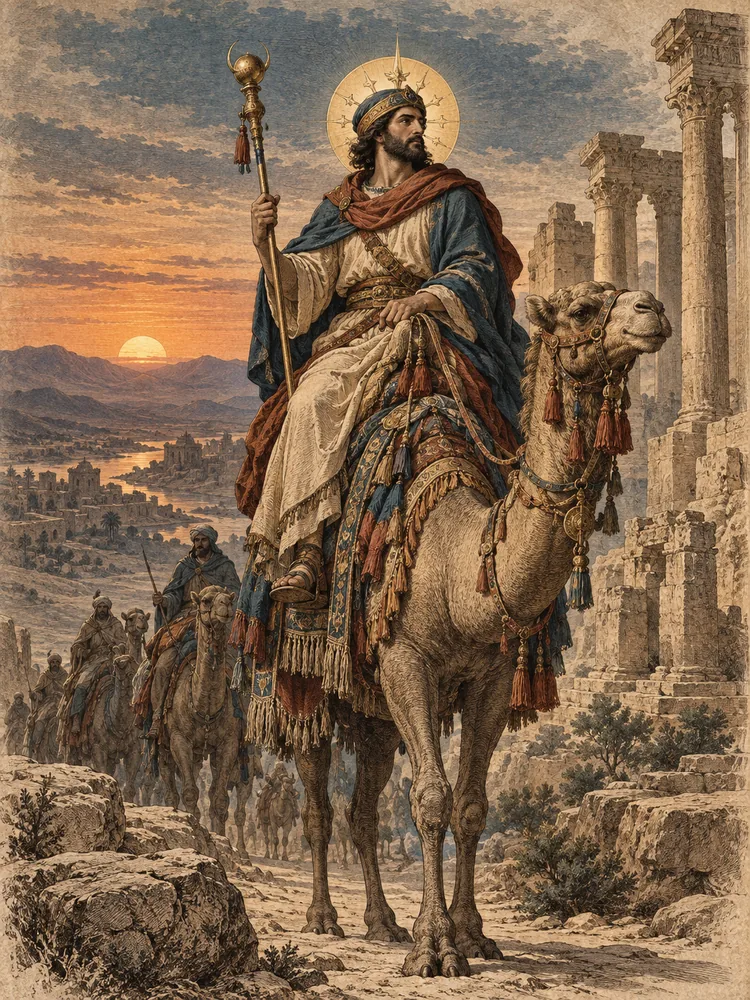
Arsu — sometimes appearing as Arsa or Arsu-Azizos in the doubled form — was a desert-divinity of the caravan-trade, depicted as a young warrior mounted on a camel, often paired with his companion Azizos (treated next) who rode a horse. The two together formed the divine escort of caravans across the desert: Arsu the camel-rider, knowing the routes through the sand and the watering-places, and Azizos the horseman, providing the warrior-protection against bandits and hostile tribes. The pair was particularly important to Palmyra because of the city's economic dependence on the caravan-trade to Mesopotamia and Arabia.
Arsu was associated with the evening — the time when caravans typically halted for the night, set up camp, and protected themselves from desert dangers. He was the divine guardian of the camp, of the resting camels, of the merchants and travelers in their tents. His invocations in the Palmyrene inscriptions often pair him with prayers for safe travel and for protection through the night.
His iconography is preserved in numerous reliefs from Palmyrene tomb-monuments and from the Temple of Bel. The camel-mounted warrior is a distinctive Palmyrene contribution to the iconography of Roman-period Syria; the figure is unmistakable, with the long-legged camel as the steed and the warrior in eastern dress with bow and lance. The cult was carried beyond Palmyra by the merchants who depended on Arsu's protection; dedications to Arsu have been found at Dura-Europos, at Hatra, and at lesser sites along the trade routes.
The pair Arsu-Azizos has parallels with the divine twin-pair pattern of Indo-European religion (the Vedic Ashvins, the Greek Dioscuri, the Roman Castor and Pollux), which has prompted speculation about possible cultural-religious influence — the Palmyrene caravan trade extended to India, and the Greco-Roman cultural reach of the imperial period was extensive. Whether Arsu-Azizos owes anything to the Dioscuri pattern, or whether the two-warrior protective-pair structure was independently developed in the desert-trade context, is debated. After the decline of Palmyra, Arsu's cult faded; Christian saints (especially Saint George the Cappadocian, the dragon-slaying horseman) absorbed some of his iconographic functions in the later Syrian-Christian tradition.