A Compendium of the Ancient Gods
Kuvava, plate

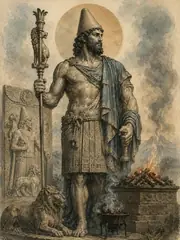
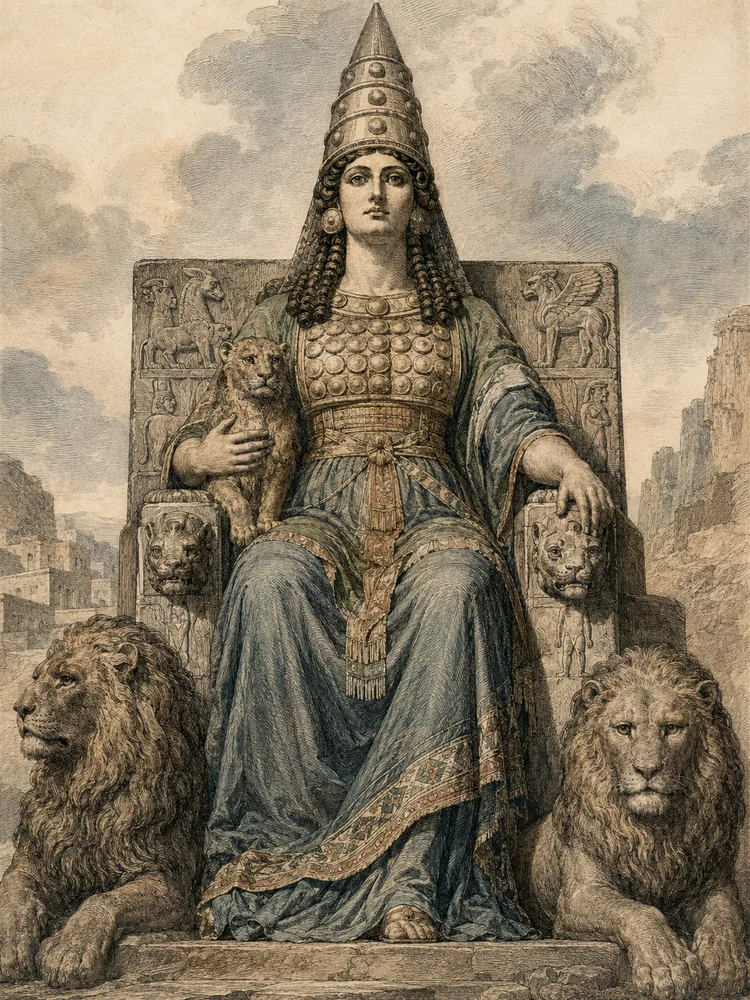
There stood, at the great Hittite-Luwian city of Carchemish on the upper Euphrates, a goddess who was its tutelary patroness for over a millennium — from the late Bronze Age through the Iron Age — under the name Kubaba. The Lydians called her Kuvava; the Phrygians eventually called her Cybele, and brought her cult to the Aegean and ultimately to Rome. She is the most-traveled goddess in this volume.

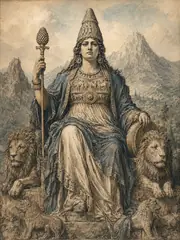
At Carchemish she was depicted, on the great basalt orthostates lining her temple precinct, as a seated goddess holding a pomegranate (symbol of fertility) and a mirror (symbol perhaps of self-knowledge, or perhaps of the divine gaze turned upon her devotees). She wore a high mural crown — a crown shaped like a city's walls — to indicate that she was the city herself; she was attended by lions; she received offerings of dressed meat and of the firstfruits of the Euphrates valley.

When Carchemish fell to the Assyrians in the eighth century BCE, her cult did not die. It moved westward, taking on Lydian and Phrygian features, until at the great Phrygian shrine of Pessinous it had become the cult of Cybele the Mother of the Gods. From Pessinous it traveled, in 204 BCE, to Rome (under the form of a black meteoric stone), and from Rome it reached every corner of the empire. The lineage Kubaba, then Kuvava, then Cybele is one of the longest-traceable continuities of any goddess-cult in the ancient world.
Curator’s note

What the sources say, and what later tradition added. The sources for this bay

Kubaba is documented at Carchemish from the late Bronze Age (where she appears in Hittite ritual texts) through the Iron Age (where her image survives in the great basalt reliefs and in Luwian hieroglyphic inscriptions) into the early classical period. Her name's etymological development to Lydian Kuvava and Phrygian-Greek Cybele has been traced philologically since the early twentieth century. The lion-attended mother-goddess on a high mural-crown throne is the iconographic ancestor of the Roman-period Cybele image, which would dominate the Mater Magna cult to the end of antiquity. The phenomenon by which a city-goddess of Bronze Age Mesopotamian-Anatolian frontier becomes the Mother of the Gods of the Roman state is among the most consequential cult-transmissions in the religious history of the western world.

Kin in the sources

Each tie is quoted from the entry that states it.

When the sources speak

Dated witnesses for Anatolia. A date marks when the evidence was written down, not when the belief began. The whole timeline

c. 3400–3000 BCE
Uruk-period writing and monumental temple economies create the earliest recoverable administrative setting for named divine institutions.
c. 2900–2350 BCE
Early Dynastic city-states preserve local cults, hymns, royal inscriptions, and god lists; later copies often transmit older compositions.
c. 2334–2154 BCE
The Akkadian Empire expands bilingual and imperial patterns of divine identification without erasing local cult titles.
c. 2112–2004 BCE
Ur III administration and scribal schooling standardize many Sumerian literary and liturgical forms.
c. 2000–1600 BCE
Old Babylonian schools copy major myths, laments, hymns, debates, and heroic narratives in the form most often used by modern editors.
c. 1650–1200 BCE
Hittite and Hurrian archives at Hattusa transmit Anatolian myths, imported Syrian materials, and ritual compositions.
c. 1400–1190 BCE
The tablets of Ugarit preserve the Baal Cycle, Kirta, Aqhat, ritual lists, and a dense Late Bronze Age West Semitic pantheon.
c. 1000–612 BCE
Neo-Assyrian and Neo-Babylonian empires collect, revise, and politically reinterpret older learned traditions.

Floor plan

The rooms follow one another in the order their peoples first appear in the written record.

  1. The Cradle of Citiesc. 3400 BCE to 395 CE. 115 works
  2. The Gift of the Nilec. 4000 BCE to 395 CE. 73 works
  3. The Olympian Orderc. 1600 BCE to 750 CE. 152 works
  4. The Persian Worldc. 2000 BCE to 1010 CE. 30 works
  5. The Levantine Borderlandsc. 1200 BCE to 500 CE. 20 works
  6. The Edges of Empirec. 2000 BCE to 1500 CE. 33 works
  7. The Etruscan Worldc. 900 BCE to 750 CE. 22 works
  8. The Roman Inheritancec. 1200 BCE to 500 CE. 58 works
  9. The Northern Inheritancec. 2000 BCE to 1600 CE. 131 works