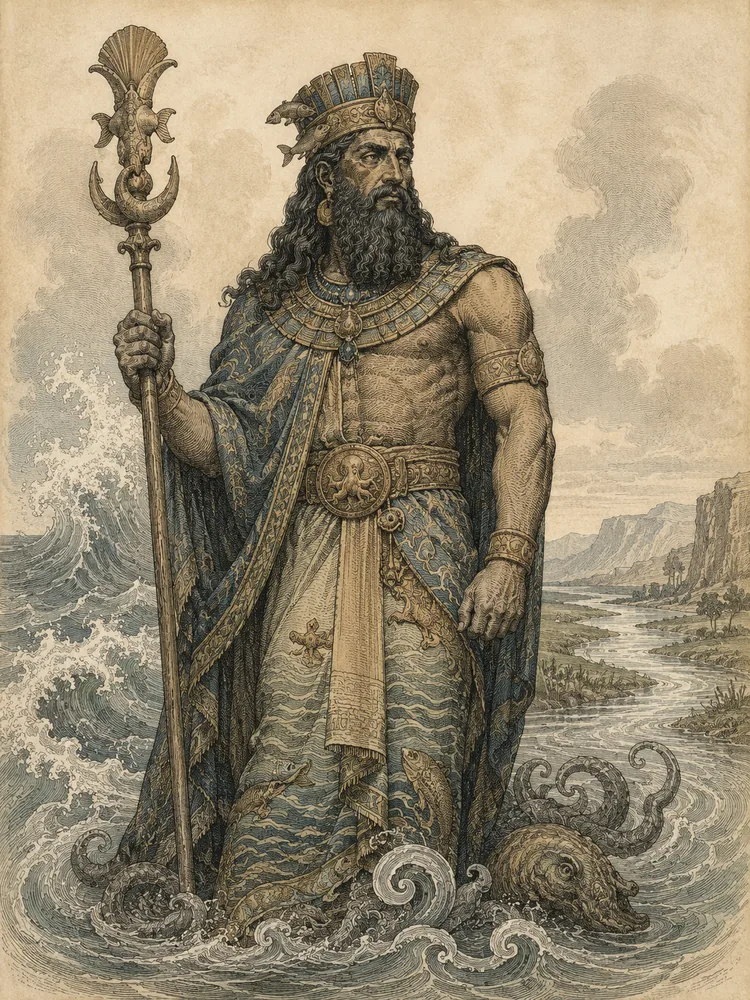
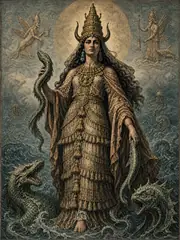
Yam was the Sea, the salt-water dragon-god, called also "Judge River" (Nahar). He was the beloved of El and was set up by El as king over the gods, with the title "Prince Sea." He demanded the surrender of Baal as his slave; he sent his arrogant messengers into the divine assembly with the demand. The gods bowed before them, but Baal alone refused. The battle that followed (told in the entry on Baal) ended in Yam's defeat and (apparently) destruction; but Yam, like the principle of chaotic water that he embodies, is not so much annihilated as set in his place — bound, restrained, bordered, but never wholly absent.
 Before thisAstarte
 Next on the wallMot
Curator’s note
What the sources say, and what later tradition added. The sources for this bay
Yam appears almost exclusively in the Baal Cycle (KTU 1.1–1.2). His role as the chaos-sea defeated by the storm-god is the closest Canaanite parallel to the Babylonian Tiamat slain by Marduk, and the two share a deep typological kinship. The biblical "Yamm" appears in fossilized form in passages such as Job 7:12 ("Am I a sea, or a dragon, that thou settest a watch over me?") and Psalm 74:13 ("Thou didst divide the sea by thy strength: thou brakest the heads of the dragons in the waters") — passages that retain, in poetic fragments, the older Canaanite mythology of the storm-god's defeat of the sea-monster, here re-attributed to Yahweh. The tradition of God's rebuking and bordering the sea (Job 38:8-11; Psalm 104:6-9) belongs to the same complex.
Kin in the sources
Each tie is quoted from the entry that states it.
 Parent ofEl
He was the beloved of El and was set up by El as king over the gods
 Slain byBaal
ended in Yam's defeat and (apparently) destruction
- Rival ofBaal
He demanded the surrender of Baal as his slave
 Compared withTiamat
the closest Canaanite parallel to the Babylonian Tiamat slain by Marduk
- Child ofEl
He grants to Yam the Sea the title of "beloved son" and the throne
When the sources speak
Dated witnesses for Canaan and Phoenicia. A date marks when the evidence was written down, not when the belief began. The whole timeline
- c. 3400–3000 BCE
- Uruk-period writing and monumental temple economies create the earliest recoverable administrative setting for named divine institutions.
- c. 2900–2350 BCE
- Early Dynastic city-states preserve local cults, hymns, royal inscriptions, and god lists; later copies often transmit older compositions.
- c. 2334–2154 BCE
- The Akkadian Empire expands bilingual and imperial patterns of divine identification without erasing local cult titles.
- c. 2112–2004 BCE
- Ur III administration and scribal schooling standardize many Sumerian literary and liturgical forms.
- c. 2000–1600 BCE
- Old Babylonian schools copy major myths, laments, hymns, debates, and heroic narratives in the form most often used by modern editors.
- c. 1650–1200 BCE
- Hittite and Hurrian archives at Hattusa transmit Anatolian myths, imported Syrian materials, and ritual compositions.
- c. 1400–1190 BCE
- The tablets of Ugarit preserve the Baal Cycle, Kirta, Aqhat, ritual lists, and a dense Late Bronze Age West Semitic pantheon.
- c. 1000–612 BCE
- Neo-Assyrian and Neo-Babylonian empires collect, revise, and politically reinterpret older learned traditions.