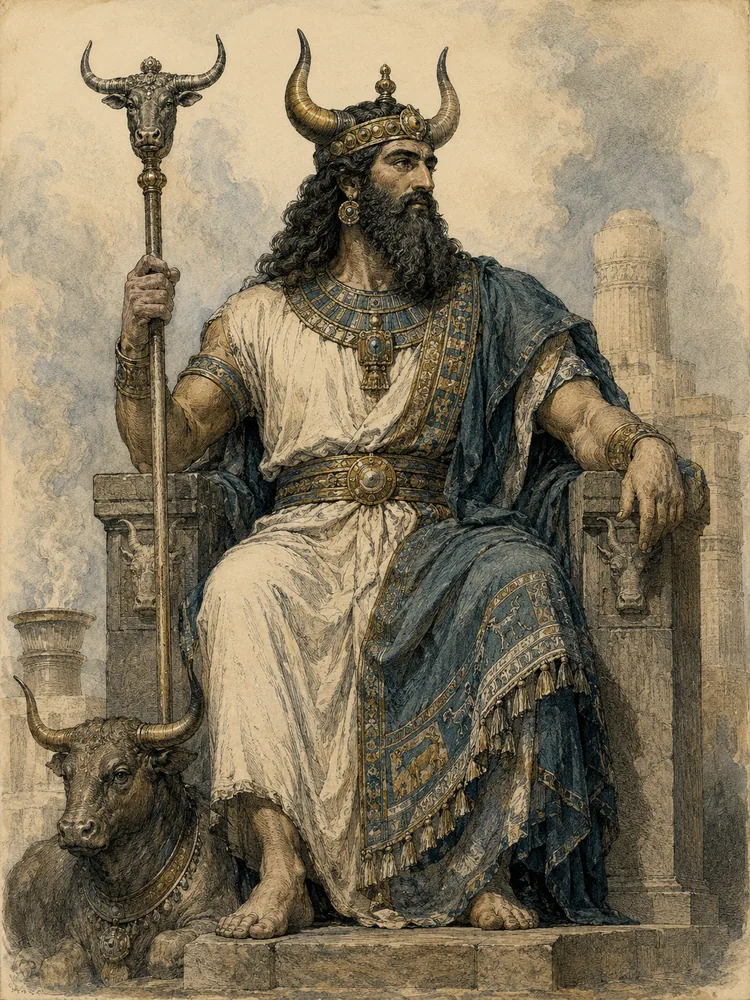
El was the father of the gods of Canaan, the king of the heavenly assembly, the bull-god whose tents were pitched at the source of the rivers, where the two oceans meet. He was an old god, white-bearded and venerable; he sat upon a throne with his feet upon a footstool of cedar, and the lesser gods came before him to make their petitions. He was called "the Kindly," "the Compassionate," "the Bull El" — for the bull was his sacred beast — and "Creator of Creatures." His wife was Asherah, mother of seventy gods. He was the high god of Ugarit, and is the same god who is called El, El Shaddai, El Elyon, and (sometimes) Yahweh, in the various strata of the Hebrew Bible — a question to which we shall return.
In the Baal Cycle, El holds the formal kingship, but he is increasingly passive: it is his sons who fight for the active sovereignty. He grants to Yam the Sea the title of "beloved son" and the throne; later, faced with Baal's victory, he assents to it, but with no enthusiasm. He is petitioned, he gives audience, he weeps when his beloved Baal is killed — but the great battles are his sons'.
Curator’s note
What the sources say, and what later tradition added. The sources for this bay
The Ugaritic El is best portrayed in the Baal Cycle (KTU 1.1–1.6) and the legends of Kirta (KTU 1.14–1.16) and Aqhat (KTU 1.17–1.19). His epithets — "Bull El," "Father of Years," "Kindly El the Compassionate," "Creator of Creatures" (bny bnwt) — are remarkably stable across the corpus. The relationship of the Canaanite El to the El/Elohim of the Hebrew Bible is one of the central problems of biblical studies. The Bible itself preserves traces of an older period in which the Israelite God was known as El Elyon (Genesis 14:18-22), El Shaddai (Genesis 17:1), and other El-titles, and was understood as one god of the Canaanite assembly under the high god El, who allotted Israel to him as his portion (Deuteronomy 32:8-9 in the Septuagint and Dead Sea Scrolls reading). The progressive identification of Yahweh with El, and the elimination of the lesser gods, is the religious history of ancient Israel. None of this requires the modern reader to draw any particular theological conclusion; it is, however, a fact that the El who sat at the source of the rivers in Ugaritic poetry is the linguistic and typological ancestor of the El who walks in the cool of the day in Genesis 3.
When the sources speak
Dated witnesses for Canaan and Phoenicia. A date marks when the evidence was written down, not when the belief began. The whole timeline
- c. 3400–3000 BCE
- Uruk-period writing and monumental temple economies create the earliest recoverable administrative setting for named divine institutions.
- c. 2900–2350 BCE
- Early Dynastic city-states preserve local cults, hymns, royal inscriptions, and god lists; later copies often transmit older compositions.
- c. 2334–2154 BCE
- The Akkadian Empire expands bilingual and imperial patterns of divine identification without erasing local cult titles.
- c. 2112–2004 BCE
- Ur III administration and scribal schooling standardize many Sumerian literary and liturgical forms.
- c. 2000–1600 BCE
- Old Babylonian schools copy major myths, laments, hymns, debates, and heroic narratives in the form most often used by modern editors.
- c. 1650–1200 BCE
- Hittite and Hurrian archives at Hattusa transmit Anatolian myths, imported Syrian materials, and ritual compositions.
- c. 1400–1190 BCE
- The tablets of Ugarit preserve the Baal Cycle, Kirta, Aqhat, ritual lists, and a dense Late Bronze Age West Semitic pantheon.
- c. 1000–612 BCE
- Neo-Assyrian and Neo-Babylonian empires collect, revise, and politically reinterpret older learned traditions.