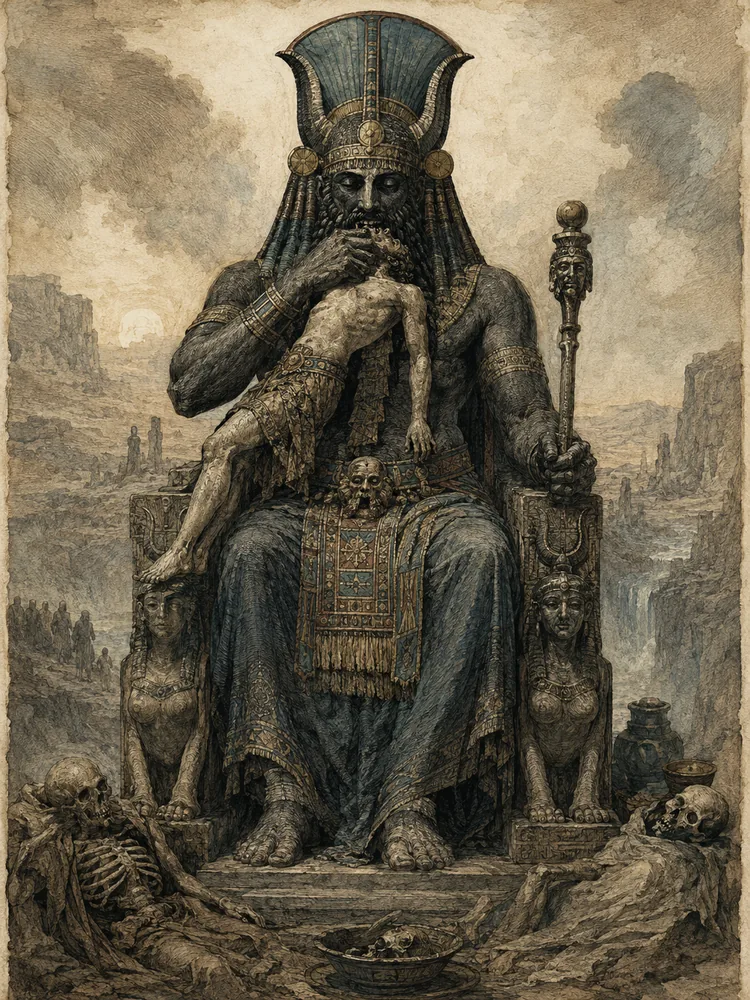
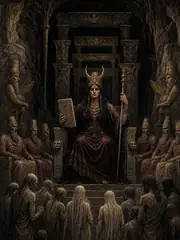
Mot was Death personified — "the beloved of El, the hero," though his honorific titles do not soften his function. He dwelt in the underworld at the place called Hmry, the Slough; his throat was wide as the sea; with one lip he touched the heavens, with the other the earth, and his tongue was as the stars. To him went all the dead, and he was insatiable; "my appetite is the appetite of the lion of the wasteland; like the seafowl I crave the sea." When he summoned Baal to the netherworld, Baal could not refuse; and Mot devoured him. But Anat in turn destroyed Mot — winnowed, ground, scattered, burned — and Baal returned. Mot returned also, in time; in the broken final tablet of the Cycle, he and Baal contend a second time, but Mot at the last yielded, acknowledging Baal's kingship.
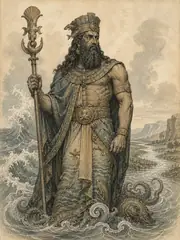 Before thisYam
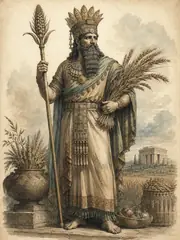 Next on the wallDagon
Curator’s note
What the sources say, and what later tradition added. The sources for this bay
Mot's mythography in the Baal Cycle is among the most theologically interesting in any ancient corpus: Death is a god, Death can be killed, Death rises again — but his rising is the rising of mortality itself, which cannot finally be abolished. His name is the simple Semitic word for "death" (Hebrew mawet, Arabic mawt). The figure stands in clear contrast to the Mesopotamian conception, in which the underworld has a queen (Ereshkigal) but death itself is not personified as a distinct active enemy of the storm-god.
Kin in the sources
Each tie is quoted from the entry that states it.
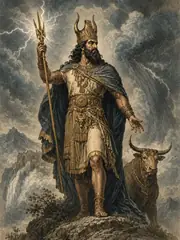 SlewBaal
When he summoned Baal to the netherworld, Baal could not refuse; and Mot devoured him.
 Slain byAnat
But Anat in turn destroyed Mot — winnowed, ground, scattered, burned — and Baal returned.
- Rival ofBaal
he and Baal contend a second time, but Mot at the last yielded, acknowledging Baal's kingship.
 Compared withEreshkigal
in which the underworld has a queen (Ereshkigal) but death itself is not personified
When the sources speak
Dated witnesses for Canaan and Phoenicia. A date marks when the evidence was written down, not when the belief began. The whole timeline
- c. 3400–3000 BCE
- Uruk-period writing and monumental temple economies create the earliest recoverable administrative setting for named divine institutions.
- c. 2900–2350 BCE
- Early Dynastic city-states preserve local cults, hymns, royal inscriptions, and god lists; later copies often transmit older compositions.
- c. 2334–2154 BCE
- The Akkadian Empire expands bilingual and imperial patterns of divine identification without erasing local cult titles.
- c. 2112–2004 BCE
- Ur III administration and scribal schooling standardize many Sumerian literary and liturgical forms.
- c. 2000–1600 BCE
- Old Babylonian schools copy major myths, laments, hymns, debates, and heroic narratives in the form most often used by modern editors.
- c. 1650–1200 BCE
- Hittite and Hurrian archives at Hattusa transmit Anatolian myths, imported Syrian materials, and ritual compositions.
- c. 1400–1190 BCE
- The tablets of Ugarit preserve the Baal Cycle, Kirta, Aqhat, ritual lists, and a dense Late Bronze Age West Semitic pantheon.
- c. 1000–612 BCE
- Neo-Assyrian and Neo-Babylonian empires collect, revise, and politically reinterpret older learned traditions.