A Compendium of the Ancient Gods
Ereshkigal, plate

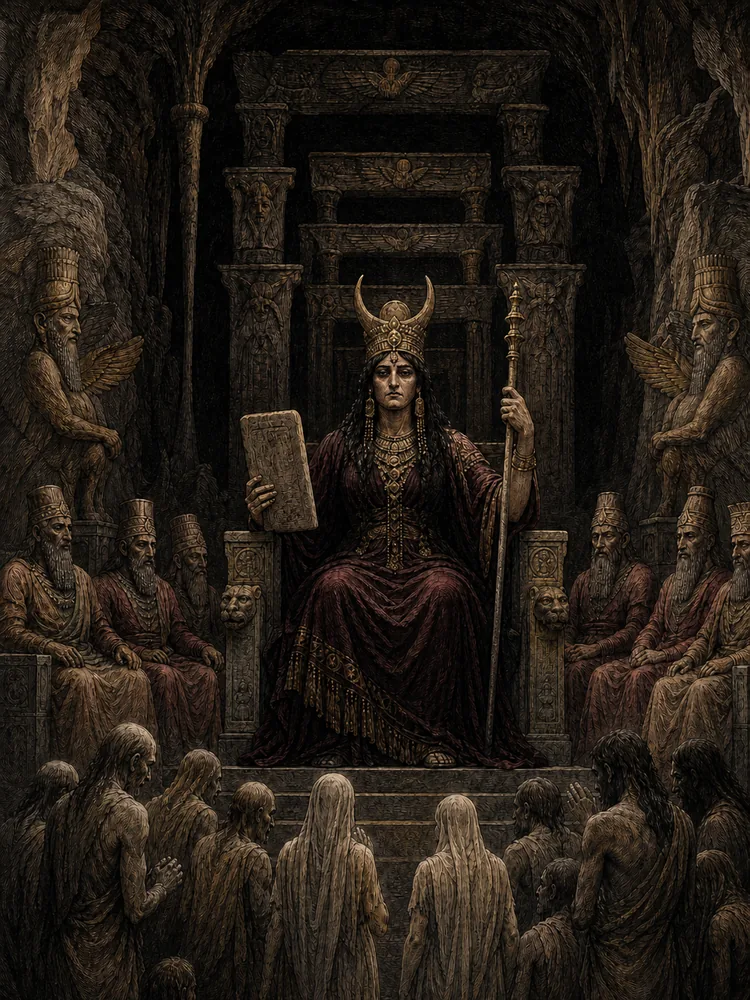
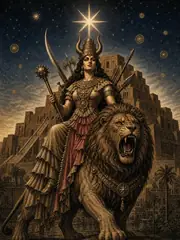
Ereshkigal was the queen of the underworld, the dark twin of Inanna, the lady of the great below where the dead dwell in dust. Her palace was Ganzir, and its seven gates were guarded; her court was attended by the seven Anunnaki of the dark realm, who passed judgment upon all who came before them. None ascended from her kingdom save by special grace; and she herself was not seen above. The dead in her keeping ate dust and drank dust, and were clothed in feathers like birds.

Of the great myths in which Ereshkigal figures, two are preserved. The first is the Descent of Inanna, in which her sister came down to challenge her, was stripped at each of the seven gates of one of her ornaments, and was at last hung as a corpse upon a hook in Ereshkigal's hall. (The fuller story is told in the entry on Inanna.)

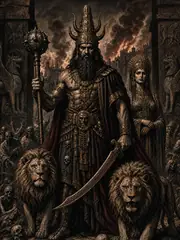
The second is the tale of Nergal and Ereshkigal. The gods above were holding a banquet, and they sent down to invite Ereshkigal; but the laws of the underworld did not permit her to ascend. She sent up her vizier Namtar in her stead. The young god Nergal, vehement and proud, did not rise to greet Namtar as the others did; and when Ereshkigal heard of the slight, she sent up word that Nergal must come down to her, that she might give him his death. Nergal armed himself and went down, and confronted Ereshkigal in her own hall; and seizing her by the hair, he dragged her from her throne and made as if to slay her. But she wept, and pleaded, saying, "Be thou my husband, and I thy wife; I shall give thee the tablet of wisdom, and thou shalt be the king beside me." Then Nergal's heart turned, and he kissed her, and wiped her tears; and he stayed below as her consort. So the underworld came to have two thrones, and Ereshkigal her king.
Curator’s note

What the sources say, and what later tradition added. The sources for this bay

Ereshkigal's principal myths are the Sumerian Descent of Inanna and the Akkadian Nergal and Ereshkigal, the latter preserved in two versions: a shorter Middle Babylonian text from El-Amarna in Egypt (where it had been used as a Mesopotamian schoolroom exercise by Egyptian scribes c. 1400 BCE), and a longer Standard Babylonian recension from Sultantepe and Uruk. The Amarna version is briefer and more violent; the Sultantepe version expands the courtship into a more leisurely tale. Ereshkigal is one of the few major Mesopotamian deities for whom no temple cult is securely attested, perhaps because her domain was such that the living preferred not to summon her presence. Her name means simply "Queen of the Great Below."

Kin in the sources

Each tie is quoted from the entry that states it.

When the sources speak

Dated witnesses for Sumer. A date marks when the evidence was written down, not when the belief began. The whole timeline

c. 3400–3000 BCE
Uruk-period writing and monumental temple economies create the earliest recoverable administrative setting for named divine institutions.
c. 2900–2350 BCE
Early Dynastic city-states preserve local cults, hymns, royal inscriptions, and god lists; later copies often transmit older compositions.
c. 2334–2154 BCE
The Akkadian Empire expands bilingual and imperial patterns of divine identification without erasing local cult titles.
c. 2112–2004 BCE
Ur III administration and scribal schooling standardize many Sumerian literary and liturgical forms.
c. 2000–1600 BCE
Old Babylonian schools copy major myths, laments, hymns, debates, and heroic narratives in the form most often used by modern editors.
c. 1650–1200 BCE
Hittite and Hurrian archives at Hattusa transmit Anatolian myths, imported Syrian materials, and ritual compositions.
c. 1400–1190 BCE
The tablets of Ugarit preserve the Baal Cycle, Kirta, Aqhat, ritual lists, and a dense Late Bronze Age West Semitic pantheon.
c. 1000–612 BCE
Neo-Assyrian and Neo-Babylonian empires collect, revise, and politically reinterpret older learned traditions.

Floor plan

The rooms follow one another in the order their peoples first appear in the written record.

  1. The Cradle of Citiesc. 3400 BCE to 395 CE. 115 works
  2. The Gift of the Nilec. 4000 BCE to 395 CE. 73 works
  3. The Olympian Orderc. 1600 BCE to 750 CE. 152 works
  4. The Persian Worldc. 2000 BCE to 1010 CE. 30 works
  5. The Levantine Borderlandsc. 1200 BCE to 500 CE. 20 works
  6. The Edges of Empirec. 2000 BCE to 1500 CE. 33 works
  7. The Etruscan Worldc. 900 BCE to 750 CE. 22 works
  8. The Roman Inheritancec. 1200 BCE to 500 CE. 58 works
  9. The Northern Inheritancec. 2000 BCE to 1600 CE. 131 works