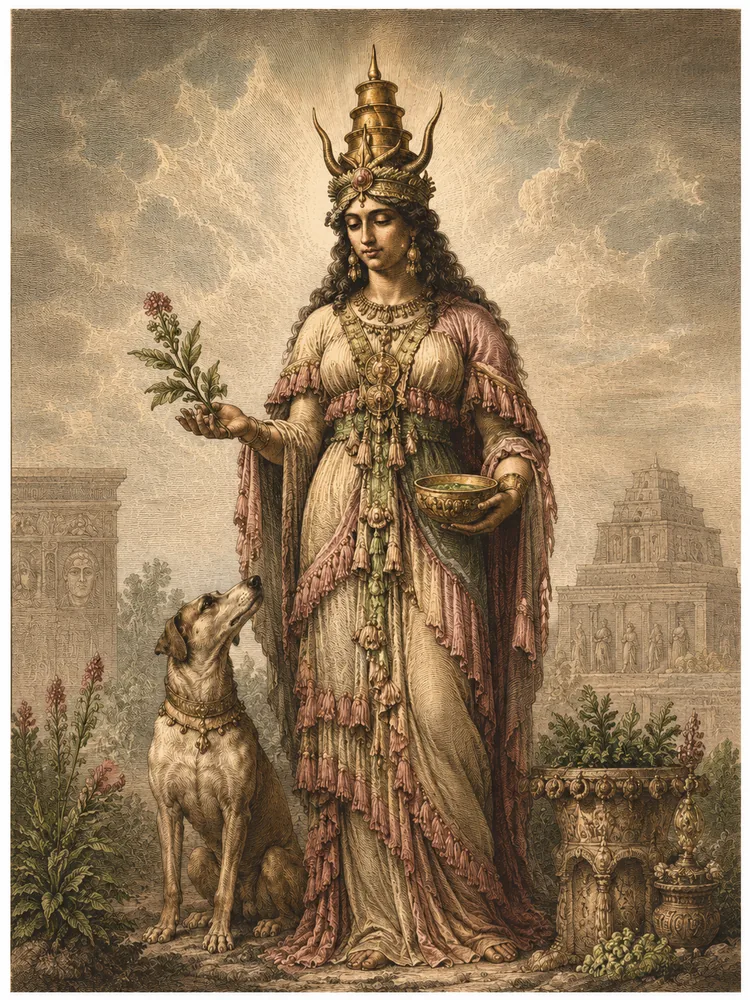
Gula was the great physician of the gods, the lady of healing, who knew the herbs and the words by which sickness was driven away. Her sacred animal was the dog, and dogs were kept at her temples; for the dog's tongue, the Sumerians said, healed the wounds it licked. Her cult-city was Isin, where her temple, the Egalmah "Great Palace," stood; but her shrines were many, and her name was invoked at every sick-bed. To break an oath sworn by Gula was to invite the disease she could withhold or send.
 Before thisEreshkigal
 Next on the wallInanna
Curator’s note
What the sources say, and what later tradition added. The sources for this bay
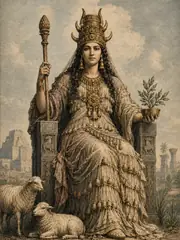
Gula appears under several names — Ninkarrak, Ninisinna ("Lady of Isin"), Bau — that are now thought to represent originally distinct goddesses progressively merged into a single figure of healing. Her iconography, well attested on kudurru boundary stones and seals, regularly shows the dog. The Great Hymn to Gula, attributed to a certain Bullutsa-rabi (probably 11th c. BCE), is one of the longest and most elaborate hymns in the Akkadian corpus; in it Gula systematically identifies herself with each of the other major mother-goddesses of Mesopotamia, in a movement that anticipates later philosophical syncretisms. Her connection with dogs has been confirmed by archaeology: a large pit at the temple of Gula at Isin contained the burials of more than thirty dogs, evidently sacred to her cult.
Kin in the sources
Each tie is quoted from the entry that states it.
 Named as the same god asBau
Gula appears under several names — Ninkarrak, Ninisinna ("Lady of Isin"), Bau
When the sources speak
Dated witnesses for Sumer. A date marks when the evidence was written down, not when the belief began. The whole timeline
- c. 3400–3000 BCE
- Uruk-period writing and monumental temple economies create the earliest recoverable administrative setting for named divine institutions.
- c. 2900–2350 BCE
- Early Dynastic city-states preserve local cults, hymns, royal inscriptions, and god lists; later copies often transmit older compositions.
- c. 2334–2154 BCE
- The Akkadian Empire expands bilingual and imperial patterns of divine identification without erasing local cult titles.
- c. 2112–2004 BCE
- Ur III administration and scribal schooling standardize many Sumerian literary and liturgical forms.
- c. 2000–1600 BCE
- Old Babylonian schools copy major myths, laments, hymns, debates, and heroic narratives in the form most often used by modern editors.
- c. 1650–1200 BCE
- Hittite and Hurrian archives at Hattusa transmit Anatolian myths, imported Syrian materials, and ritual compositions.
- c. 1400–1190 BCE
- The tablets of Ugarit preserve the Baal Cycle, Kirta, Aqhat, ritual lists, and a dense Late Bronze Age West Semitic pantheon.
- c. 1000–612 BCE
- Neo-Assyrian and Neo-Babylonian empires collect, revise, and politically reinterpret older learned traditions.