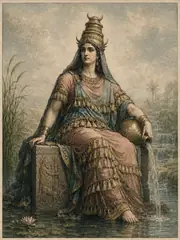
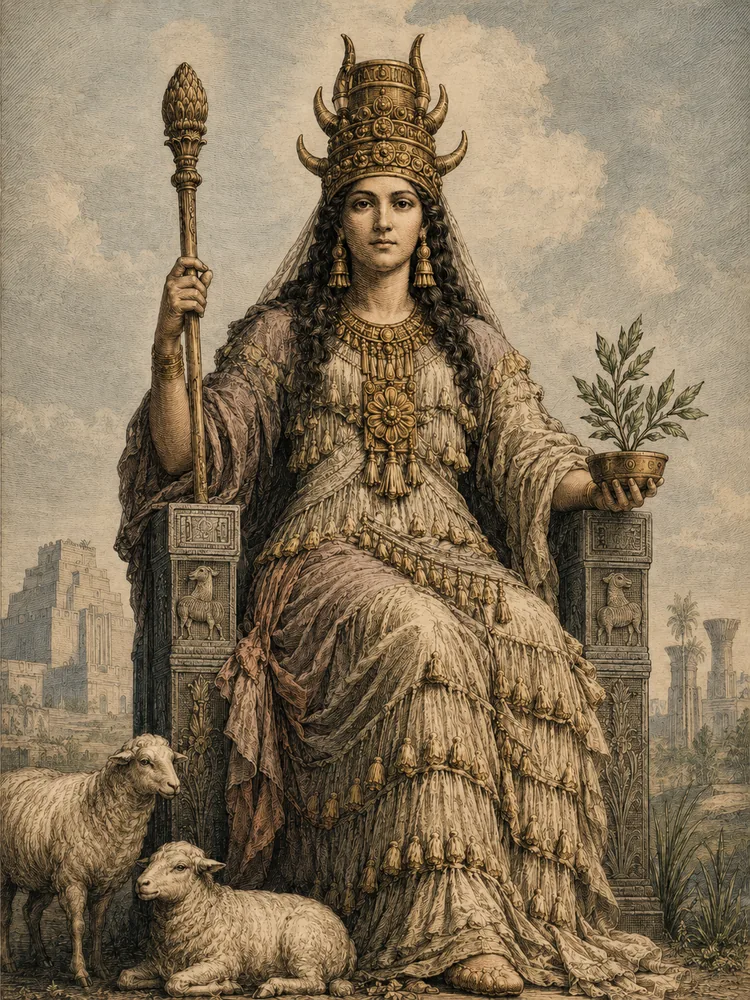
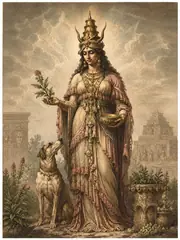
At Lagash and at her sister-city Girsu, in the marshy southland of Sumer, was worshipped the goddess Bau — also called Baba — wife of Ningirsu the warrior-god of those cities, and lady of healing. Her sacred animal was the dog, in honor of the curative properties the Mesopotamians attributed to canine saliva; and her great temple at Girsu, the Eninnu, was built for her husband Ningirsu and elaborated by king Gudea about 2125 BCE in cylinders of inscribed clay which preserve some of the most beautiful Sumerian temple-poetry to come down to us.
To Bau the people of Lagash brought their illnesses, and from her they hoped for restoration. She received the New Year's reconciliation rites of her city; she was patroness of midwives; she was, in many respects, the southern counterpart of the better-known Gula of Isin, with whom in later Mesopotamian times she was regularly identified, until in the end the two were nearly one goddess under two names.
When the sources speak
Dated witnesses for Sumer. A date marks when the evidence was written down, not when the belief began. The whole timeline
- c. 3400–3000 BCE
- Uruk-period writing and monumental temple economies create the earliest recoverable administrative setting for named divine institutions.
- c. 2900–2350 BCE
- Early Dynastic city-states preserve local cults, hymns, royal inscriptions, and god lists; later copies often transmit older compositions.
- c. 2334–2154 BCE
- The Akkadian Empire expands bilingual and imperial patterns of divine identification without erasing local cult titles.
- c. 2112–2004 BCE
- Ur III administration and scribal schooling standardize many Sumerian literary and liturgical forms.
- c. 2000–1600 BCE
- Old Babylonian schools copy major myths, laments, hymns, debates, and heroic narratives in the form most often used by modern editors.
- c. 1650–1200 BCE
- Hittite and Hurrian archives at Hattusa transmit Anatolian myths, imported Syrian materials, and ritual compositions.
- c. 1400–1190 BCE
- The tablets of Ugarit preserve the Baal Cycle, Kirta, Aqhat, ritual lists, and a dense Late Bronze Age West Semitic pantheon.
- c. 1000–612 BCE
- Neo-Assyrian and Neo-Babylonian empires collect, revise, and politically reinterpret older learned traditions.