A Compendium of the Ancient Gods
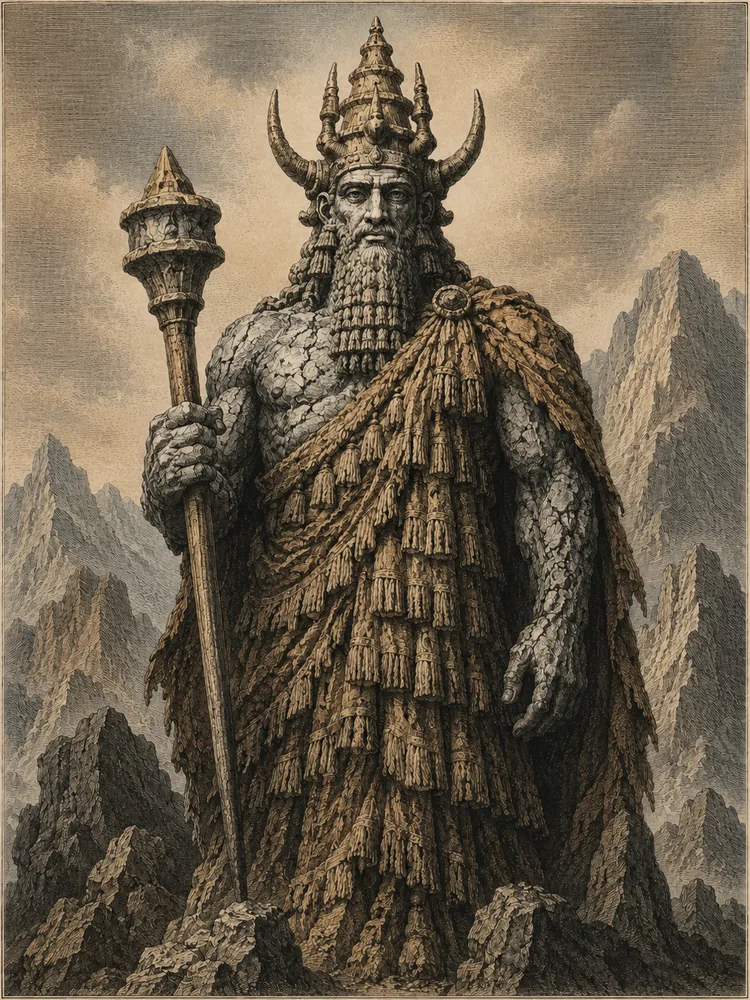
Asag, plate

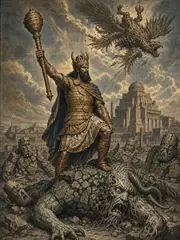
In the high mountain country to the north and east of Sumer, where the rivers had their sources and the foreign peoples their dwellings, there dwelt a being which the Sumerians called Asag — a monstrous offspring of An the heaven and Ki the earth, born of the marriage of those great powers but turned out, by some defect in his making, hideous and inimical to the order of things. He raised up an army from the stones of the mountains, that they should march down upon Sumer and devour it; and the gods, in council, knew not what to do.

The hero of the matter was Ninurta, the warrior-son of Enlil. Armed with his terrible mace Sharur — a weapon which spoke and gave counsel, the most articulate of all weapons in any literature — he rode forth in the storm-chariot to meet Asag in the foothills. The poem of Ninurta's exploit, the Lugal-e ("O King!"), describes the battle in towering verse: the dust storms raised by their meeting, the warning Sharur shouts to its master, the great heat that scorches the slopes, the final overthrow of Asag in the rubble of his own army.

From the stones of the slain, Ninurta made the new world that follows victory: he assigned each stone its proper purpose — limestone for building, lapis for ornament, alabaster for cult-vessels — and brought back to Sumer the materials of civilization. So the storm-god's defeat of the chaos-monster was not only an act of cosmic preservation but an act of cosmic provision; the world, after his fight, was richer than before.
Curator’s note

What the sources say, and what later tradition added. The sources for this bay

Asag (Akkadian Asakku) is the principal monster of the Sumerian poem Lugal-e, sometimes called Ninurta and Asag, a composition of perhaps three hundred lines preserved in Old Babylonian copies of an older Sumerian original. In later Akkadian incantation literature, Asakku becomes a class of disease-demons rather than a single figure, and is conjured against in the series Asakku Marṣutu. The Lugal-e is the principal Sumerian instance of a mythological pattern — the storm-god's defeat of a primordial monster in the high country, after which the world is reordered — that recurs widely in Indo-European tradition, in Indra's killing of Vritra, in Zeus's defeat of Typhon, in Thor's struggles with the giants. Whether these parallels reflect ancient diffusion or a common human pattern is a perennial question; the Sumerian instance is among the earliest written evidence of the type.

Kin in the sources

Each tie is quoted from the entry that states it.

When the sources speak

Dated witnesses for Sumer. A date marks when the evidence was written down, not when the belief began. The whole timeline

c. 3400–3000 BCE
Uruk-period writing and monumental temple economies create the earliest recoverable administrative setting for named divine institutions.
c. 2900–2350 BCE
Early Dynastic city-states preserve local cults, hymns, royal inscriptions, and god lists; later copies often transmit older compositions.
c. 2334–2154 BCE
The Akkadian Empire expands bilingual and imperial patterns of divine identification without erasing local cult titles.
c. 2112–2004 BCE
Ur III administration and scribal schooling standardize many Sumerian literary and liturgical forms.
c. 2000–1600 BCE
Old Babylonian schools copy major myths, laments, hymns, debates, and heroic narratives in the form most often used by modern editors.
c. 1650–1200 BCE
Hittite and Hurrian archives at Hattusa transmit Anatolian myths, imported Syrian materials, and ritual compositions.
c. 1400–1190 BCE
The tablets of Ugarit preserve the Baal Cycle, Kirta, Aqhat, ritual lists, and a dense Late Bronze Age West Semitic pantheon.
c. 1000–612 BCE
Neo-Assyrian and Neo-Babylonian empires collect, revise, and politically reinterpret older learned traditions.

Floor plan

The rooms follow one another in the order their peoples first appear in the written record.

  1. The Cradle of Citiesc. 3400 BCE to 395 CE. 115 works
  2. The Gift of the Nilec. 4000 BCE to 395 CE. 73 works
  3. The Olympian Orderc. 1600 BCE to 750 CE. 152 works
  4. The Persian Worldc. 2000 BCE to 1010 CE. 30 works
  5. The Levantine Borderlandsc. 1200 BCE to 500 CE. 20 works
  6. The Edges of Empirec. 2000 BCE to 1500 CE. 33 works
  7. The Etruscan Worldc. 900 BCE to 750 CE. 22 works
  8. The Roman Inheritancec. 1200 BCE to 500 CE. 58 works
  9. The Northern Inheritancec. 2000 BCE to 1600 CE. 131 works