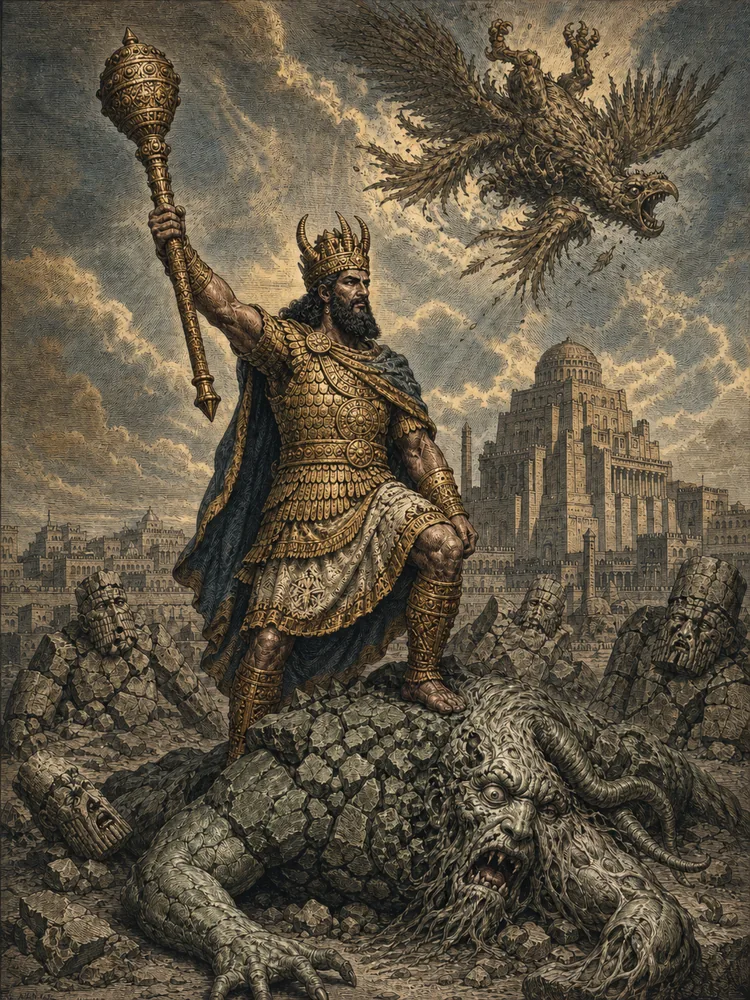
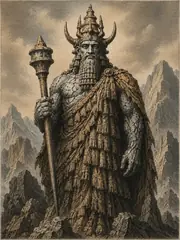
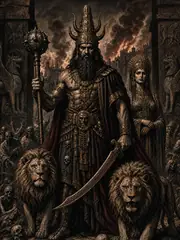
Ninurta was the warrior of Enlil's house, the champion sent out to fight the battles of the gods. He held a great mace called Sharur, "the Smasher of Thousands"; and the mace itself spoke, and gave him counsel. He was lord of the plough as well as the spear; the irrigation works of Sumer were ascribed to him, and the spring rains.
In the great mountain country east of Sumer there lived a monster called the Asag, a being neither stone nor flesh, who took as his army the rocks and the boulders of the highlands, and made war upon the gods of the plain. Ninurta went up against him. The first battle went ill, and Ninurta retreated; but Sharur the mace flew back to Enlil and asked counsel, and returned with strategy. In the second engagement, Ninurta brought down a storm of arrows and slew the Asag at last. Then he piled up the stones of the slain monster as a great wall, and dammed the bitter rivers behind it; and he turned the waters into the canals of Sumer, that the fields might drink. The stones themselves he judged: this one he cursed, that it should be soft and useless; this one he blessed, that it should hold up the city walls; another, that it should be the touchstone of the merchant. So out of his victory came at once the irrigation system of the land, and the proper hierarchy of the minerals.
Curator’s note
What the sources say, and what later tradition added. The sources for this bay
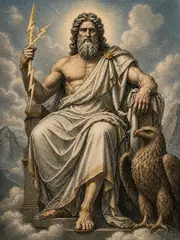
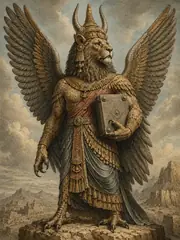
This story is told in Lugal-e ud me-lám-bi nir-ǧál (commonly Lugal-e), a Sumerian narrative poem of about 700 lines preserved in copies from Old Babylonian Nippur and Ur. It is among the longest and most theologically elaborate of Sumerian compositions, and it functions on at least two levels: as a victory-myth of the storm/warrior god, and as an etiology for the geography and the geology of southern Mesopotamia. A second composition, Angim, treats Ninurta's triumphal return; a third, the Anzud bird myth, treats his recovery of the stolen Tablet of Destinies. Ninurta's Akkadian counterpart, also Ninurta, was the patron of the Assyrian city of Kalhu (Nimrud); his iconography there shows him pursuing the Anzud bird with thunderbolts, in scenes that may stand behind some elements of later Greek Zeus-Typhon imagery.
When the sources speak
Dated witnesses for Sumer. A date marks when the evidence was written down, not when the belief began. The whole timeline
- c. 3400–3000 BCE
- Uruk-period writing and monumental temple economies create the earliest recoverable administrative setting for named divine institutions.
- c. 2900–2350 BCE
- Early Dynastic city-states preserve local cults, hymns, royal inscriptions, and god lists; later copies often transmit older compositions.
- c. 2334–2154 BCE
- The Akkadian Empire expands bilingual and imperial patterns of divine identification without erasing local cult titles.
- c. 2112–2004 BCE
- Ur III administration and scribal schooling standardize many Sumerian literary and liturgical forms.
- c. 2000–1600 BCE
- Old Babylonian schools copy major myths, laments, hymns, debates, and heroic narratives in the form most often used by modern editors.
- c. 1650–1200 BCE
- Hittite and Hurrian archives at Hattusa transmit Anatolian myths, imported Syrian materials, and ritual compositions.
- c. 1400–1190 BCE
- The tablets of Ugarit preserve the Baal Cycle, Kirta, Aqhat, ritual lists, and a dense Late Bronze Age West Semitic pantheon.
- c. 1000–612 BCE
- Neo-Assyrian and Neo-Babylonian empires collect, revise, and politically reinterpret older learned traditions.