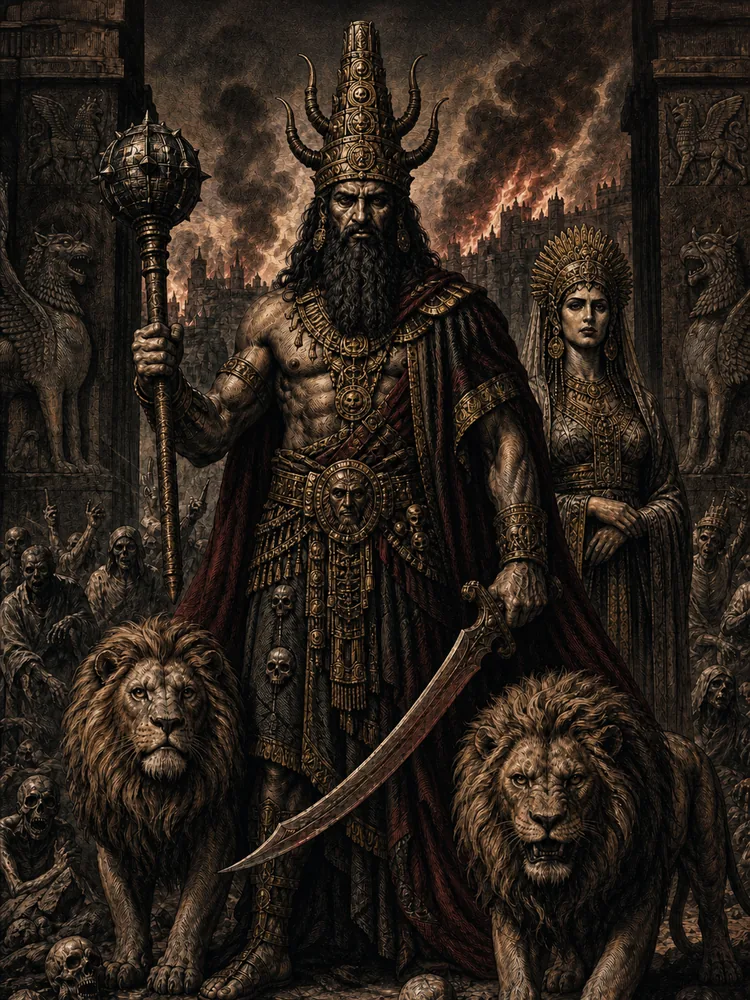
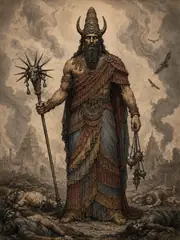
Nergal was the god of all that burns: the fever of plague, the heat of high summer, the fire of the funeral pyre. He was a warrior god, fierce and ungovernable, the patron of Kutha, where his temple Emeslam stood. His weapon was the mace, his beast the lion; his train was the seven plague-demons, called Sebitti, who went out before him into battle. He was a son of Enlil, brother to Nanna and Ninurta; and his fate was sealed when he descended to the underworld and took Ereshkigal to wife (as told in her entry above). Thereafter Nergal sat enthroned beside her in the great below, and was lord of the dead alongside her, and the plagues and the fevers were dispatched by his hand.
 Before thisNanshe
 Next on the wallNingishzida
Curator’s note
What the sources say, and what later tradition added. The sources for this bay
Nergal (Sumerian Erra in some traditions, though Erra is sometimes treated as a distinct figure) appears in numerous compositions, of which the most important are Nergal and Ereshkigal (in Middle and Standard Babylonian recensions) and the Erra Epic, a five-tablet Akkadian poem of the late second millennium BCE attributed to one Kabti-ilani-Marduk, in which Nergal/Erra rampages through Babylonia until he is at length pacified. The Erra Epic was prized as an apotropaic text; copies of it were kept in households as protection against plague. Nergal's identification with the planet Mars is attested in late Babylonian astronomical texts; the link between war-god and red planet is one of the few elements of Mesopotamian religion to have survived continuously into Western astrology.
Kin in the sources
Each tie is quoted from the entry that states it.
 Child ofEnlil
He was a son of Enlil, brother to Nanna and Ninurta
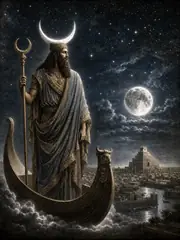 Sibling ofNanna
He was a son of Enlil, brother to Nanna and Ninurta
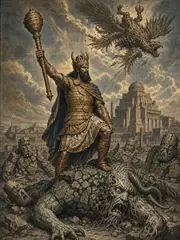 Sibling ofNinurta
He was a son of Enlil, brother to Nanna and Ninurta
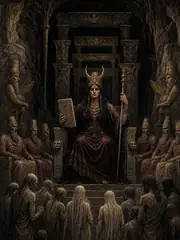 Consort ofEreshkigal
he descended to the underworld and took Ereshkigal to wife
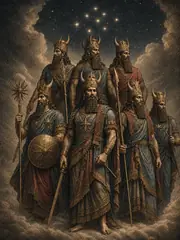 Companion ofThe Sebitti
his train was the seven plague-demons, called Sebitti, who went out before him into battle
 Named as the same god asErra
Nergal (Sumerian Erra in some traditions, though Erra is sometimes treated as a distinct figure)
 Child ofNinlil
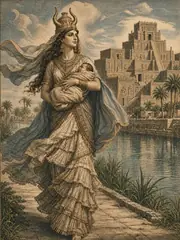
She was the mother of Nanna the moon, of Nergal, of Ninazu, of Enbilulu
The same god in other rooms
The ancient sources themselves name these as one god under different names. See Nergal and Erra hung together
When the sources speak
Dated witnesses for Sumer. A date marks when the evidence was written down, not when the belief began. The whole timeline
- c. 3400–3000 BCE
- Uruk-period writing and monumental temple economies create the earliest recoverable administrative setting for named divine institutions.
- c. 2900–2350 BCE
- Early Dynastic city-states preserve local cults, hymns, royal inscriptions, and god lists; later copies often transmit older compositions.
- c. 2334–2154 BCE
- The Akkadian Empire expands bilingual and imperial patterns of divine identification without erasing local cult titles.
- c. 2112–2004 BCE
- Ur III administration and scribal schooling standardize many Sumerian literary and liturgical forms.
- c. 2000–1600 BCE
- Old Babylonian schools copy major myths, laments, hymns, debates, and heroic narratives in the form most often used by modern editors.
- c. 1650–1200 BCE
- Hittite and Hurrian archives at Hattusa transmit Anatolian myths, imported Syrian materials, and ritual compositions.
- c. 1400–1190 BCE
- The tablets of Ugarit preserve the Baal Cycle, Kirta, Aqhat, ritual lists, and a dense Late Bronze Age West Semitic pantheon.
- c. 1000–612 BCE
- Neo-Assyrian and Neo-Babylonian empires collect, revise, and politically reinterpret older learned traditions.