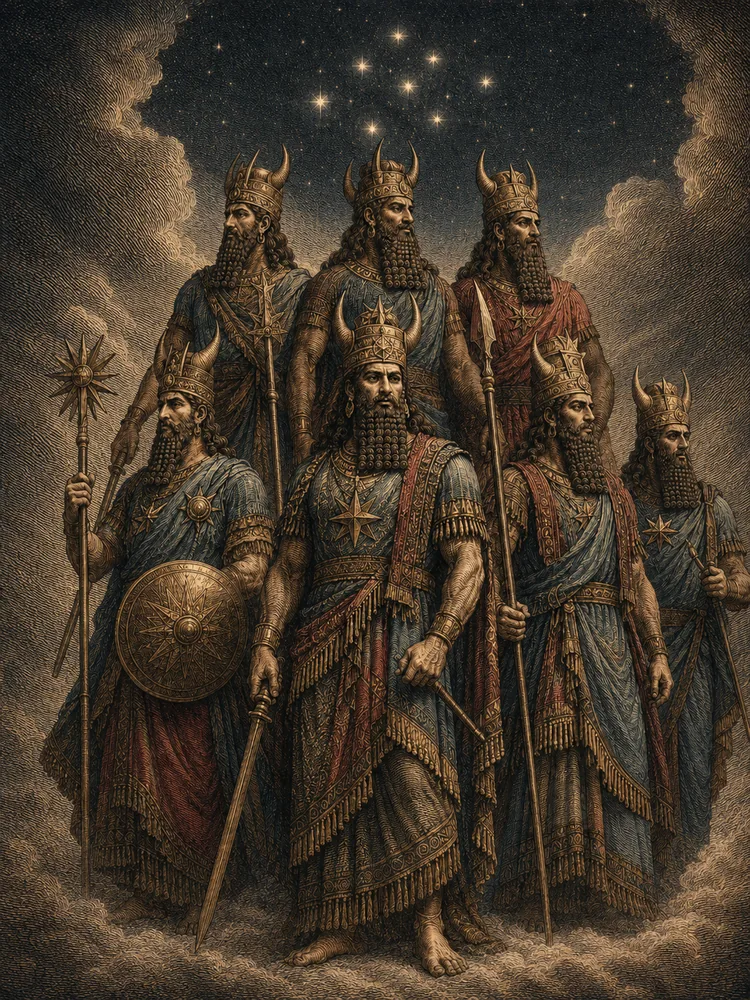
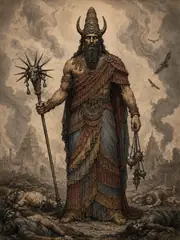
Among the lesser warrior-gods of Akkadian religion were a group of seven who acted always together, sharing a single mind and a single ferocity: the Sebitti, or "the Seven." They were the children of Anu and the earth; they were sometimes identified with the seven stars of the cluster the Greeks called the Pleiades; and they were dispatched by the high gods upon errands of war or pestilence too violent for any single deity to undertake alone.
It was the Seven who, in the Erra Epic, persuaded their kinsman Erra to wake from his long peace and resume the work of war. They came to him in his chamber; they reproached him with his sloth; they sang to him of the great campaigns of former days, of cities falling and rivers flowing red, of the joys of the warrior who lives by the sword. Erra was inflamed; the slaughter that follows is, in part, theirs.
But the Seven were not always destructive. Bound and invoked properly, they were also protectors; and small clay or stone amulets bearing their figures, or naming them, were carried as a kind of double-edged talisman — for what could rouse such gods could also, if rightly approached, command them.
When the sources speak
Dated witnesses for Akkad, Babylon and Assyria. A date marks when the evidence was written down, not when the belief began. The whole timeline
- c. 3400–3000 BCE
- Uruk-period writing and monumental temple economies create the earliest recoverable administrative setting for named divine institutions.
- c. 2900–2350 BCE
- Early Dynastic city-states preserve local cults, hymns, royal inscriptions, and god lists; later copies often transmit older compositions.
- c. 2334–2154 BCE
- The Akkadian Empire expands bilingual and imperial patterns of divine identification without erasing local cult titles.
- c. 2112–2004 BCE
- Ur III administration and scribal schooling standardize many Sumerian literary and liturgical forms.
- c. 2000–1600 BCE
- Old Babylonian schools copy major myths, laments, hymns, debates, and heroic narratives in the form most often used by modern editors.
- c. 1650–1200 BCE
- Hittite and Hurrian archives at Hattusa transmit Anatolian myths, imported Syrian materials, and ritual compositions.
- c. 1400–1190 BCE
- The tablets of Ugarit preserve the Baal Cycle, Kirta, Aqhat, ritual lists, and a dense Late Bronze Age West Semitic pantheon.
- c. 1000–612 BCE
- Neo-Assyrian and Neo-Babylonian empires collect, revise, and politically reinterpret older learned traditions.