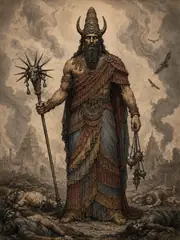
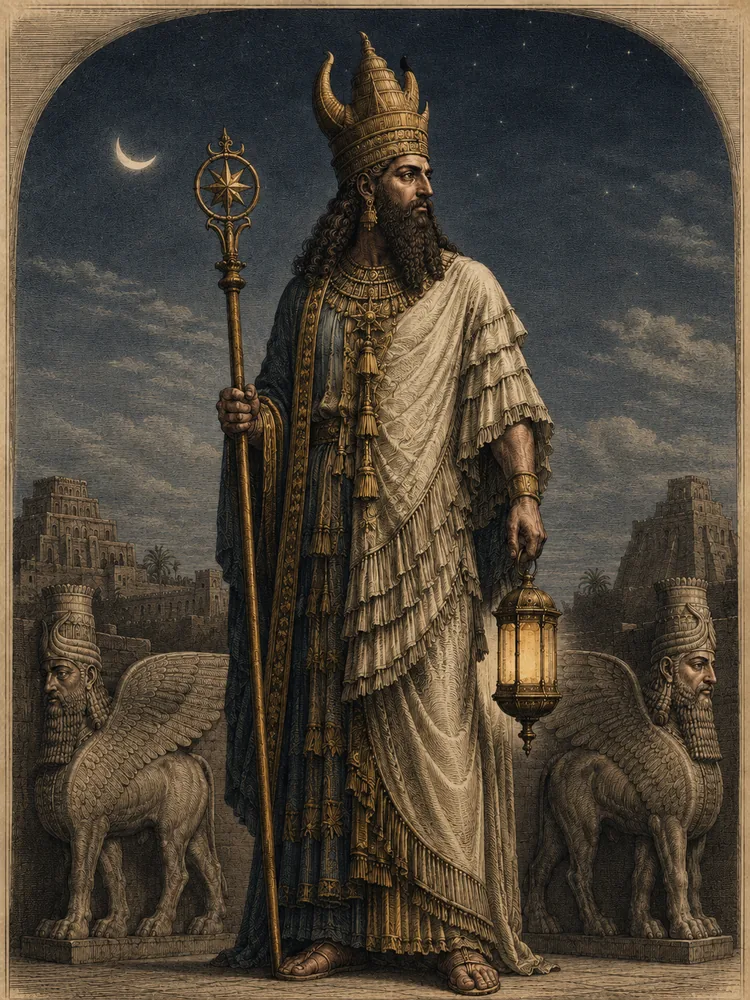
Beside Erra walked his herald Ishum — the watchman of the night, the bearer of the lamp. Where Erra was the rage of slaughter, Ishum was the steady fire of an unsleeping witness; he carried the torch in the dark hours when no man stirred, and he saw what his master did, and he kept account.
In the Erra Epic, it is Ishum who at last halts the killing. He does so not by reproach — for Erra is past reproach — but by description. He recites, with terrible exactitude, the list of cities Erra has overturned, the temples desecrated, the just men slain; and he does this not in tones of accusation but in the voice of a herald rendering account, as it were, of a campaign concluded. Erra, hearing the catalogue, recognizes his own work and is at last sated. He stops; he sits; he allows himself to be praised. The poem grants Ishum credit for this; it grants him also the unusual honor (for a Mesopotamian minor god) of being addressed by the protagonist as "good adviser."
Curator’s note
What the sources say, and what later tradition added. The sources for this bay
Ishum, in older Sumerian known as Hendursaga, is principally the companion-figure of Erra in the Erra Epic, but he had his own modest cult and his own hymns (which survive partially in Sumerian copies). His association with the night-fire — the lamp that watches while men sleep — gives him a function unusual among Mesopotamian gods: he is patron of nocturnal vigilance, the steady alertness that does not sleep. The Erra Epic's structural use of him as the merciful counter-voice to a destructive god is among the more sophisticated theological balances in Akkadian literature; it suggests that the Mesopotamians could imagine, within the same divine assembly, both the rage that destroys and the steady watching that, eventually, calls a halt.
When the sources speak
Dated witnesses for Akkad, Babylon and Assyria. A date marks when the evidence was written down, not when the belief began. The whole timeline
- c. 3400–3000 BCE
- Uruk-period writing and monumental temple economies create the earliest recoverable administrative setting for named divine institutions.
- c. 2900–2350 BCE
- Early Dynastic city-states preserve local cults, hymns, royal inscriptions, and god lists; later copies often transmit older compositions.
- c. 2334–2154 BCE
- The Akkadian Empire expands bilingual and imperial patterns of divine identification without erasing local cult titles.
- c. 2112–2004 BCE
- Ur III administration and scribal schooling standardize many Sumerian literary and liturgical forms.
- c. 2000–1600 BCE
- Old Babylonian schools copy major myths, laments, hymns, debates, and heroic narratives in the form most often used by modern editors.
- c. 1650–1200 BCE
- Hittite and Hurrian archives at Hattusa transmit Anatolian myths, imported Syrian materials, and ritual compositions.
- c. 1400–1190 BCE
- The tablets of Ugarit preserve the Baal Cycle, Kirta, Aqhat, ritual lists, and a dense Late Bronze Age West Semitic pantheon.
- c. 1000–612 BCE
- Neo-Assyrian and Neo-Babylonian empires collect, revise, and politically reinterpret older learned traditions.