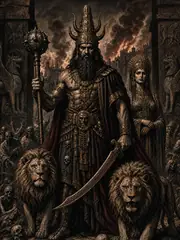
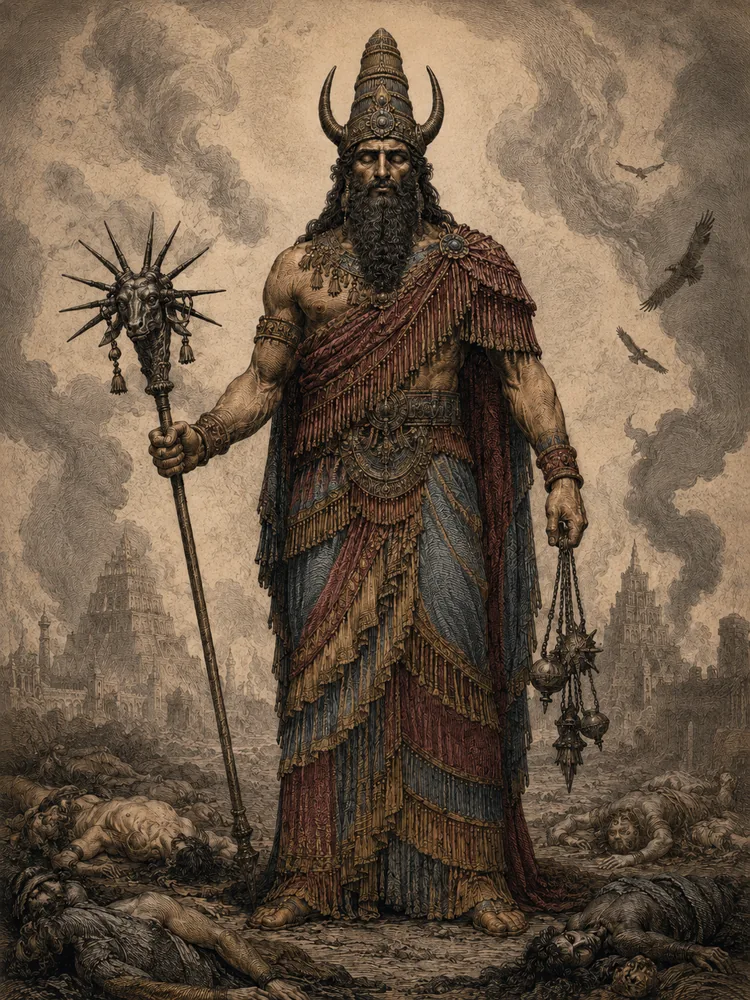
There were times in Mesopotamia when plague swept the cities, when armies came down from the mountains, when the harvest failed and the rivers ran red, and the surviving people sought a god to whom they might attribute the calamity. That god was Erra — sometimes called Irra, sometimes identified with Nergal of Cutha — the god of plague and indiscriminate war, whose passions were not the cold strategies of high gods but the hot frenzies of slaughter for slaughter's sake.
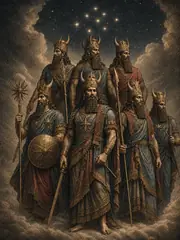
His great epic, composed (so a colophon tells us) by one Kabti-ilani-Marduk, who claimed to have received it in a dream from Ishum the herald, runs to five tablets and tells how Erra was incited to madness by his Seven companions, the Sebitti, who whispered to him that war was being neglected and that his weapons were rusting. Erra was persuaded. He approached Marduk, who was then ruling at Babylon, and tricked the great god into stepping down briefly from his throne — for Marduk's robes, said Erra, needed cleaning, and Marduk in his vanity agreed to allow this. The throne empty, Erra raged. He overturned the cities of the south; he set brother against brother; he laid waste sanctuaries and good men together with bad. The poem describes his violence with appalling vividness, in the voice of a god who recognizes no proportion.
It was Ishum, his herald, who at last persuaded him to stop — not by argument but by reciting back to him the catalogue of his own destructions, until even Erra was sated with what he had done. The poem ends with Erra accepting praise as a scourge of mankind: a frightening conclusion, and one which Babylonian and Assyrian readers seem to have valued, for fragments and amulets quoting the epic's final lines were carried as protections against plague.