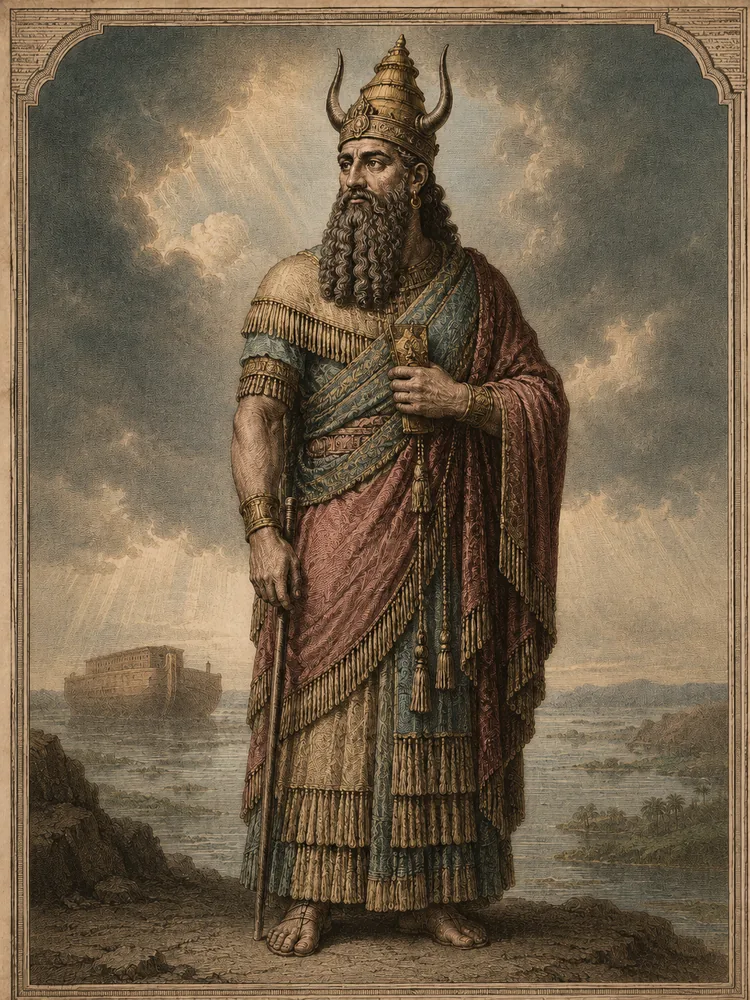
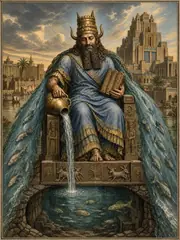
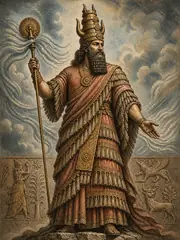
Long before the time of recorded kings, there lived in Sumer a man named Atrahasis — "the Exceeding Wise" — whom the gods would single out from all his generation for survival when they decided to destroy mankind. The Sumerians called him Ziusudra, the Babylonians Atrahasis or Utnapishtim; the variations are of name only, and the substance of the story is one.
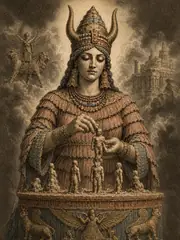
In the Atrahasis Epic, the Babylonian poem which preserves the fullest version, the affair runs thus. The lesser gods, weary of their labor, had revolted, and Enki had advised that mankind be made to take their burden — clay mixed with the blood of a slain god, pinched into shape by Belet-ili the mother. Mankind multiplied; mankind was noisy; the noise of human cities rose up to Enlil's hearing and disturbed his rest. Enlil sent plagues, drought, famine; each time, Enki taught Atrahasis some means of relief, until at last Enlil grew angry that the punishments were not effective, and called for the Flood.
The gods were sworn to secrecy; but Enki, bound by oath, found his usual loophole. He did not tell Atrahasis directly. He came down to the reed wall of Atrahasis's hut and addressed the wall: "Reed wall, reed wall! Listen, listen! Tear down the house, build a ship; abandon possessions, save life; take aboard the seed of all living things." Atrahasis, listening on the other side of the wall, heard. He built his ship; he loaded it with his family and his beasts; the rains came, and for seven days the world was water, and at the end of seven days the ship grounded on a mountain, and Atrahasis sent forth a dove, and a swallow, and a raven, and the third did not return. He came forth, and offered sacrifice; and the gods, who had been suffering hunger in the absence of their human servants, came down to the smoke of his sacrifice like flies, and Enlil — who had been angry to find a survivor — was at last persuaded by Enki to grant Atrahasis and his wife eternal life and to set them apart at "the source of the rivers," where the Mesopotamians believed the world's edge to be.
Curator’s note
What the sources say, and what later tradition added. The sources for this bay
The Atrahasis Epic, in its Old Babylonian recension (c. 1700 BCE), is preserved on three tablets and gives the most complete extant version of the Mesopotamian flood. The same story appears in fragments of an older Sumerian Flood Tablet (where the hero is Ziusudra), and reaches its most famous form on Tablet XI of the Standard Babylonian Gilgamesh Epic, where Utnapishtim ("He Found Life") tells it to Gilgamesh in his immortal exile. The literary kinship of these accounts to the biblical Flood of Genesis 6–9 is now universally recognized: the building of the ship, the loading of the animals, the duration of the rains, the grounding on a mountain, the sending of the birds, the sacrifice on emergence, the divine response to the sacrifice — all are shared. That the Hebrew text is the borrower is the consensus position, though the precise mechanism of borrowing — whether literary, oral, or substrate — remains debated.
When the sources speak
Dated witnesses for Akkad, Babylon and Assyria. A date marks when the evidence was written down, not when the belief began. The whole timeline
- c. 3400–3000 BCE
- Uruk-period writing and monumental temple economies create the earliest recoverable administrative setting for named divine institutions.
- c. 2900–2350 BCE
- Early Dynastic city-states preserve local cults, hymns, royal inscriptions, and god lists; later copies often transmit older compositions.
- c. 2334–2154 BCE
- The Akkadian Empire expands bilingual and imperial patterns of divine identification without erasing local cult titles.
- c. 2112–2004 BCE
- Ur III administration and scribal schooling standardize many Sumerian literary and liturgical forms.
- c. 2000–1600 BCE
- Old Babylonian schools copy major myths, laments, hymns, debates, and heroic narratives in the form most often used by modern editors.
- c. 1650–1200 BCE
- Hittite and Hurrian archives at Hattusa transmit Anatolian myths, imported Syrian materials, and ritual compositions.
- c. 1400–1190 BCE
- The tablets of Ugarit preserve the Baal Cycle, Kirta, Aqhat, ritual lists, and a dense Late Bronze Age West Semitic pantheon.
- c. 1000–612 BCE
- Neo-Assyrian and Neo-Babylonian empires collect, revise, and politically reinterpret older learned traditions.