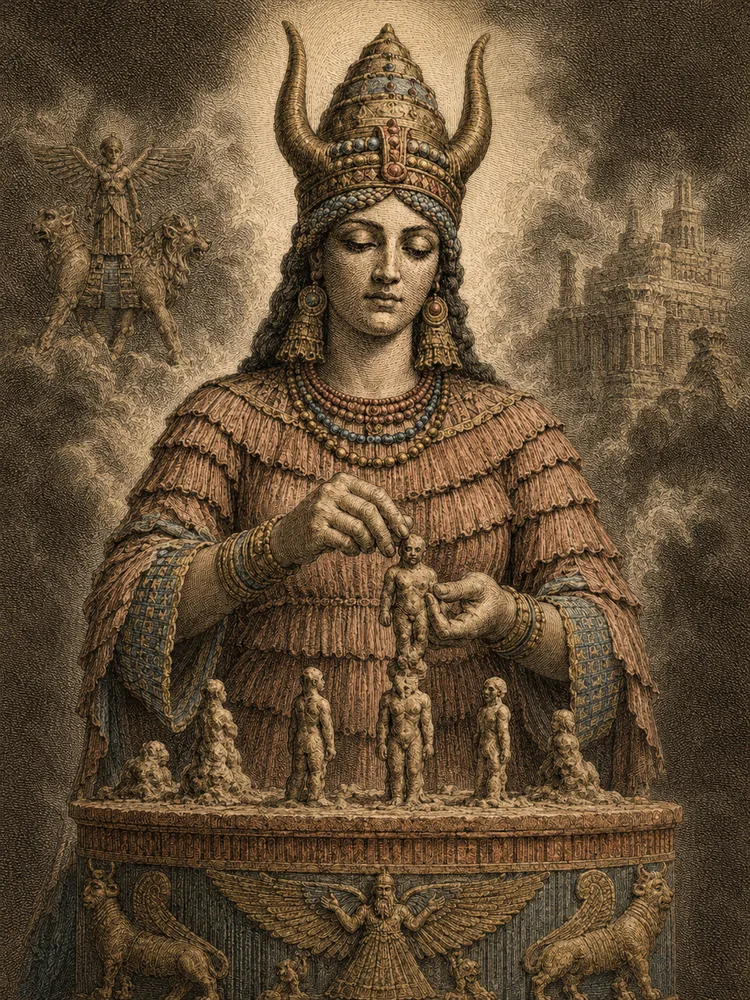
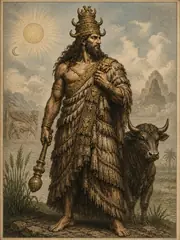
Of all the Mesopotamian goddesses, the most fundamental in function was the one called by the Akkadians Belet-ili — "the Lady of the Gods" — and known under many other names: Mami, Nintu, Ninmah, Aruru. She was the mother of mankind, the goddess who at the gods' command took up clay from the marshes and pinched it into the shape of human beings, that humanity might bear the labor the gods had wearied of.
The story is told most fully in the Atrahasis Epic, where the lesser gods, exhausted with the digging of the great irrigation canals, throw down their tools and refuse to work. Enki proposes a remedy: let mankind be made, that mankind may bear the burden. The proposal accepted, a god named We-ila is slain, his blood mixed with clay, and Belet-ili takes up the mass and shapes it into fourteen embryos — seven male, seven female — which she gives to fourteen birth-goddesses to bring to term. So the human race began, with divine spirit in clay flesh.
She was thereafter the patroness of birth, and of midwives, and of the womb itself; for the Mesopotamians, her name was on the lips of every laboring woman. In some traditions, she is identified with Ninhursag the Lady of the Foothills; in others, she is distinct, and Ninhursag is treated as her sister or her counterpart. The variations matter less than the steady fact: where children are coming into the world, Belet-ili is at hand.
Curator’s note
What the sources say, and what later tradition added. The sources for this bay
Belet-ili appears under multiple names — Mami, Mama, Ninmah, Nintu, Aruru — across Sumerian and Akkadian sources, and the relations among these names is a matter of long scholarly discussion. The principal narrative of human creation by clay is preserved in the Old Babylonian Atrahasis Epic, where the technical terminology of midwifery is reused as cosmological language. The slain god We-ila (sometimes Geshtu-e), whose blood gives the human creature its divine spirit, is one of the more theologically interesting figures in Mesopotamian myth — a deity sacrificed to make humanity, leaving in every human being a trace of divine substance. The structural parallel to Genesis 2:7, where God forms man of the dust of the ground and breathes into his nostrils the breath of life, has been remarked since the discovery of Atrahasis; the question of dependence is one of the perennial debates of comparative religion.
When the sources speak
Dated witnesses for Akkad, Babylon and Assyria. A date marks when the evidence was written down, not when the belief began. The whole timeline
- c. 3400–3000 BCE
- Uruk-period writing and monumental temple economies create the earliest recoverable administrative setting for named divine institutions.
- c. 2900–2350 BCE
- Early Dynastic city-states preserve local cults, hymns, royal inscriptions, and god lists; later copies often transmit older compositions.
- c. 2334–2154 BCE
- The Akkadian Empire expands bilingual and imperial patterns of divine identification without erasing local cult titles.
- c. 2112–2004 BCE
- Ur III administration and scribal schooling standardize many Sumerian literary and liturgical forms.
- c. 2000–1600 BCE
- Old Babylonian schools copy major myths, laments, hymns, debates, and heroic narratives in the form most often used by modern editors.
- c. 1650–1200 BCE
- Hittite and Hurrian archives at Hattusa transmit Anatolian myths, imported Syrian materials, and ritual compositions.
- c. 1400–1190 BCE
- The tablets of Ugarit preserve the Baal Cycle, Kirta, Aqhat, ritual lists, and a dense Late Bronze Age West Semitic pantheon.
- c. 1000–612 BCE
- Neo-Assyrian and Neo-Babylonian empires collect, revise, and politically reinterpret older learned traditions.