A Compendium of the Ancient Gods
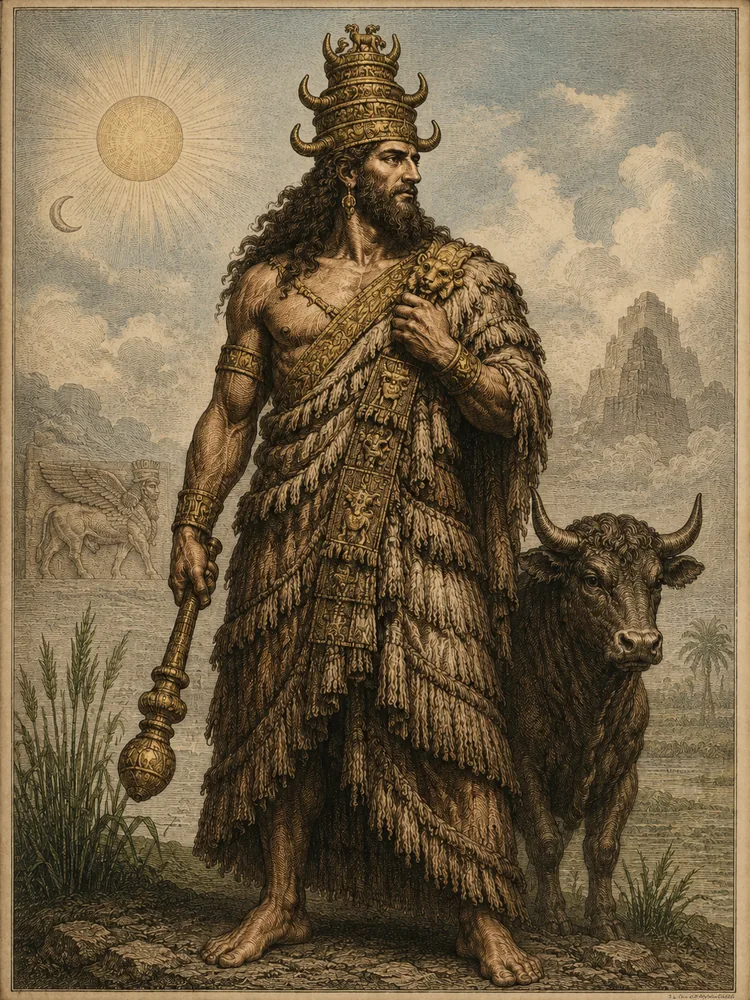
Enkidu, plate

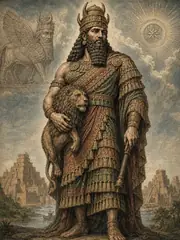
When Gilgamesh's oppressions of Uruk grew unbearable to the people, and they cried out to the gods for relief, the goddess Aruru — who had once made mankind from clay — was bidden by Anu to make an equal match for the king. She washed her hands, took clay from the riverbank, and pinched it into shape; and the figure she made was Enkidu — strong as Gilgamesh, fierce as Gilgamesh, but unkinged and unhoused, set down upon the steppe to live among the gazelles, eating grass with the wild herds, drinking with them at the watering-holes.

Enkidu was discovered by a hunter, who had come upon his traps unset and the trapped beasts freed by this strange wild man; the hunter went to Uruk, and Gilgamesh sent the temple-prostitute Shamhat into the wilderness to civilize Enkidu by the means proper to her art. Six days and seven nights Shamhat lay with him; and at the end of that time, Enkidu found that the gazelles fled from him, that the herd no longer knew him for one of their own. Shamhat fed him bread and beer; she clothed him; she taught him to wash and anoint himself; and she brought him at last to Uruk to meet the king who had been made his equal.

Of his bond with Gilgamesh — of their wrestling-match in the city street, of their journey to the Cedar Forest, of their slaying of Humbaba and of the Bull of Heaven — the Epic gives a fuller account than this volume can repeat. It is enough here to say that the gods, looking down, decided that the killings could not go unanswered, and that one of the two friends must die. They chose Enkidu. He sickened of an illness no medicine could touch; he dreamed dreams of being dragged by a winged demon into the dark House of Dust; and he died. Gilgamesh, who had not understood until then what death was, sat with the body for seven days and seven nights, refusing to let it be buried, until a worm fell from Enkidu's nose and the king at last conceded that mortality was real.
Curator’s note

What the sources say, and what later tradition added. The sources for this bay

The grief of Gilgamesh for Enkidu, in Tablets VIII and following of the Standard Babylonian Epic, is the principal emotional center of the work. The intimacy of the friendship — the dreams shared, the embraces, the lament for the friend loved beyond speech — has prompted modern readers to ask whether the relationship is to be understood as erotic. Sumerian and Akkadian texts use vocabulary which is consistent with either reading; the cultures of the ancient Near East drew the modern lines between friendship and lover-relations less sharply than we do, and the question may be in part a question we are imposing. What is clear, in the text as it stands, is that Enkidu's death undoes Gilgamesh utterly, and that the king's quest for immortality begins not from philosophical curiosity but from inconsolable loss. The civilizing-by-Shamhat episode — which Mesopotamian literature treats as straightforwardly redemptive — has been read by some moderns as a fall narrative analogous to Eden, since Enkidu loses his prelapsarian unity with the animals through erotic knowledge; the parallel is striking but should not be pressed too hard.

Kin in the sources

Each tie is quoted from the entry that states it.

When the sources speak

Dated witnesses for Sumer. A date marks when the evidence was written down, not when the belief began. The whole timeline

c. 3400–3000 BCE
Uruk-period writing and monumental temple economies create the earliest recoverable administrative setting for named divine institutions.
c. 2900–2350 BCE
Early Dynastic city-states preserve local cults, hymns, royal inscriptions, and god lists; later copies often transmit older compositions.
c. 2334–2154 BCE
The Akkadian Empire expands bilingual and imperial patterns of divine identification without erasing local cult titles.
c. 2112–2004 BCE
Ur III administration and scribal schooling standardize many Sumerian literary and liturgical forms.
c. 2000–1600 BCE
Old Babylonian schools copy major myths, laments, hymns, debates, and heroic narratives in the form most often used by modern editors.
c. 1650–1200 BCE
Hittite and Hurrian archives at Hattusa transmit Anatolian myths, imported Syrian materials, and ritual compositions.
c. 1400–1190 BCE
The tablets of Ugarit preserve the Baal Cycle, Kirta, Aqhat, ritual lists, and a dense Late Bronze Age West Semitic pantheon.
c. 1000–612 BCE
Neo-Assyrian and Neo-Babylonian empires collect, revise, and politically reinterpret older learned traditions.

Floor plan

The rooms follow one another in the order their peoples first appear in the written record.

  1. The Cradle of Citiesc. 3400 BCE to 395 CE. 115 works
  2. The Gift of the Nilec. 4000 BCE to 395 CE. 73 works
  3. The Olympian Orderc. 1600 BCE to 750 CE. 152 works
  4. The Persian Worldc. 2000 BCE to 1010 CE. 30 works
  5. The Levantine Borderlandsc. 1200 BCE to 500 CE. 20 works
  6. The Edges of Empirec. 2000 BCE to 1500 CE. 33 works
  7. The Etruscan Worldc. 900 BCE to 750 CE. 22 works
  8. The Roman Inheritancec. 1200 BCE to 500 CE. 58 works
  9. The Northern Inheritancec. 2000 BCE to 1600 CE. 131 works