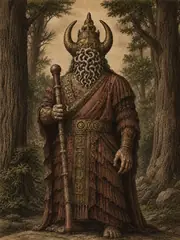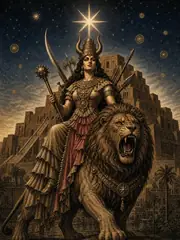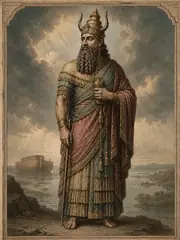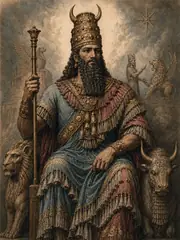
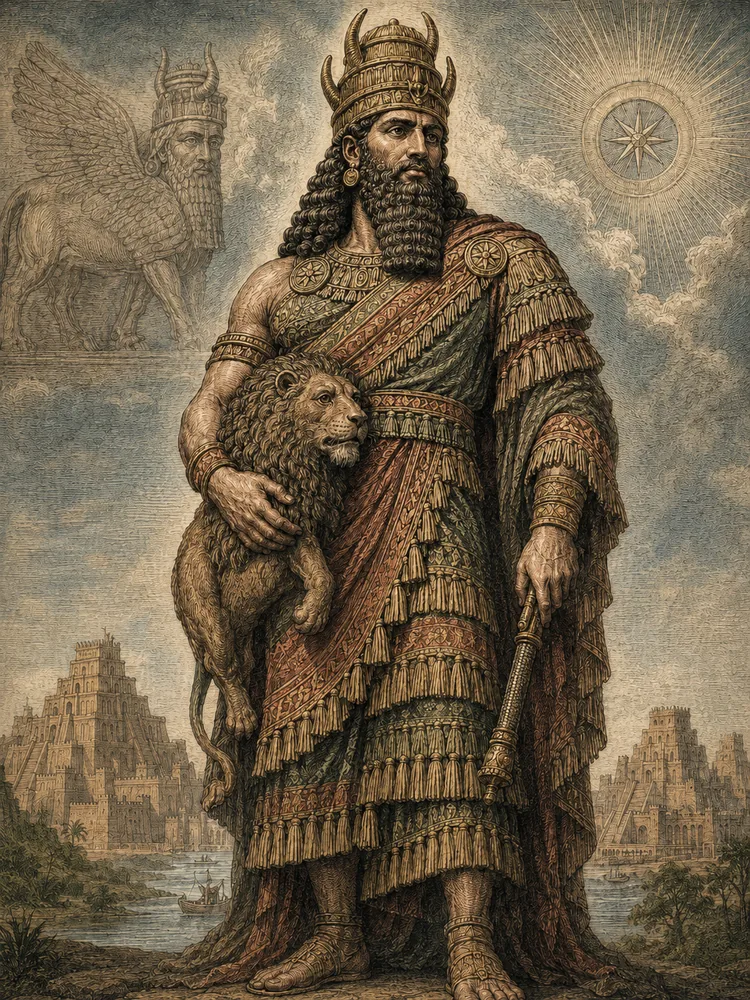
Of all the figures of Mesopotamian literature, the most fully drawn — and the only one whose name has reached, with anything like its ancient force, into our own time — is Gilgamesh, the king of Uruk. Two parts god and one part man, he was reckoned the son of the goddess Ninsun and of Lugalbanda the deified hero of the previous generation; and the Sumerian King List gives him a reign of one hundred and twenty-six years, the fifth king of the First Dynasty of Uruk, somewhere in the third millennium BCE. Whether any historical king lay behind the legend is a question that cannot now be answered; but the Sumerians and their successors treated him as a real ancestor, and built upon his name the largest single literary monument of the ancient Near East.
His story, in the form best known to us — the Standard Babylonian Epic of Gilgamesh, twelve tablets long, attributed by tradition to the scribe Sin-leqi-unninni and recovered chiefly from the library of Ashurbanipal at Nineveh — runs as follows. Gilgamesh, young and strong and oppressive of his city, was matched by the gods with an equal: the wild-man Enkidu, fashioned from clay and set upon the steppe to live among animals. The two met in a public wrestling-match, recognized in each other their proper companion, and went forth together upon adventures: they slew Humbaba, the monstrous guardian of the Cedar Forest; they refused the love of Ishtar and slew the Bull of Heaven she sent against them; they brought back trophies to Uruk.
But the gods, offended at these killings, decreed that one of the friends must die; and Enkidu sickened and died, and Gilgamesh — who had thought himself, perhaps, exempt from death — was undone by the loss. He could not bear to see Enkidu rotting in the grave; he threw down his royal robes; he wandered, dressed in skins, in the wilderness in search of immortality. Twelve leagues he traveled through the dark beneath the mountain Mashu; he crossed the Waters of Death; he came at last to the place where Utnapishtim, the survivor of the Flood, dwelt with his wife in everlasting life.
Utnapishtim told him the story of the Flood — the same story Mesopotamians had been telling for a thousand years before Gilgamesh's epic was composed — and offered him a test: stay awake for six days and seven nights. Gilgamesh, exhausted, fell asleep at once, and woke disgraced. Utnapishtim told him of a plant of immortality at the bottom of the sea; Gilgamesh dove for it and brought it up; but a serpent stole it from him while he bathed. So he returned to Uruk empty-handed, and looked upon his city's walls — built by his own hand — and accepted at last that he would die, and that what remained was the work that his hands had done.