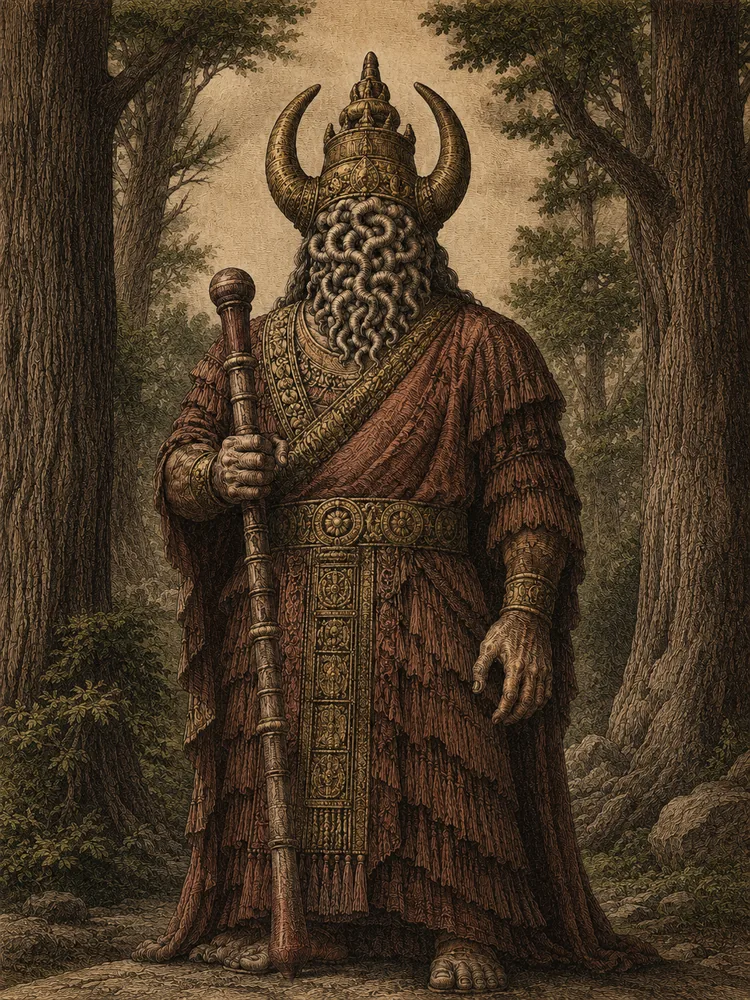
In the great cedar forest of the western mountains — the Lebanon range, or perhaps the Amanus, or some other place in those highlands which the Mesopotamians knew chiefly through trade and rumor — Enlil had set, as guardian of the holy timber, a being whose face was so terrible that men described it as a coiled mass of intestines, twisting and grimacing upon itself, with seven dreadful aspects. This was Humbaba — Sumerian Huwawa — and his roar was the rumble of distant storm, his breath the heat of burning wind.
He was killed by Gilgamesh and Enkidu, in one of their first joint exploits. The two friends had set out from Uruk on the long journey westward to the cedar forest, that they might bring back great timbers to enrich their city. They had crossed mountains and rivers; they had endured terrible dreams along the way, dreams sent (Gilgamesh interpreted) by Shamash to forewarn them of the giant. They came at last to the gate of the forest, where the great cedars stood in a green hush, and Humbaba came forth to meet them.
There was a battle whose details the Epic preserves only in fragments. Shamash sent the thirteen winds against Humbaba, holding him fast; Gilgamesh and Enkidu fell upon him; he begged for his life, offering them all the cedars of the forest and his own service as porter. Enkidu, fearing Humbaba's craft, urged Gilgamesh to kill him quickly; Gilgamesh struck the giant down. They felled the great cedars and floated them down the river to Uruk. But the killing was an offense against the gods who had set Humbaba in his place, and was numbered among the offenses for which Enkidu would later die.